

Table of Contents
Integrating a hotel booking API is not one task — it is four calls in a strict sequence, each with its own failure modes. Get the order and the error handling right and bookings confirm first time. Get them wrong and customers pay for rooms that were never held. Here is the sequence, call by call.
Most guides to hotel API integration stop at “connect and pull availability.” That is the easy 20%. The hard 80% — and the part that decides whether your OTA actually confirms bookings — is the transactional sequence that runs after search: rechecking the rate, committing the reservation, and handling the dozen ways a supplier can fail mid-transaction. This guide is about that 80%.
If you want the broader conceptual picture of hotel API integration first — the types of APIs, what they cost, how the landscape fits together — start with what hotel API integration is. This piece assumes you know that and goes straight to implementing the booking flow, endpoint by endpoint. With OTAs now carrying 40%+ of global hotel bookings (Phocuswright, 2024), the reliability of this exact sequence is what separates a platform that scales from one that leaks refunds.
A hotel booking API is the transactional layer of hotel distribution — the calls that turn a shopper into a confirmed guest. Integrating it means wiring four operations into your platform in a strict order: search live availability, re-verify the chosen rate, create the booking, and manage it afterwards. This is a narrower and harder job than “hotel API integration” in general, which also covers content APIs, static data and mapping. Booking integration is specifically about moving money against inventory and getting an unambiguous confirmation back — which is why its failure modes are financial, not cosmetic. A broken content call shows a missing photo; a broken book call charges a customer for a room that was never held.
Four things need to exist before the first call. Credentials and environment — API keys plus, critically, a sandbox that mirrors production so you can exercise the book call without real money. An authentication model — most hotel booking APIs use API-key or OAuth-style token auth; know how tokens are issued, how long they live, and how to refresh them, because auth failures mid-sequence are a common production surprise. A data model for rates and bookings — you need somewhere to persist the rate token or session between search and book, and a booking record keyed to the confirmation number. A payment approach — decide net-rate (merchant) versus pay-at-hotel before you build, because it changes what the book call sends. Getting these four in place first is what makes the sequence below straightforward rather than a series of surprises.
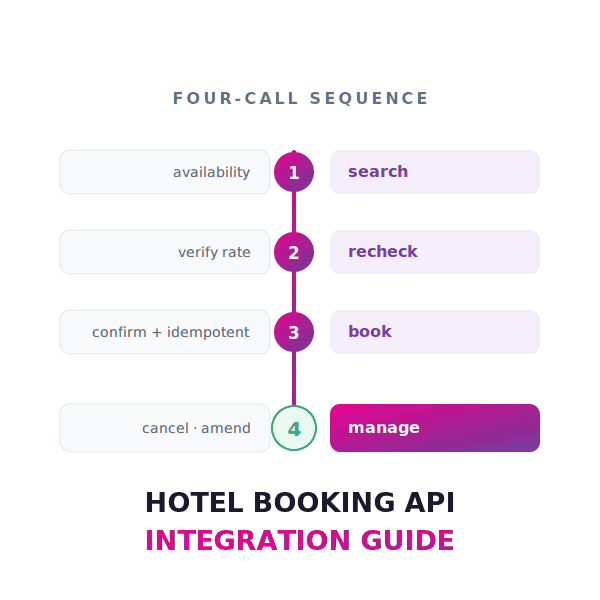
Every hotel booking API integration comes down to these four calls, in this order. Skip or reorder any one and the failure shows up in production, not in testing.
The Four-Call Integration Sequence: Search → Recheck → Book → Manage. The recheck step is the one that separates reliable integrations from refund generators.
The book call is where integrations live or die, and the reason is ambiguity. When a normal API call times out, you retry. When a booking call times out, a naive retry can double-book and double-charge — because the first attempt may have succeeded on the supplier’s side even though your side never got the response. The fix is idempotency: send a unique idempotency key with the book request so a retry with the same key returns the original result instead of creating a second booking. Beyond that, three error classes need explicit handling. Rate-gone errors (the price moved between recheck and book) should route the user back to a fresh search, not a generic error. Supplier-down errors should trigger failover to an alternative source where one exists, invisibly to the customer. Ambiguous timeouts should trigger a status query by idempotency key to determine the true outcome before telling the customer anything. Handling these three is the unglamorous work that turns a demo integration into a production one.
Five patterns account for most failed hotel booking API integrations. Skipping the recheck — the top cause of price-change failures and the easiest to avoid. Non-idempotent book calls — double bookings on retry, which are expensive to reconcile and erode trust. Treating timeouts as failures — telling a customer a booking failed when it actually succeeded, then watching them book again. No failover — a single supplier outage taking down bookings that another supplier could have fulfilled. Ignoring the manage calls — shipping without cancel and amend, then drowning support in manual changes. Each is a specific engineering decision, and each is cheap to get right at build time and expensive to retrofit under production load — which is the entire case for integrating a booking API that has already solved them rather than rebuilding the solutions per supplier.
One integration handles recheck, idempotency, retry and failover across every connected source.
Explore the Hotel Booking API →Integrating a single supplier’s booking API from scratch typically runs 6–9 months once error handling, failover and maintenance are counted. Integrating a pre-built booking API that already spans many suppliers compresses the same outcome to roughly 15 days, because the hard parts already exist. The shape of that path:
| Days | Phase | What you do |
|---|---|---|
| 1–2 | Sandbox & auth | Keys issued, auth flow working, first search call returning data. |
| 3–5 | Search & recheck | Wire search and recheck; persist rate tokens; render final verified prices. |
| 6–9 | Book & manage | Implement book with idempotency, plus retrieve, cancel and amend. |
| 10–13 | Error & edge testing | Exercise timeouts, rate-gone, supplier-down and failover against the sandbox. |
| 14–15 | Production go-live | Switch to production keys, take first live bookings, monitor. |
ZentrumHub’s booking API is one integration of the four-call sequence that reaches 100+ suppliers at once. Search returns deduplicated availability across every connected source at sub-500ms; recheck is enforced at pre-booking so stale-price failures are designed out; book runs with idempotency, retry and automatic failover across suppliers, which is how booking failure sits near zero across 30M+ daily API calls; and manage — retrieve, cancel, amend — is part of the same contract. Because it is bring-your-own-licence, your supplier contracts stay yours, and because ZentrumHub absorbs every supplier API change, the integration you ship is the integration you keep — no per-supplier maintenance treadmill. Sandbox access is available from day one, and the typical path is the 15 days above rather than the 6–9 months a single supplier build demands.
Also Read: Hotel Booking API vs Booking Engine: which one do you actually need? →
Search, recheck, book and manage — solved, with idempotency and failover built in. Sandbox from day one, live in about 15 days.
Wire four calls in order: search for live availability, recheck the selected rate before taking payment, create the booking with an idempotency key and retry-with-failover logic, then implement manage calls to retrieve, cancel and amend. Set up authentication, a sandbox, and persistence for rate tokens and booking records first. The recheck and idempotency steps are the ones most integrations skip and most regret, because they are what prevent price-change failures and double bookings.
Building against a single supplier from scratch typically takes 6–9 months once error handling, failover and maintenance are counted. Integrating a pre-built booking API that already spans many suppliers compresses it to roughly 15 days: sandbox and auth in days 1–2, search and recheck by day 5, book and manage by day 9, edge-case testing through day 13, and production go-live by day 15. The difference is that the hard parts — deduplication, recheck orchestration, failover — already exist on the platform side.
Hotel prices move continuously, so the rate returned at search may no longer be valid by the time a customer reaches checkout. The recheck call re-verifies the selected rate live against the supplier and returns the confirmed price, final taxes and cancellation policy. Skipping it is the most common cause of “the price changed at checkout” and of book calls that fail on commit because they were sent against a stale price. It is one extra round-trip that prevents a whole class of failures.
Idempotency means a repeated request with the same unique key returns the original result instead of performing the action again. It matters most on the book call, because a timeout there is ambiguous — the booking may have succeeded on the supplier’s side even if your side never got the response. Without an idempotency key, retrying can create a second booking and a second charge. With one, the retry safely returns the original confirmation. It is the single most important safeguard in a booking integration.
Building per supplier runs roughly $215K and 6–9 months for each integration, plus permanent maintenance as supplier APIs change. Integrating one booking API that already spans many suppliers replaces all of that with a single build, because deduplication, recheck, idempotency and failover exist once on the platform side and are maintained there. For any OTA that intends to carry more than one supplier — which is almost all of them — the single-integration path is dramatically cheaper over any realistic time horizon.
Drop your work email and we’ll send you the 12-page report that breaks down where 6–9 months and $215K+ quietly disappear — free.