

Table of Contents
They get used as if they mean the same thing. They don’t. A hotel booking API is the plumbing your team builds on; a booking engine is the finished storefront built for you. The whole choice comes down to one question — do you want to build the interface, or have it built?
Ask two travel-tech teams whether they need a hotel booking API or a booking engine and you will often find they are describing the same goal — “let customers book hotels on our platform” — while meaning completely different amounts of work. One team wants raw calls to build their own experience on. The other wants a working storefront they can brand and launch. Both are valid; picking the wrong one wastes months.
This guide draws the line precisely, because the two sit at different layers of the same stack rather than competing at the same one. A booking engine is built on a booking API — so the real question is never “which has better inventory” but “how much of the front end do you want to build yourself.” With OTAs carrying 40%+ of global hotel bookings (Phocuswright, 2024), getting this layer decision right at the start saves a rebuild later.
A hotel booking API is the transactional layer of hotel distribution — a set of machine-to-machine calls that let your platform search live availability, verify a rate, create a confirmed reservation, and manage it afterwards. It has no interface of its own. It returns data — JSON, not pixels. Your engineering team consumes those calls and builds whatever front end you want on top: your own search UI, your own checkout, your own design system. The API gives you complete control of the experience and complete responsibility for building it. It is the plumbing; what the customer sees is entirely yours to construct.
A hotel booking engine is the customer-facing storefront — the finished product travellers actually see and use. Search interface, results pages, filters, room selection, checkout, payment handling, confirmation screens: all built, all working, ready to brand as your own. Under the hood it runs on a booking API, but you never touch those calls; the interface is done for you. Where the API gives you raw capability and asks you to build the experience, the engine gives you the experience and asks only that you configure and brand it. It is the plumbing plus the entire storefront on top.
One question decides which you need, and it is about how much you want to build: do you want to build the booking interface yourself, or have it built for you?
The Build Line. Build the front end yourself → API. Have the front end built for you → engine.
| Dimension | Hotel booking API | Booking engine |
|---|---|---|
| What it is | Transactional plumbing (data) | Customer-facing storefront (UI) |
| Has an interface? | No — you build it | Yes — built and brandable |
| Who implements it | Your engineering team | Configure & brand, minimal dev |
| Control of experience | Complete | Within the engine’s framework |
| Time to launch | Longer — you build the front end | Fast — front end already exists |
| Best for | Teams building a custom product | Teams launching quickly |
| Inventory reached | Same suppliers | Same suppliers |
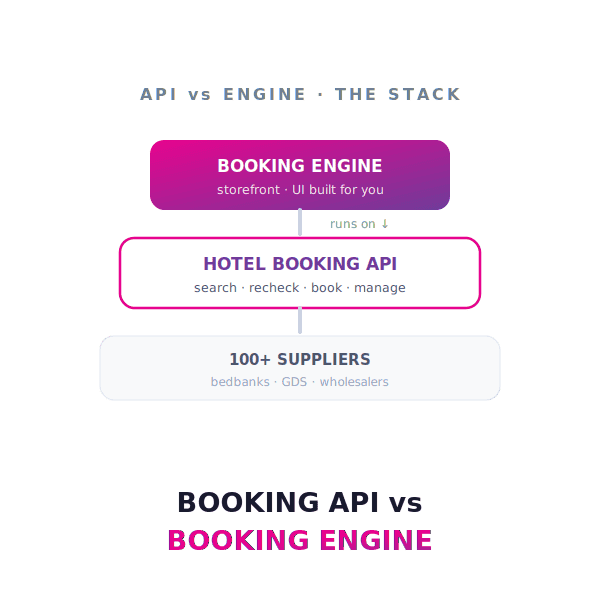
The clearest way to see the relationship is as layers. At the bottom sit the suppliers — bedbanks, GDS, wholesalers. Above them, a booking API unifies those suppliers and exposes search, recheck, book and manage as clean calls. Above the API sits the booking engine — the interface that turns those calls into screens a traveller uses. A booking engine cannot exist without a booking API underneath it; the API can exist without an engine, running under a front end you build yourself. This is why “API vs engine” is really a question of where you plug in: one layer down for full control, or one layer up for a finished product. Both plug into the same supply beneath.
Also Read: Hotel Booking API Integration: the four-call sequence, step by step →
Both run on the same 100+ suppliers — the choice is only how much front end you build.
Talk It Through in a Demo →Run the Build Line against your situation. Take the booking API if you have engineering capacity, want a signature experience no competitor can copy, need to embed hotels into an existing product with its own design, or are building something the standard engine flow does not fit — an AI agent, a super-app, a bespoke corporate tool. You are buying capability and control. Take the booking engine if you want to launch a working hotel platform in weeks rather than months, do not want to build and maintain UI, checkout and payment flows, and are happy to brand and configure a proven experience rather than invent one. You are buying speed and completeness. A useful tie-breaker: if the interface is your differentiator, take the API; if the interface just needs to work well, take the engine. And because both can run on the same platform, choosing one does not lock you out of the other later.
ZentrumHub is one of the few platforms that gives you either side of the Build Line on the same supply. Take the hotel booking API and your team builds a custom experience on search, recheck, book and manage across 100+ suppliers, with deduplication, failover and maintenance handled for you. Or take the Zentrum Booking Engine and get the whole storefront — AI-powered search, checkout, multi-currency, sub-1-second performance — ready to brand and launch. Both reach the same 900,000+ deduplicated hotels; both run on the same reliable transactional core; both are bring-your-own-licence so your supplier contracts stay yours. The decision is not inventory or reliability — those are identical. It is only how much of the front end you want to own, and you can start on one and move to the other as your product matures.
Build on the API or launch on the engine — same 100+ suppliers, same reliability, live in 15 days.
A hotel booking API is the transactional plumbing — machine-to-machine calls to search, recheck, book and manage reservations, with no interface of its own. A booking engine is the customer-facing storefront — search UI, checkout, payments and confirmation — built on top of a booking API. The API gives you raw capability and asks you to build the experience; the engine gives you the experience ready to brand. They sit at different layers, so they are complementary rather than competing.
Only if you do not want to build the interface yourself. A booking API gives you the calls to build your own search, checkout and confirmation screens; if your team builds those, you do not need a separate engine. If you would rather not build and maintain that front end, a booking engine provides it, running on the same kind of API underneath. So it comes down to the Build Line: build the interface yourself and the API is enough; have it built for you and you want the engine.
Neither is universally better; it depends on your engineering capacity and how much the interface is your differentiator. An OTA with a strong dev team and a distinctive experience in mind is usually better with the booking API, because it offers complete control. An OTA that wants to launch quickly without building UI, checkout and payments is usually better with the booking engine. Inventory and reliability are the same on both when they share a platform, so the decision is purely about how much front end you want to own.
Yes. A booking engine is built on top of a booking API — the engine’s search, availability and booking screens are powered by the API’s calls underneath. The difference to you as a buyer is that with an engine you never touch those calls; the interface consumes them for you. With a standalone booking API, your team consumes the calls directly and builds the interface. Same transactional core, different amount of front-end work on your side.
On a platform that offers both, yes. Many teams launch on a booking engine to get to market quickly, then move to the booking API later when they want a custom experience and have the engineering capacity to build it. Others start on the API for a bespoke build and adopt engine components where speed matters more than control. Because both run on the same supplier connections and transactional core, moving between them does not mean re-sourcing inventory or rebuilding the foundation.
Drop your work email and we’ll send you the 12-page report that breaks down where 6–9 months and $215K+ quietly disappear — free.