

Table of Contents
Sub-agents are the engine of a B2B travel agency — but only if onboarding them is fast, their access is properly scoped, and each one is priced and measured on its own terms. This guide shows you how to bring sub-agents and partner agencies onto your portal without the chaos.
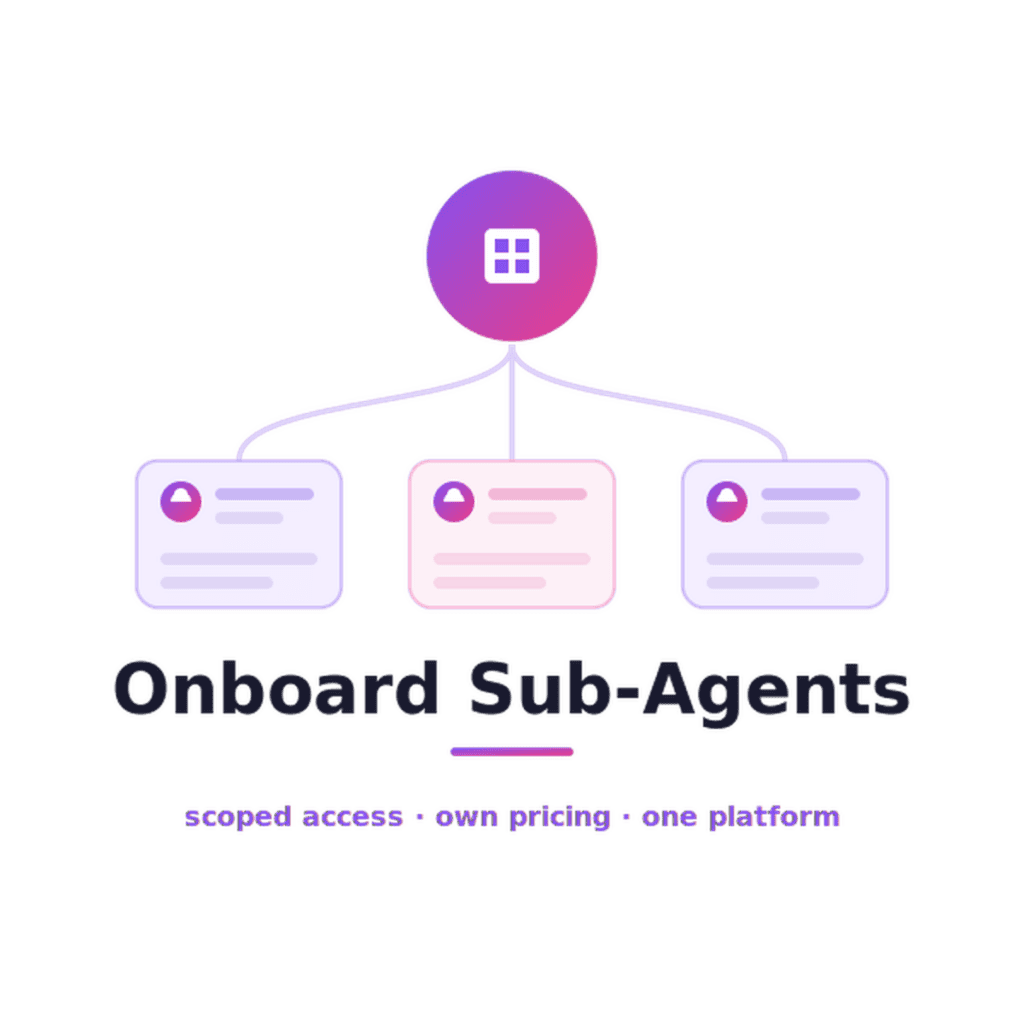
Onboarding a sub-agent on a B2B travel portal means giving them a login scoped to their own data, a pricing arrangement tailored to their relationship, and a view of the portal that shows only what they should see. On a modern platform this is a configuration task, not a project: each sub-agent or partner agency runs on its own channel with its own pricing, supplier set and reporting, all from a single integration — so you can add a sub-agent in minutes and manage hundreds without them ever seeing each other’s data or your commercials.
Last updated: September 2026 · Written for B2B travel agency owners and founders
A B2B travel agency grows through its sub-agents. Each one you onboard extends your reach into a new market, a new client base, a new city — without you adding headcount. But sub-agents also introduce complexity: they need their own access, their own pricing, their own branding sometimes, and they generate cost and support load that has to be managed. Handle that well and every sub-agent is pure leverage. Handle it badly and each new agent adds friction, risk and confusion.
This guide is written for the owner scaling a sub-agent network. It covers what onboarding actually involves, why channels are the structural foundation that makes it manageable, and how modern B2B travel agency software lets you scope access, set per-agent pricing, control cost and measure performance — all without a developer.
Onboarding a sub-agent is more than creating a login. To do it properly, four things have to be set up together: access scoped to that agent’s own data, a pricing arrangement that fits the relationship, any branding the agent needs, and reporting that isolates their activity. Miss any of these and problems surface later — an agent seeing another agent’s bookings, a sub-agent priced the same as your public site, or a support team unable to tell whose booking failed.
The difference between an agency that onboards a sub-agent in an afternoon and one that takes weeks is structural. If each of those four things is a separate manual setup, onboarding is slow and error-prone. If they are all attributes of a single container you configure once, onboarding is fast and consistent. That container is the channel.
A channel is a self-contained context within your platform that carries its own pricing rules, its own supplier set, its own search behaviour and its own reporting — all running on your single integration. Each sub-agent, partner agency, corporate client or white-label partner gets its own channel. This is the structural idea that makes a large sub-agent network manageable, because everything specific to an agent lives in one place.
On ZentrumHub, channels are how one agency runs many different businesses from a single contract. The same platform can serve a public website, a sub-agent network, a corporate portal and a white-label partner at the same time, each with completely different economics, behind one consolidated reporting view. Onboarding a new sub-agent means creating their channel and setting its attributes — not rebuilding anything.
One agency runs four channels off a single ZentrumHub integration: a public B2C website at 12 percent markup; a sub-agent network on pass-on commission; a corporate portal carrying a service fee with a policy exclusion list; and a white-label partner with revenue rules switched off because the partner prices on their own side. Four genuinely different business models, one contract, one reporting view — and a new sub-agent joins simply by adding another channel.
Access control is the part owners most often underestimate, and it matters for two reasons: privacy and support load. A sub-agent must never see another sub-agent’s bookings, another agent’s pricing, or your underlying commercial configuration — that information is commercially sensitive and, in the wrong hands, competitively damaging. At the same time, each agent needs full visibility of their own activity so they are self-sufficient and not constantly calling your team.
Scoped user access solves both. On ZentrumHub, each sub-agent’s users see only their own channel — their bookings, their customers, their performance — and nothing outside it. Your own team retains the full cross-channel view. This keeps your business private, cuts the “what happened to my booking” support load because agents can self-serve, and lets you grant the right level of access to different people within a sub-agency, from a booking user to an agency admin.
A sub-agent logs in and sees a clean view of their own bookings, their own customers and their own numbers — with no sign that dozens of other sub-agents exist on the same platform, and no access to the markup rules behind their rates. The agency owner sees everything across every channel. One platform, many private workspaces.
Give every agent their own scoped login, pricing and reporting — all from one integration.
See the B2B Travel Portal →Not every sub-agent should get the same price. A high-volume agency that sends you hundreds of bookings a month has earned better terms than one sending a handful; a new agent in a strategic market might get a keen introductory rate. Because pricing on ZentrumHub is scoped to the channel, you can set genuinely different economics per sub-agent without touching anyone else’s rates.
The most useful model for sub-agents is pass-on commission. If a supplier pays you commission on a booking, you can split it with the sub-agent — keeping part as your margin and passing part on to sharpen the rate they see. That makes your price competitive against the aggregators they could buy from directly, which drives their volume, while you still earn on every booking. You set the split per channel, so a strategic agent can get a more generous share than a casual one.
A distributor sets a 50 percent pass-on for its sub-agent network: on a 100 rate carrying 10 commission, 5 is retained and 5 improves the rate the sub-agent sees. Their price beats the market, so they book more and the distributor earns more in absolute terms on the higher volume. For its top three agencies, the split is set more generously on their own channels to reward the volume — a change made in the back office in seconds, invisible to everyone else.
For the full range of pricing rules — supplier-specific markup, city and season rules, capping — see our guide to B2B travel portal revenue management.
Every sub-agent generates cost as well as revenue, and the cost most owners never see is API consumption. Each search a sub-agent runs is an API call you pay for downstream. A well-behaved agent searches efficiently; a poorly integrated one — re-searching on every page load, or running automated queries — can quietly consume a large share of your total search volume while producing very little in return. Without per-channel visibility, you never know it is happening.
ZentrumHub gives you API consumption data per channel, so you can see exactly what each sub-agent costs. That lets you do two things: fix an inefficient integration before it inflates your bill, and charge partners fairly on usage rather than a flat fee that overcharges light users and subsidises heavy ones. It also surfaces abnormal patterns that can indicate scraping or bot activity, so you can act before it becomes a problem.
An agency reviews API consumption by channel and finds one white-label partner accounting for 40 percent of its search calls while producing just 6 percent of its bookings — the partner was re-searching on every page load. One conversation and one fix removed a large recurring cost. The same per-channel data lets the agency move that partner onto usage-based charging, so heavy users pay their share instead of being subsidised by everyone else.
A sub-agent network you cannot measure is a network you cannot manage. You need to know which agents are growing, which are stalling, which are profitable after their costs, and which deserve better terms or more attention. That requires reporting that isolates a single agent rather than blending everyone together.
ZentrumHub’s per-client focus view does exactly this: it shows one sub-agent’s bookings, revenue, commission and average booking value on its own, so you can manage each relationship on its numbers. Combined with the API-cost view, you get a true picture of each agent — what they bring in and what they cost — which is the basis for deciding who to invest in, who to renegotiate, and who is quietly unprofitable. This is the account-management layer that turns a loose collection of sub-agents into a deliberately managed distribution network.
An owner reviews the per-client view and sees one agency’s bookings climbing month on month while another’s have flattened. She offers the growing agency a more generous pass-on split to lock in the relationship, and opens a conversation with the stalling one to find out what is holding it back — decisions driven by each agent’s own numbers instead of a blended total that hides both stories.
Put together, onboarding a new sub-agent on a channel-based platform follows a clear, repeatable sequence:
| Step | What you do |
|---|---|
| 1. Create the channel | Set up the sub-agent’s own channel as their container. |
| 2. Set pricing | Apply their markup or pass-on commission split. |
| 3. Choose supply | Assign the supplier set they should sell from. |
| 4. Scope access | Create their users with access limited to their channel. |
| 5. Brand (optional) | Apply white-label branding if they sell under their own name. |
| 6. Go live & monitor | Activate, then watch their bookings, cost and performance. |
Because each step is configuration rather than development, the whole sequence takes minutes for a straightforward agent, and the same repeatable process scales from your first sub-agent to your hundredth. For agents who need their own branded storefront, the branding step draws on the same white-label booking engine your own portal runs on — covered in our white-label B2B travel portal guide.
Scoped logins, per-agent pricing, fair API-cost control and per-client reporting — onboard in minutes and manage hundreds. See it configured for your agency.
It involves setting up four things together: access scoped to that agent’s own data, a pricing arrangement suited to the relationship, any branding they need, and reporting that isolates their activity. On a channel-based platform like ZentrumHub, all four are attributes of the sub-agent’s own channel, so you configure them once as a unit. That turns onboarding from a multi-step manual project into a quick, repeatable task you can run from your first sub-agent to your hundredth.
Yes. Because pricing is scoped to each sub-agent’s channel, you can give every agent different economics without affecting anyone else. A common model is pass-on commission, where you split supplier commission with the agent — keeping part as margin and passing part on to sharpen their rate — and you can set a more generous split for high-volume or strategic agents. All of this is changed in the back office in seconds, with no developer and no impact on other channels.
Through scoped user access. Each sub-agent’s users are limited to their own channel, so they see only their own bookings, customers and performance — never another agent’s activity, another agent’s pricing, or your underlying commercial configuration. Your own team keeps the full cross-channel view. This protects commercially sensitive information and also reduces support load, because agents can self-serve on their own data instead of calling you.
By measuring API consumption per channel. Every search a sub-agent runs is an API call you pay for, and consumption varies enormously between a well-integrated agent and a poorly integrated one. Per-channel consumption data lets you see exactly what each sub-agent costs, fix inefficient integrations, and charge on usage rather than a flat fee that overcharges light users and subsidises heavy ones. It also surfaces abnormal patterns that can indicate scraping or bot activity.
With per-client reporting that isolates one agent at a time. ZentrumHub’s per-client focus view shows a single sub-agent’s bookings, revenue, commission and average booking value on their own, rather than blended with everyone else. Combined with the per-channel API-cost view, this gives a true picture of what each agent brings in and what they cost — the basis for deciding who to invest in, who to renegotiate, and which relationships are quietly unprofitable.
Run this same sequence for every sub-agent so onboarding stays fast and consistent.
'+ '| Step | Done |
|---|---|
| Create the sub-agent\\'s own channel | |
| Assign the supplier set they sell from |
| Step | Done |
|---|---|
| Set markup or pass-on commission split | |
| Apply a more generous split for strategic agents |
| Step | Done |
|---|---|
| Create users scoped to their channel only | |
| Set agency admin vs booking-user roles | |
| Apply white-label branding (if they resell) |
| Step | Done |
|---|---|
| Activate the channel | |
| Watch bookings & per-client performance | |
| Watch API consumption for this channel |
Checklist by ZentrumHub - zentrumhub.com/blog/onboard-sub-agents-b2b-travel-portal - Book a demo at zentrumhub.com/book-time
'+ ''; var w = window.open('', '_blank'); w.document.write(html); w.document.close(); w.focus(); setTimeout(function(){ w.print(); }, 350); }