


Table of Contents
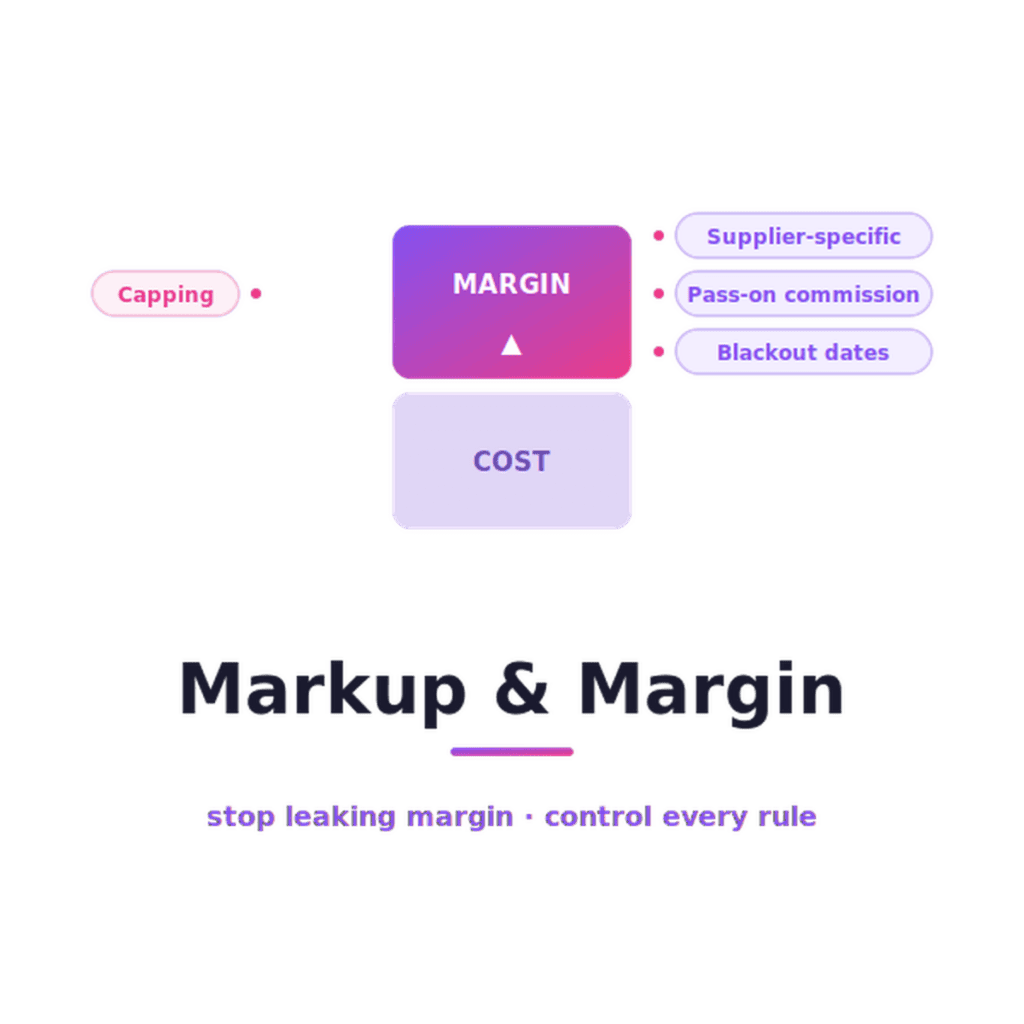
Markup is where a travel agency makes or loses its money — and most agencies leak margin without ever seeing it. This guide shows the pricing rules that protect your margin: supplier-specific markup, pass-on commission, blackout-date pricing and capping, all changed by you in seconds without a developer.
Travel agency markup control is the ability to set your selling price above supplier cost using rules you configure yourself — by supplier, city, season and channel — rather than a single flat percentage. Strong markup control also handles pass-on commission (accounting for supplier commission before you price), blackout-date surcharges for peak demand, and capping to stay competitive on high-value bookings. On a modern platform, every rule is a back-office edit that goes live in seconds, with no developer.
Last updated: September 2026 · Written for B2B travel agency owners and founders
Ask a travel agency owner what their margin is and most will give you a single number. Ask them whether that number holds across every supplier, every city, every season and every sub-agent, and the confidence usually fades — because it does not. Margin leaks in the gaps between a flat markup and the reality of how hotel supply is actually priced, and the leaks are invisible unless your platform lets you see and control them.
This guide is written for the owner who wants to stop that leak. It walks through the specific pricing rules that protect margin in a B2B agency — with worked examples of each — and shows how the revenue management in modern B2B travel agency software lets you configure them yourself, in seconds, without a developer or a code release.
Markup control is how you set your selling price above what a supplier charges you. At its simplest it is one percentage added to every rate. But real markup control is a layered system of rules: a baseline that applies everywhere, then conditional rules that adjust the price by supplier, city, season, booking value and channel. The quality of that system decides two things at once — how much margin you capture, and how competitive your prices look.
It matters because those two goals pull against each other. Price too high and you win the margin but lose the booking; price too low and you win the booking but give away margin you could have kept. The only way to win both is to price precisely — more where you can, less where you must — and that precision is impossible with a single blunt number. The rules in this guide are how you get it.
A flat markup treats every rate as if it arrived the same way. It did not. A net wholesale rate from a bedbank comes in deeply discounted and can carry a healthy markup; a retail-priced feed already has margin built in and can take very little more before it looks expensive; a rate that pays you commission has a true cost below the number you were quoted. Apply one percentage across all of them and you are simultaneously too expensive on some and too cheap on others — losing bookings here and giving away margin there, every single day.
The insidious part is that you never see it. The bookings you lose to an over-marked rate leave no trace, and the margin you give away on an under-marked one just looks like a normal sale. Flat markup does not fail loudly; it fails quietly, in the background, forever. Fixing it means replacing the single number with rules that match how supply is actually priced — starting with the supplier.
The single highest-value pricing change most agencies can make is to stop marking every supplier the same. Because different supplier types arrive at different price points, each deserves its own markup: more on deeply net wholesale feeds, less on retail-priced ones, and little or nothing on rates that already carry embedded margin. This one change usually lifts blended margin while making your results look more competitive, not less.
On ZentrumHub, supplier-specific markup is a rule you set per supplier and change whenever you like. You are not committing to a number forever — if a supplier renegotiates their rates or you shift volume, you adjust the rule in the back office and it is live immediately.
An agency connected to 14 suppliers runs three rule sets: 14 percent on its net wholesale feeds, 8 percent on retail-priced suppliers, and 0 percent on content that already carries embedded margin. Its blended margin rises, and its search results never look uncompetitive — the exact opposite of what a single flat markup would have produced. Nothing about the catalogue changed; only the pricing logic did.
Set markup by supplier, city, season and channel — and change any rule yourself in seconds.
See the B2B Travel Portal →Pass-on commission is the most misunderstood margin mechanic in B2B hotel distribution, and getting it wrong quietly suppresses your sub-agent bookings. Here is the trap. A supplier quotes a hotel at 100 and pays you 10 commission after the stay. Your true cost is 90. But if you apply a markup to the 100 you were quoted, you sell at 110 — which is really a 22 percent margin on your actual 90 cost. To your sub-agent, that price looks uncompetitive against the aggregators they could buy from directly, so they book elsewhere, and you never see the booking you lost.
A pass-on commission rule fixes this by accounting for the commission first, then letting you split it. You keep part as margin and pass part on to sharpen the rate your sub-agent sees. Their price becomes competitive, they book more, and you earn on higher volume — a better outcome for both sides than a naive markup that priced you out of the deal.
A distributor configures a 50 percent pass-on for its sub-agent network. On a 100 rate carrying 10 commission, 5 is retained as margin and 5 improves the rate the sub-agent sees. The sub-agent’s price now beats what they would get buying direct, so their volume rises — and the distributor earns more in absolute terms on that higher volume than it would have on a handful of over-priced bookings. It is also a visibly fairer deal, which helps retain agents.
Some dates sell themselves. A festival week, a major sporting fixture, a big trade show, the peak of a holiday season — on these dates demand is high and price sensitivity is low, so a standard markup leaves obvious money on the table. Most agencies fail to capture this, not because they do not know it exists, but because raising prices only on specific dates normally means a developer building date logic into the booking flow.
Blackout-date pricing turns that into a rule you set yourself. You define the dates and the uplift, scoped by check-in date and, if you want, by city, and the platform applies the surcharge automatically for stays on those dates. Peak periods are typically a small share of your annual room nights but the least price-sensitive of the year, so a well-placed surcharge is close to pure incremental profit.
An agency adds an extra 5 percent on top of its standard 10 percent for check-ins on 23–25 December. A guest arriving on 23 December carries 15 percent; one arriving on 12 January carries the usual 10 percent. Those peak dates are among the least price-sensitive of the year, so the uplift converts almost as well as the standard rate — and drops almost entirely to the bottom line. The same approach works for a Formula 1 weekend, a major conference, or a national holiday in a key market.
A percentage markup has a hidden failure mode at the top end. On a modest booking, a percentage is fine. On a high-value luxury booking, the same percentage produces a very large absolute markup that can price you straight out of a stay you badly wanted to win — where the absolute margin was already generous even at a smaller percentage. The customer sees an inflated total and books elsewhere, and you lose a premium, high-margin sale to your own pricing rule.
Capping fixes this by putting a ceiling on the markup in absolute terms. Standard bookings are unaffected; only the high-value ones where the percentage would overshoot get pulled back to the cap. You stay competitive in the premium segment while still taking a healthy margin.
An agency running a 12 percent markup caps it at 150 per booking. On a 300 booking the markup is 36, unaffected. On a 4,000 luxury booking, the markup is pulled back to 150 rather than 480 — so the agency stays competitive on a premium stay where 150 of margin is already healthy, and wins the booking instead of pricing itself out of it.
Every rule so far becomes far more powerful when it can differ by audience. A B2B agency does not have one customer type — it has a public website, a sub-agent network, corporate clients and white-label partners, and each deserves its own pricing. Because ZentrumHub scopes pricing to the channel, all of these rules apply per audience from a single integration.
| Channel | Typical pricing approach |
|---|---|
| Public B2C site | Standard markup, margin-optimised ordering |
| Sub-agent network | Pass-on commission, split set per agent |
| Corporate portal | Service fee, capping on high-value stays |
| White-label partner | Net rates, your revenue rules switched off |
This is what lets one agency run genuinely different economics for each audience without multiplying platforms. For the full picture of how channels underpin sub-agents and partners, see our guide to onboarding sub-agents on your B2B portal.
Pricing power is the most sensitive control in your platform, because a single markup rule affects every price on your site. That makes two things essential: restricting who can change pricing, and recording every change. A support agent should be able to look up a booking without being able to alter a markup rule; that authority belongs with commercial and finance.
Role-based access and audit logs handle this. Access limits pricing changes to the right people, and the log records who changed which rule and when — so if margin moves unexpectedly, you can see exactly what happened and reverse it in minutes rather than investigating for days. It is the difference between pricing being a controlled, accountable function and an unexplained mystery. To see how markup fits alongside supply, sub-agents and reporting in one platform, start with the pillar guide to B2B travel agency software, or read the full revenue management features.
Supplier-specific markup, pass-on commission, blackout-date pricing and capping — set per channel, changed in seconds, no developer. See it configured for your agency.
Markup control is the ability to set your selling price above supplier cost using rules you configure yourself, rather than one flat percentage. Strong markup control layers a baseline with conditional rules by supplier, city, season, booking value and channel, and also handles pass-on commission, blackout-date surcharges and capping. On a modern platform like ZentrumHub, every rule is a back-office edit that goes live in seconds with no developer, so pricing stays in the hands of your commercial team.
Because different rates arrive at different price points. A net wholesale rate can carry a healthy markup, a retail-priced feed can take very little more, and a commission-paying rate has a true cost below the quoted price. One flat percentage across all of them makes you too expensive on some and too cheap on others — losing bookings and giving away margin at the same time, invisibly. Replacing the flat number with supplier-specific and commission-aware rules fixes it.
Pass-on commission is a pricing rule that accounts for supplier commission before you mark a rate up, then lets you split that commission with your sub-agent. If a supplier quotes 100 and pays 10 commission, your true cost is 90; a pass-on rule lets you keep part of the 10 as margin and pass part on to sharpen the sub-agent’s rate. This keeps your B2B price competitive against the aggregators your agents could buy from directly, driving their volume while you still earn on every booking.
With blackout-date or seasonal pricing rules. You define the peak dates and the uplift — scoped by check-in date and optionally by city — and the platform automatically applies the surcharge for stays on those dates. Peak periods like holidays, festivals and major events are typically a small share of annual room nights but the least price-sensitive, so a well-placed surcharge converts almost as well as a standard rate and drops mostly to the bottom line, without a developer building date logic into your booking flow.
Yes. On ZentrumHub, pricing is scoped to the channel, so your public site, sub-agent network, corporate portal and white-label partners can each have their own markup, commission split, capping and surcharges — all from one integration. You can run a standard markup on the public site, pass-on commission on the sub-agent network with a different split per agent, a service fee on corporate, and net rates with your rules switched off for a white-label partner, changing any of them yourself in seconds.
Five places B2B travel agencies quietly lose margin - and the fix for each. Tick the leaks you have plugged.
'+ '| The leak | The fix | Fixed |
|---|---|---|
| Flat markup across all suppliers | Supplier-specific markup (more on net, less on retail, ~0 on embedded-margin feeds) | |
| Marking up the quoted rate, ignoring commission | Pass-on commission rule (price off true cost, split with sub-agent) | |
| Peak dates priced the same as any day | Blackout-date surcharge by check-in date / city | |
| Percentage runaway on luxury bookings | Markup cap in absolute terms | |
| Everyone priced the same regardless of audience | Per-channel pricing (public / sub-agent / corporate / white-label) | |
| Anyone can change pricing, no record | Role-based access + audit logs on pricing rules |
Checklist by ZentrumHub - zentrumhub.com/blog/travel-agency-markup-margin-control - Book a demo at zentrumhub.com/book-time
'+ ''; var w = window.open('', '_blank'); w.document.write(html); w.document.close(); w.focus(); setTimeout(function(){ w.print(); }, 350); }