

Table of Contents
You already know how to judge which aggregator is best. This is the harder list — the twelve questions that decide what you are actually signing: who owns your data, what the SLA is worth when it breaks, and how you leave if it goes wrong. Ask these before the contract, not during the outage.
Most aggregator deals go wrong not because the platform was bad, but because the contract was thin. The demo dazzled, the inventory was deep, the price looked fair — and nobody asked who owned the property mappings, what the 99.9% SLA actually paid out when it was missed, or how to get the data back when it was time to leave. Those answers exist in every contract. The only question is whether you read them before signing or discovered them during a crisis.
This is the due-diligence list for the commercial and contractual side of a hotel API aggregator — the twelve questions that decide what you are really agreeing to. In a bedbank-fed market worth $62.4B in 2025 and climbing to $118.7B by 2034 (Marketintelo), the aggregator you sign becomes load-bearing infrastructure fast, and the cost of a weak contract compounds with every booking that runs through it.
Two different jobs sit inside “picking an aggregator.” The first is deciding which platform is best on the merits — coverage, deduplication quality, speed, pricing model, maintenance, go-live, proof. That is the evaluation, and it has its own method in how to choose a hotel API aggregator. The second job — this one — begins after you have a favourite: reading the commercial and contractual terms that the demo never touches. A platform can win the evaluation and still carry a contract you should not sign. These twelve questions are how you tell.
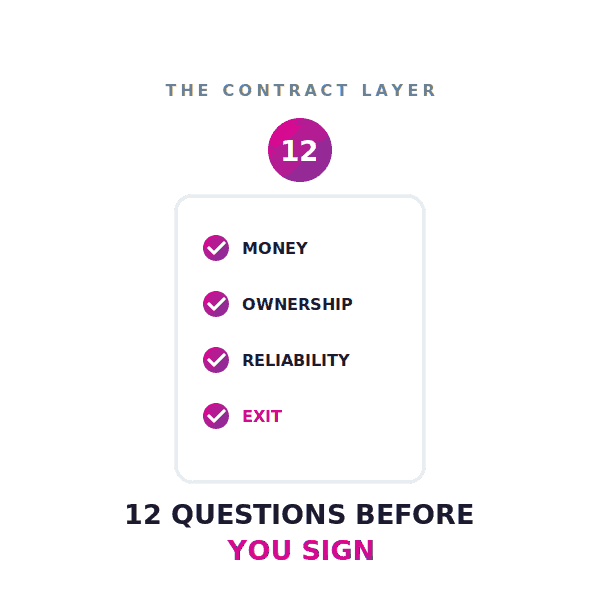
Every question worth asking before signing lands in one of four zones. Together they are the Contract Layer — the part of the deal that lives in the agreement, not the product.
The Contract Layer. Money and Reliability get asked; Ownership and Exit get skipped — and Exit is where the regret lives.
Not the headline number — the loaded one, at a volume you will actually hit. Setup, per-booking or per-transaction fees, payment-gateway margins, support tiers, overage charges. The full taxonomy of what hides in an aggregator quote is in the aggregator pricing guide. Red flag: a number that only exists after a sales call, or a per-booking fee waved away as “negligible at your size.”
Annual uplift, volume-tier jumps, and what triggers a re-quote. A contract silent on escalation is a contract that escalates on the vendor’s terms. Red flag: “we’ll discuss renewal pricing closer to the time.”
Per-booking and per-transaction models scale your cost with your success; flat SaaS does not. Ask them to plot your bill against 2x and 5x your current volume. Red flag: a cost curve that rises as fast as your bookings do — you are renting a tax on your own growth.
In a bring-your-own-licence model, your commercial relationships and negotiated rates remain yours; the aggregator only runs the technology on top. In other models, the aggregator is the supplier and the relationship is theirs. This single answer changes your leverage, your margins and your ability to leave. Red flag: ambiguity about whether you or the platform holds the supplier relationship.
Your bookings, your customers, your transaction history — get it in writing that they are yours, exportable on demand, and not resold or reused. Red flag: data-usage clauses that grant the platform rights to aggregate or monetise your booking data.
The deduplication mappings, markup rules and routing configuration you build up are real switching-cost assets. If the platform owns them, leaving means rebuilding from zero. Red flag: “the mapping layer is proprietary and cannot be exported.”
An uptime number is marketing until it has teeth. Ask what a breach credits, how downtime is measured, and whether the SLA covers the supplier layer or only the API gateway in front of it. Red flag: a headline uptime figure with no defined remedy, or an SLA that quietly excludes supplier outages.
Data handling, payment security, and applicable regional compliance — documented, not asserted. Your customers’ data flows through this platform. Red flag: compliance described verbally with no certification or documentation to back it.
Response-time guarantees, escalation paths, and whether a named contact exists or you file into a queue. Bookings fail at all hours; support that sleeps is support you do not have. Red flag: “email support, best-effort response” on a platform your revenue depends on.
The zone nobody asks about at signing and everybody wishes they had. The best time to negotiate how you leave is before you join — leverage is never higher than at signature.
Contract length, auto-renewal, and how much notice to leave without penalty. Red flag: multi-year lock-in with automatic renewal and a short cancellation window buried in a clause.
Format, timeline, and cost of a full export — bookings, customers, mappings, configuration. “You can leave” means nothing if what you built stays behind. Red flag: no defined offboarding process, or an export fee that functions as an exit toll.
Whether you can run a parallel connection during a switch, how supplier credentials move, and what breaks in between. A platform confident in its service will describe its own offboarding plainly; the quality of that answer predicts the whole relationship. A bring-your-own-licence platform is structurally easier to leave, because the supplier relationships were always yours. Red flag: visible discomfort at the mere question.
Bring the list to a ZentrumHub call — every answer, in writing, before you commit.
Explore the Hotel API Aggregator →A due-diligence list is only fair if its author will sit for it. On Money: flat SaaS with zero per-booking fees, so the model does not tax growth — priced against your real volume, not a call-gated number. On Ownership: a bring-your-own-licence model means your supplier contracts, negotiated rates and booking data stay yours by design, and your mappings and configuration travel with you. On Reliability: a 99.99% uptime SLA across 30M+ daily API calls, covering the supplier layer with automatic failover, plus documented security and a real support relationship rather than a queue. On Exit: because the supplier relationships were always yours under BYOL, leaving is structurally clean — your data and contracts are not held hostage by the platform. Ask every vendor on your shortlist all twelve, this one included; a contract that cannot survive the questions is a contract worth walking from.
Also Read: Best Hotel API Aggregators in 2026: the ranked comparison by layer →
Flat SaaS, your contracts and data stay yours, 99.99% uptime, clean exit — bring the twelve questions and we’ll answer all of them.
Ask across four zones. Money: the fully loaded cost at your real volume, how it escalates, and whether the model punishes growth. Ownership: whether your supplier contracts, booking data and property mappings stay yours. Reliability: what the SLA pays out when missed, the security and compliance credentials, and the support terms. Exit: the notice period, how you get your data and mappings back, and what a migration out looks like. These twelve questions cover the contract, which the demo never does.
Who owns your data and mappings, and how you get them back when you leave. Buyers focus on price and features and skip the exit entirely, so switching cost quietly accumulates until leaving means rebuilding from zero. Ask about data ownership, mapping portability and offboarding before signing, when your leverage is highest. A bring-your-own-licence platform answers these more favourably, because your supplier relationships and data were always yours.
Evaluation decides which platform is strongest on the merits — coverage, deduplication, speed, pricing model, maintenance, go-live and proof — and has its own scorecard method. This list starts after you have a favourite: it examines the commercial and contractual terms behind that platform, the things a demo never shows. A platform can win the evaluation and still carry a contract you should not sign, which is why both steps matter and neither replaces the other.
Because it decides your unit economics for years. A per-booking or per-transaction model scales your cost directly with your success, so the fee that looked negligible at launch becomes a significant line item at scale. Flat SaaS decouples cost from volume, which usually wins as you grow. Always model every candidate at two and five times your current volume rather than today’s, and read the escalation terms — the price you sign is rarely the price you pay in year three.
Yes — exit terms are cheapest to negotiate at signing, when your leverage is highest and the vendor wants the deal. Lock down the notice period, data and mapping export format and timeline, any export fees, and whether you can run a parallel connection during migration. Discovering these terms during an outage or a strained renewal is the expensive path. A vendor confident in its service will describe offboarding plainly; reluctance at the question is itself a signal about the relationship ahead.
Drop your work email and we’ll send you the 12-page report that breaks down where 6–9 months and $215K+ quietly disappear — free.