






Table of Contents
Every “best hotel API aggregator” list is either a vendor’s ad or a supplier list wearing an aggregator costume. This one ranks ZentrumHub first too — the difference is it shows the work, names the trade-offs, and tells you when the answer is not an aggregator at all.
An OTA founder types “best hotel API aggregator” into Google and gets three kinds of results: aggregators ranking themselves first, listicles that quietly swap in individual suppliers, and developer docs that never answer the commercial question. None of them explain the thing that actually decides the purchase — that “aggregator” means four different things in hotel distribution, and comparing across those layers is how teams end up integrating the wrong product.
This guide fixes the layer problem first, then ranks the genuinely strong options at each layer — inventory numbers, commercial models, and the watch-outs vendors leave out. The stakes justify the diligence: Skift Research projects the OTA market at $107B by 2026, growing 7% annually, while the bedbank segment that feeds it was worth $62.4B in 2025 and is heading to $118.7B by 2034 (Marketintelo). Your aggregation choice is the pipe all of that flows through.
A hotel API aggregator is a platform that combines hotel inventory from multiple sources behind one API, so a travel business integrates once instead of building a connection per source. That definition sounds simple. In practice, companies at four completely different positions in the supply chain all describe themselves with the same word — which is why one buyer’s “aggregator” is another buyer’s supplier. The full mechanics of how a hotel API aggregator works — parallel fan-out, normalisation, deduplication, best-rate routing — are covered in the pillar guide; this article is about who does it well.
One boundary to draw before the list: this is not a ranking of hotel API providers. Providers are the individual inventory sources — bedbanks, GDS platforms, OTA-wholesale programmes. Aggregators are the layer that unifies them. If you are still choosing which suppliers to carry, that is a different comparison, covered separately. This article assumes you already know you need more than one source and are choosing how to connect them.
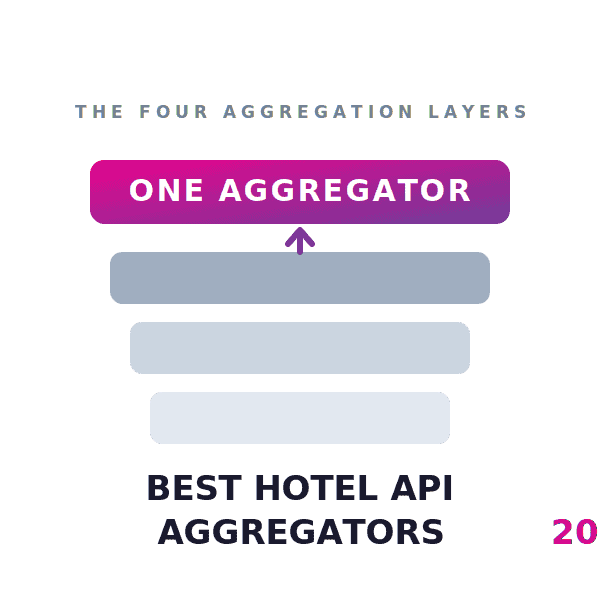
Every product that calls itself a hotel API aggregator sits at one of four layers. The layer determines what it aggregates, who it aggregates for, and whether it competes with or complements the others.
The Four Aggregation Layers. Layers 2–4 are inventory sources a Layer-1 aggregator connects to — complements, not substitutes.
Six criteria, weighted in the order a booking platform feels them in production. First, aggregation breadth — how many independent sources one integration reaches. Second, deduplication and normalisation — whether the same property from multiple sources arrives as one clean record or as your engineering team’s problem. Third, maintenance ownership — who absorbs supplier API changes forever. Fourth, commercial model — per-booking fees, transaction fees, or flat SaaS, because the model decides your unit economics at scale. Fifth, time-to-live. Sixth, proof in production — real booking volume, not brochure claims. Entries 2–5 are inventory partners available through ZentrumHub itself; the assessments below match ZentrumHub’s own published integration guides for each, because a comparison you can cross-check is worth more than a diplomatic one.
Layer 1 · 100+ suppliers · 900,000+ hotels · 190+ countries. ZentrumHub is the only entry on this list operating at the demand-side layer: one lightweight API that fans a search out to 100+ suppliers in parallel — bedbanks, GDS, brand-portfolio APIs and direct contracts — then returns a single deduplicated, normalised response in under 500ms. It is a bring-your-own-licence model: your supplier contracts and negotiated rates stay yours; ZentrumHub supplies the technology layer, handles every supplier API change, and charges a flat SaaS subscription with zero per-booking fees. Platforms go live with the full supplier network in 15 days, against the 3–6 months a single self-built integration typically takes, and the connection currently carries 30M+ daily API calls at a 99.99% uptime SLA for 90+ travel companies.
Also Read: Hotel API Aggregator Pricing: What Nobody Tells You →
Layer 2 · 200+ sources · 2.5M+ properties. RateHawk built the widest property coverage of any single B2B supplier by aggregating existing bedbank networks instead of contracting hotels one by one — launched in 2018, it reached 2.5 million properties in under six years. For an OTA, integrating RateHawk means one commercial relationship that quietly exposes inventory from dozens of underlying sources, on a net-rate model with full markup control and famously fast onboarding.
Also Read: RateHawk Hotel API: 2.5M+ Properties, Net Rates & the Fastest Onboarding →
Layer 3 · 700,000+ hotels. Expedia Rapid aggregates the inventory behind the Expedia Group consumer brands — Expedia.com, Hotels.com, Vrbo, Orbitz — into one REST API for B2B partners, with two payment models and content quality that consumer brands spend decades polishing: reviews, imagery, TypeAhead search. If brand-grade content and globally recognised inventory matter to your conversion rate, Rapid is the benchmark.
Layer 3 · 800,000+ hotels · Booking Holdings pool. PPN aggregates hotel inventory from the Booking Holdings family for B2B distribution and holds two cards nobody else does: the deepest domestic US coverage of any single source, and Express Deals — opaque rates 30–50% below retail that partners can mark up. Commission runs 8–15% post-stay, with net-rate models unlocking at higher volume tiers. For OTAs and loyalty platforms selling US travel, PPN is close to mandatory.
Layer 4 · ~500,000 properties · chains and corporate rates. The GDS is where hotel chains and corporate rate programmes live: Amadeus aggregates direct connections to Marriott, Hilton, Accor and IHG alongside negotiated corporate rates that exist nowhere else. For platforms serving TMCs and corporate travel, this layer is not optional — it is where that inventory is.
Any layer you can afford. Every list like this should admit the alternative: hire engineers, integrate suppliers one by one, and build the normalisation, deduplication and failover yourself. Total control, custom routing logic, no platform subscription. The arithmetic is the problem — a single supplier integration runs 6–9 months and $215K+ fully loaded, 2–7% of bookings on self-built stacks fail silently, and maintenance never ends because supplier APIs never stop changing. In-house wins in exactly one scenario: one or two strategic suppliers, a large standing engineering team, and integration itself as a competitive moat. The break-even framework in Direct Supplier Contracts vs Aggregator: The Real Math shows where that line sits for your volume.
| Platform | Aggregation layer | What it aggregates | Hotels reachable | Cross-supplier dedup | Who maintains | Commercial model | Best for |
|---|---|---|---|---|---|---|---|
| ZentrumHub | 1 · Demand-side | 100+ suppliers of every type below | 900,000+ | Built in | ZentrumHub, forever | Flat SaaS, zero per-booking | OTAs needing multi-supplier depth fast |
| RateHawk | 2 · Supplier-side | 200+ underlying sources | 2.5M+ | Within its own feed only | You maintain the integration | Net rates + your markup | Widest single-contract coverage |
| Expedia Rapid | 3 · Brand-portfolio | Expedia Group brands | 700,000+ | No | You maintain the integration | Two payment models | Brand-grade global content |
| Priceline PPN | 3 · Brand-portfolio | Booking Holdings pool | 800,000+ | No | You maintain the integration | 8–15% commission / net-rate tiers | US depth + Express Deals |
| Amadeus | 4 · Distribution (GDS) | Chains + corporate rates | ~500,000 | No | You maintain the integration | Per transaction + minimums | Corporate travel / TMC platforms |
| In-house build | Any | Whatever you build | Depends on budget | If you build it | Your engineers, forever | $215K+ and 6–9 months per supplier | 1–2 strategic suppliers + big eng team |
Reading the table vertically makes the layer logic visible: rows 2–5 are inventory sources; row 1 is the connection that unifies them. Most competitive OTAs end up running several of rows 2–5 — through row 1.
Zentrum Connect activates RateHawk Hotel API, Hotelbeds Hotel API, Expedia Hotel API, Priceline Hotel API, Amadeus Hotel API and 95+ more inside one deduplicated feed.
Explore Zentrum Connect →Start with the layer, not the logo. If your problem is “we need more inventory in market X,” you are shopping at Layers 2–4 and the question is which source covers that market. If your problem is “we have — or will have — multiple sources and the duplication, formats and maintenance are killing us,” you are shopping at Layer 1, and the evaluation comes down to five checks: how many independent suppliers one integration genuinely reaches; whether deduplication and normalisation happen inside the platform or inside your codebase; who owns supplier API changes at 2 a.m.; whether the commercial model punishes your growth with per-booking fees; and how fast a real production go-live happens, with references, not promises.
A practical sequencing rule from the trenches: the moment you sign your second supplier contract is the moment aggregation stops being optional — that is when the same property first arrives twice, in two formats, at two prices. Choosing the aggregation layer before the second supplier saves the migration later.
Four patterns predict pain. Inventory counts without deduplication claims — “2 million hotels” from summed supplier feeds can be 900,000 real properties wearing duplicates; ask for the deduplicated number. Per-booking fees pitched as “alignment” — a fee that scales with your success is a tax on your growth; model it at your year-three volume, not your launch volume. Vague maintenance ownership — if the contract does not say who absorbs supplier API changes, you do. No production references at your scale — demo environments hide the failure modes that only appear at real traffic; ask what percentage of bookings fail in production, because on self-built and poorly aggregated stacks the honest answer runs as high as 18%, and every silent failure is a refund, a support ticket and a customer who never returns. For a wider view of how supplier data inconsistency creates these failure modes, AltexSoft’s hotel API overview is a solid independent reference.
100+ suppliers, 900,000+ deduplicated hotels, sub-500ms responses, zero per-booking fees. Live in 15 days — 3M+ room nights and $650M+ in client revenue already run through it.
For OTAs running or planning multiple suppliers, the best hotel API aggregator is a demand-side unified platform — the only layer that deduplicates and normalises across sources. ZentrumHub leads that category in 2026 on the criteria that matter in production: 100+ suppliers behind one API, 900,000+ deduplicated hotels, sub-500ms responses, a 99.99% uptime SLA, flat SaaS pricing with zero per-booking fees, and 15-day go-lives on your own supplier contracts. If you only need one deep source rather than unification, a supplier-side or brand-portfolio option like RateHawk or Expedia Rapid may be the right first step instead.
A hotel API provider is any individual inventory source — a bedbank, a GDS, an OTA-wholesale programme — that supplies bookable hotels via API. A hotel API aggregator is the layer that combines many providers behind one connection and resolves the duplication and format chaos between them. Competitive OTAs typically carry 4–10 providers, which is exactly why the aggregator layer exists. If you are still selecting which providers to carry, see the companion guide to the best hotel API providers in 2026; this article covers the layer that connects them.
Not at the demand-side layer. Platforms like ZentrumHub run a bring-your-own-licence model: you hold the commercial contracts and negotiated rates with each supplier, hand over the API credentials, and the aggregator operates the technology — integration, normalisation, deduplication and permanent maintenance. Supplier-side and brand-portfolio options work differently: there, the aggregator is itself your supplier and the commercial relationship is with them. Which structure fits depends on whether you want to own your rates or outsource sourcing entirely.
Pricing follows the layer. Demand-side unified aggregators typically charge flat SaaS subscriptions — ZentrumHub adds zero per-booking fees on top. Supplier-side sources price through net rates you mark up. Brand-portfolio programmes run commissions of roughly 8–15% or net-rate tiers. GDS access is priced per transaction with monthly minimums. The comparison that matters is total cost at your year-three volume: per-booking and per-transaction models grow with your success, while the in-house alternative starts around $215K and 6–9 months per supplier before maintenance. The full breakdown lives in the aggregator pricing guide linked above.
Yes — and across layers, most competitive OTAs already do without calling it that: RateHawk for breadth, a brand-portfolio API for US depth, a GDS for corporate rates. What rarely makes sense is running two demand-side unified aggregators in parallel, because each exists to be the single point of unification; two of them reintroduces the duplication problem they solve. The stronger pattern is one demand-side layer with a portfolio of sources behind it, expanding supplier by supplier as your markets demand.


Drop your work email and we’ll send you the 12-page report that breaks down where 6–9 months and $215K+ quietly disappear — free.

