Table of Contents
Corporate accounts are where the steady, high-value volume is, but they come with a gatekeeper. An enterprise RFP asks whether you can enforce a travel policy and prove who changed what. If the answer is no, you are scored out before the conversation starts. This guide covers the compliance you need.
Corporate travel policy compliance is the ability to enforce a client’s travel rules and prove that you did. For a B2B agency moving upmarket into corporate accounts, it means restricting which hotels appear so out-of-policy properties never get booked, recording every change to pricing and configuration in an audit trail and controlling who on your team can change what. These are the things an enterprise procurement process checks for. Having them is often what separates the agencies that win corporate accounts from the ones that never get past the RFP.
Written for B2B travel agency owners moving into corporate accounts
Corporate travel is a tempting market for a B2B agency. The volume is steady, the clients are sticky and the bookings tend to be higher value than leisure. But corporate is guarded by a procurement process that leisure never puts you through. A company handing its travel to an agency wants assurance that its rules will be followed and its spending can be accounted for, so it tests for that assurance in a formal request for proposal before it signs anything.
This guide is written for the owner who wants to move upmarket into corporate accounts. It covers the compliance capabilities an enterprise buyer looks for, why each one matters to them and how the controls inside B2B travel agency software help you answer yes where it counts. The corporate segment is described further on the corporate travel companies page.
A leisure customer books what they want and pays for it themselves. A corporate traveller books within rules set by their employer, while someone other than the traveller is paying and answering for the spend. That difference is the whole reason corporate procurement is so demanding. The company is trusting you to enforce its policy on its behalf and to give it a clear record of what happened, because its own finance and compliance teams will ask.
So the corporate gate is not really about price or inventory, which leisure competes on. It is about control and accountability. Can you stop travellers booking outside policy. Can you show exactly what was booked, at what price, under whose configuration. Can you limit who inside your own operation can change the rules. An agency that cannot answer these confidently will struggle to win corporate accounts no matter how good its rates are, because the buyer cannot take the risk. The capabilities below are what turn those questions into a yes.
The most concrete compliance requirement is policy enforcement, which usually comes down to controlling what a traveller can book. A corporate client will have rules about which hotels are acceptable, whether by brand, by rate ceiling, by location or by safety and quality standards, so it needs you to make sure out-of-policy properties simply do not get booked. The cleanest way to do that is at the source, by keeping non-compliant hotels out of the results the corporate traveller sees in the first place.
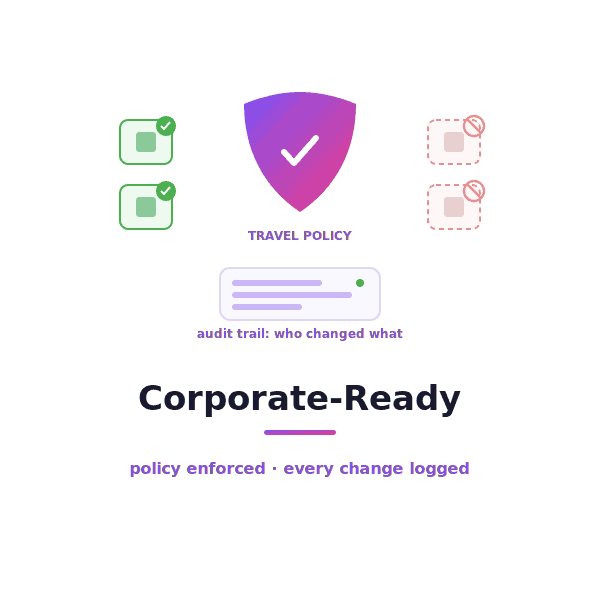
On ZentrumHub you can restrict which hotels appear for a given channel, so a corporate account can be set up to exclude the properties that fall outside its policy. Because the corporate client runs on its own channel, this curated inventory applies only to them and does not affect any other audience. Enforcing policy by shaping what is bookable, rather than relying on travellers to follow the rules voluntarily, is exactly the kind of hard control a corporate buyer wants to see. The mechanics of restricting inventory per channel are covered in our guide to controlling which hotels and suppliers appear.
A corporate client requires its travellers to stay only in approved hotel brands within a set nightly rate. The agency sets up the client on its own channel and excludes the properties that fall outside those rules, so a traveller searching only ever sees compliant options. There is no way to book out of policy because out-of-policy hotels never appear, which is a far stronger guarantee than a rule the traveller is trusted to remember.
Enforce a corporate travel policy at the source, on the client’s own channel, with full accountability.
See Corporate Solutions →Enforcing policy is half the requirement. The other half is proving it, because a corporate client answers to its own finance, audit and compliance functions, which will ask for evidence. An audit trail that records changes to pricing, configuration and policy settings, showing who made each change and when, is what lets you demonstrate that the account was run as agreed. Without it, you are asking the client to take your word, which no serious procurement process will do.
ZentrumHub keeps an audit log of changes, so if a question ever arises about how the account was configured or why a price looked a certain way, there is a clear record to point to. This matters in two ways. It satisfies the corporate client’s need for accountability. It also protects you, because if something is queried you can show exactly what happened rather than reconstructing it from memory. An audit trail turns a difficult trust conversation into a matter of looking up the record.
Accountability inside your own operation matters to a corporate buyer too. If anyone on your team can change a markup rule or a policy setting, the client has no assurance that its configuration will stay as agreed. Role-based access solves this by limiting sensitive changes to the right people. A support agent should be able to look up a booking without being able to alter a pricing rule or a policy exclusion. Those authorities should sit with the people responsible for them.
On ZentrumHub you can grant each person the access their job requires and no more, so pricing and policy controls sit with commercial and account management while operational staff get the access they need to do their work. Combined with the audit trail, this gives a corporate client confidence that its account is not just configured correctly today but protected from accidental or unauthorised change tomorrow. Controlled access is a quiet capability that corporate procurement notices immediately, because its absence is an obvious risk.
An agency serving a corporate account gives its support team the ability to view and manage bookings but not to change pricing or policy rules, which stay with the commercial team. When the client asks during a review who can alter its configuration, the agency can point to a small, named group and to the audit log that records every change. That answer, backed by evidence, is exactly what a corporate compliance team wants to hear.
A corporate client wants to see its own activity clearly, separate from everyone else you serve. It needs to understand its spend, its booking patterns and its compliance, expecting that view to be about its account alone. Reporting that isolates a single client is therefore part of being corporate-ready, because a blended figure that mixes the corporate account in with your leisure and sub-agent business tells the client nothing useful about itself.
ZentrumHub provides a per-client focus view that shows one account’s bookings, revenue and patterns on their own, which is exactly the kind of dedicated reporting a corporate relationship runs on. It lets you have an informed conversation with the client about its own travel, backed by clean numbers. It also signals that you treat the account as the distinct, managed relationship a corporate buyer expects it to be. The reporting side is covered fully in our guide to B2B travel portal analytics.
Put together, these capabilities are what let you answer a corporate RFP with confidence. When the procurement questionnaire asks whether you can enforce a travel policy, you can say yes and explain that non-compliant hotels are excluded at the source. When it asks whether you keep an audit trail, you can say yes and describe it. When it asks who can change the configuration and how that is controlled, you have a clear answer backed by role-based access and the log. Each yes moves you forward, while each no where a competitor says yes moves you out.
The wider point is that corporate readiness is a capability you build before you pitch, not something you promise and hope to deliver later. An agency that already has policy enforcement, audit trails, controlled access and per-client reporting in place can pursue corporate accounts with a straight face, while one that does not will keep losing them at the RFP stage without always understanding why. To see how these corporate capabilities sit within the full platform, start with the pillar guide to B2B travel agency software.
Policy enforced at the source, a full audit trail, controlled access and per-client reporting, so you can pursue corporate accounts with confidence. See it configured for your agency.
It is the ability to enforce a corporate client’s travel rules and prove that you did. In practice, for a B2B agency, it means restricting which hotels appear so out-of-policy properties never get booked, recording every change to pricing and configuration in an audit trail, controlling who on your team can change what and reporting on the client’s account separately. Corporate procurement tests for these, because the company is trusting you to enforce its policy on its behalf and to give it a clear record, so having them is often what separates the agencies that win corporate accounts from those that do not.
The cleanest way is at the source, by keeping non-compliant hotels out of the results the corporate traveller sees. On ZentrumHub you can restrict which hotels appear for a given channel, so a corporate account can be set up to exclude properties that fall outside its policy. Because the client runs on its own channel, it it applies only to them. Enforcing policy by shaping what is bookable, rather than relying on travellers to follow rules voluntarily, is a far stronger guarantee and exactly the kind of hard control a corporate buyer wants to see.
Because the client answers to its own finance, audit and compliance teams, who will ask for evidence that the account was run as agreed. An audit trail records changes to pricing, configuration and policy settings, showing who made each change and when, so you can demonstrate exactly what happened rather than asking the client to take your word. It satisfies the client’s need for accountability and also protects you, because if something is ever queried you can point to the record instead of reconstructing events from memory.
Because a corporate buyer wants assurance that its configuration will stay as agreed, which means not everyone on your team should be able to change it. Role-based access limits sensitive changes, such as pricing rules and policy exclusions, to the right people, while operational staff get the access they need to do their work and no more. Combined with an audit trail, this gives the client confidence that its account is protected from accidental or unauthorised change. Its absence is an obvious risk that corporate procurement notices immediately.
Reporting about its own account alone, separate from everyone else you serve. A corporate client needs to understand its spend, booking patterns and compliance, so a blended figure that mixes it in with your leisure and sub-agent business tells it nothing useful. A per-client focus view isolates one account and shows its bookings, revenue and patterns on their own, which is the dedicated reporting a corporate relationship runs on. It lets you have an informed, numbers-backed conversation with the client and signals that you treat the account as the distinct, managed relationship a corporate buyer expects.
The compliance an enterprise RFP will test. Can you answer yes to each?
'+ '| Requirement | Yes |
|---|---|
| Enforce a travel policy by excluding out-of-policy hotels at the source | |
| Apply that policy to the corporate account only, on its own channel | |
| Keep an audit trail of pricing and configuration changes | |
| Show who changed what and when | |
| Limit who on your team can change pricing and policy | |
| Report on the corporate account separately from everyone else |
Checklist by ZentrumHub. zentrumhub.com/blog/corporate-travel-policy-compliance. Book a demo at zentrumhub.com/book-time
'+ ''; var w = window.open('', '_blank'); w.document.write(html); w.document.close(); w.focus(); setTimeout(function(){ w.print(); }, 350); }