Table of Contents
A handful of weeks each year carry demand so strong that travellers barely notice the price. Festivals, holiday peaks and major events are when margin is easiest to earn, yet most agencies price them exactly like any ordinary week. This guide shows how to capture them.
Peak-season pricing means charging more on the specific dates when demand is high and price sensitivity is low, such as festival weeks, holiday peaks and major events. Because these periods are usually a small share of your annual room nights but the least price-sensitive of the year, a well-placed surcharge on them is close to pure incremental profit. The practical way to do it is a blackout-date rule that applies an extra markup by check-in date, scoped by city if you want, which you set yourself without a developer.
Written for B2B travel agency owners and founders
Every travel agency has a rhythm to its year. There are quiet stretches where every booking is fought for on price, while peaks arrive where demand surges so hard that rooms sell almost regardless of what they cost. The interesting thing is that most agencies price both the same way, applying one standard markup across the whole calendar. That means they compete hard for thin margin in the quiet weeks and then hand back easy margin in the busy ones.
This guide is written for the owner who wants to capture the busy weeks properly. It explains why peak dates are commercially different, how a blackout-date rule lets you price them without any developer work, plus how the analytics inside B2B travel agency software help you find exactly which dates to target. The pricing rules themselves sit within our wider guide to markup and margin control.
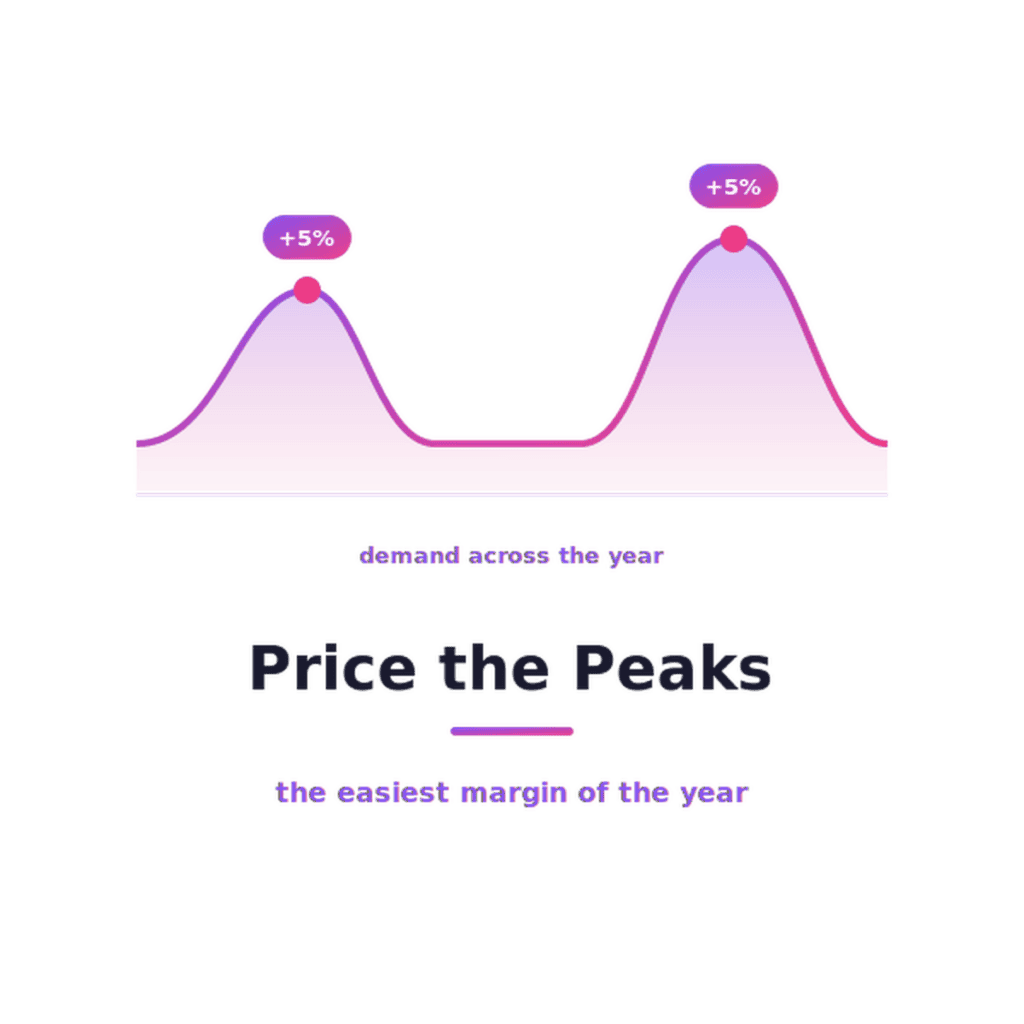
The margin available in peak periods is some of the easiest an agency will ever earn, because the usual tension between price and conversion barely applies. In a normal week, raising your price risks losing the booking to a cheaper competitor. In a genuine peak, the traveller is far more focused on securing a room at all than on shaving a few percent off the rate, so a modest surcharge rarely costs you the sale. The margin is sitting there waiting to be taken.
Yet most agencies never take it. The reason is almost always practical rather than strategic. Pricing differently on specific dates traditionally means a developer building date logic into the booking flow, which is slow, costly and easy to get wrong, so it never gets done. The peak arrives, everything sells at the standard markup and the easiest margin of the year quietly passes by. Closing that gap does not require clever strategy. It requires a way to set date-based pricing yourself, which is exactly what a blackout-date rule provides.
Peak demand comes from events that pull a large number of travellers to the same place at the same time, in a few recognisable shapes. There are cultural and religious festivals that fill a region for a week. There are holiday peaks when a whole country travels at once. There are major sporting or business events that draw visitors to a single city on specific dates. There are also school and summer holidays that concentrate leisure demand into predictable windows. What they share is a spike in demand that is known in advance and largely insensitive to price.
That combination, predictable and inelastic, is what makes them a pricing opportunity rather than just a busy time. Because the dates are known ahead, you can prepare for them. Because demand is inelastic, you can price into that demand without losing the booking. An agency that recognises this treats its peak calendar as a revenue plan rather than a seasonal inconvenience, setting its surcharges in advance so the margin is captured automatically when the dates arrive.
A blackout-date rule lets you apply an additional markup to bookings whose check-in falls on dates you choose, on top of your standard pricing. You define the peak dates and the extra percentage, then the platform applies the surcharge automatically to any stay that touches those dates, leaving every other booking on your normal markup. There is no developer, no code release and no manual intervention when the dates arrive. You set it once and it works.
On ZentrumHub this is a rule you configure yourself in the back office, defined by check-in date, so a stay arriving in a peak window carries your peak markup while a stay outside it carries the standard one. Because it keys off the check-in date rather than the booking date, it captures the demand correctly regardless of how far in advance the traveller books. This is what turns peak pricing from a developer project into a setting you can adjust in minutes.
An agency adds an extra five percent on top of its standard ten percent markup for check-ins during a major holiday peak. A guest arriving during those dates carries fifteen percent, while a guest arriving a few weeks later carries the usual ten. The peak dates are among the least price-sensitive of the year, so the surcharge converts almost as well as the standard rate and drops almost entirely to the bottom line. The same rule is reused every year simply by moving the dates.
Set a peak surcharge by check-in date in minutes and capture margin others give away.
See the B2B Travel Portal →Peaks are often local rather than national. A major event drives demand in one city while the rest of the country carries on as normal, so a surcharge applied everywhere would overprice the places that are not busy and lose you bookings there. The sharper approach is to scope the peak markup to the city or destination where the demand actually is, leaving the rest of your inventory on standard pricing.
Combining date and city gives you precise control. You can raise pricing for one city during an event weekend without touching another city on the same dates, so each surcharge lands exactly where the inelastic demand sits and nowhere else. This precision is what separates thoughtful peak pricing from a blunt across-the-board increase that captures some extra margin in the busy places at the cost of lost bookings in the quiet ones.
A major sporting event fills one city for a single weekend while demand elsewhere is unchanged. The agency applies a peak surcharge scoped to that city and those dates only. Bookings into the event city over the weekend carry the higher markup and convert strongly because rooms are scarce, while bookings into every other city stay on standard pricing and remain competitive. The margin is captured precisely where the demand is, with no collateral loss elsewhere.
Knowing that peaks exist is one thing, knowing exactly which dates and cities are yours is another. This is where your own data beats guesswork. The events that matter to your agency are the ones your travellers actually book, which depend on your markets and your customer base rather than a generic calendar. Your booking history shows where your demand concentrates, both in time and in place, so it tells you precisely which peaks are worth pricing for.
Seasonality and city-concentration analytics turn that history into a plan. They show the shape of your demand across the year and the destinations that drive it, so you can set your surcharges around the peaks that are genuinely yours rather than the ones everyone talks about. This pairs the pricing rule with the evidence to aim it well, which we cover more fully in our guide to B2B travel portal analytics. Find the peak in the data, then price it with a rule.
Peak pricing works because the demand is genuinely inelastic, so the discipline is to apply it only where that is true and to keep the surcharge sensible. A modest uplift on a real peak converts almost as well as the standard rate and drops to your margin. An aggressive surcharge does the opposite. So does one applied to a period that is not a strong peak, driving bookings to competitors who priced it more carefully. The goal is to capture the easy margin, not to gouge, because your agents book against alternatives and will notice if you overreach.
Set sensibly, peak pricing becomes a quiet, reliable source of extra margin that costs you almost nothing to run once the rules are in place. You prepare the surcharges in advance around the peaks your data confirms, scope them to the right dates and cities, keep them modest and let them capture margin automatically while you focus elsewhere. To see how peak pricing fits alongside your everyday pricing, supply and analytics, start with the pillar guide to B2B travel agency software.
Find your real peaks in the data, then price them with a blackout-date surcharge scoped to the right dates and cities, all without a developer. See it configured for your agency.
Peak-season pricing means charging more on the specific dates when demand is high and price sensitivity is low, such as festival weeks, holiday peaks and major events. These periods are usually a small share of your annual room nights but the least price-sensitive of the year, so a modest surcharge on them rarely costs you the booking and is close to pure incremental profit. The practical way to apply it is a blackout-date rule that adds an extra markup by check-in date, optionally scoped by city, which you set yourself without a developer.
A normal markup applies to every booking equally. A blackout-date rule adds an extra markup only to bookings whose check-in falls on the peak dates you choose, on top of your standard pricing, while leaving every other booking untouched. On ZentrumHub you configure it yourself in the back office by check-in date, so a stay in a peak window carries your peak markup while a stay outside it carries the standard one. Because it keys off the check-in date, it captures the demand correctly no matter how far in advance the traveller books.
A modest one rarely does, because peak demand is inelastic. During a genuine peak the traveller is focused on securing a room at all rather than shaving a few percent off the rate, so a sensible surcharge converts almost as well as the standard rate and drops to your margin. The risk comes from overreaching, either by setting the surcharge too high or by applying it to a period that is not actually a strong peak, which pushes bookings to competitors. The discipline is to apply it only where demand is genuinely inelastic and to keep it modest.
Yes, by scoping the surcharge to the city or destination where the demand is. Peaks are often local, so a major event may fill one city while the rest of the country is unchanged. Combining date and city lets you raise pricing for that city over the event dates without touching another city on the same dates, so each surcharge lands exactly where the inelastic demand sits. This precision captures the extra margin where it is available while keeping your pricing competitive everywhere the demand is normal.
From your own booking data rather than a generic calendar. The peaks that matter to your agency are the ones your travellers actually book, which depend on your markets and customer base. Seasonality and city-concentration analytics show the shape of your demand across the year and the destinations that drive it, so you can set your surcharges around the peaks that are genuinely yours. The pattern is to find the peak in the data first, then price it with a blackout-date rule scoped to the right dates and cities.
Turn your busiest weeks into your best margin. Work through each step.
'+ '| Step | Done |
|---|---|
| Use seasonality analytics to find your real demand peaks | |
| Use city concentration to see where each peak sits | |
| Set a blackout-date surcharge by check-in date | |
| Scope the surcharge to the right city where demand is local | |
| Keep the uplift modest so it still converts | |
| Prepare surcharges in advance, before the peak arrives | |
| Review after each peak and adjust for next time |
Checklist by ZentrumHub. zentrumhub.com/blog/peak-season-event-pricing. Book a demo at zentrumhub.com/book-time
'+ ''; var w = window.open('', '_blank'); w.document.write(html); w.document.close(); w.focus(); setTimeout(function(){ w.print(); }, 350); }