






Table of Contents
GDS, bedbank, direct hotel API — three ways to source hotel inventory, each with very different rates, coverage, and economics. Here is how all three actually work, where each wins, and why the smartest OTAs increasingly stop choosing between them.
Every OTA faces the same foundational question: where does your hotel inventory actually come from? The three answers — GDS, bedbank, and direct hotel API — sound interchangeable but behave completely differently. They carry different rate types, cover different hotels and regions, and have very different economics. Pick the wrong primary source and you end up with thin coverage, uncompetitive prices, or a maintenance burden that grows every month.
This guide explains how each inventory source works, where each genuinely wins, and how to decide — including why the most competitive OTAs increasingly stop choosing between them. The market context is telling: Marketintelo values the global bedbank market at $62.4 billion in 2025, projected to reach $118.7 billion by 2034 — a sign of how much hotel inventory now flows through aggregated wholesale channels rather than any single pipe.
A GDS (Global Distribution System) is a centralised network — the major ones are Amadeus, Sabre, and Travelport — that connects travel sellers to hotels, airlines, and car rentals. Originally built for airline distribution, the GDS became the backbone of corporate and travel-agency booking, and it still carries large volumes of hotel inventory, particularly from chains.
For hotels, the GDS is strongest on branded chain properties and corporate/managed travel, where standardised content and commissionable rates matter. Its weaknesses are independent and leisure hotels (thinner coverage) and rate competitiveness for price-sensitive leisure bookings, where wholesale net rates usually win.
Best for chain hotels and corporate travel, with commissionable rates and standardised content — weaker on independent/leisure properties and budget rate competitiveness.
A bedbank (also called a hotel wholesaler) is a company that contracts hotel rooms in bulk — often at net, pre-negotiated wholesale rates — and resells them to OTAs and travel agencies through an API. The best-known examples are Hotelbeds and WebBeds. Bedbanks are the workhorse of leisure travel distribution.
Their strength is net (wholesale) rates you can mark up, deep coverage of independent and leisure hotels, and strong regional depth — different bedbanks dominate different markets. The trade-off is that each bedbank’s coverage is partial, so relying on one leaves gaps; and as wholesale rates, they require markup management. For a deeper look, see our guide on including Hotelbeds as a supplier.
Best for leisure and independent hotels with net wholesale rates and strong regional depth — but each bedbank covers only part of the world, so one is rarely enough.
A direct hotel API is a connection straight to a hotel chain’s or supplier’s own system, giving you their live rates, availability, and content without a wholesaler in the middle. Large suppliers like Expedia and others expose their inventory this way. The appeal is direct rates and the freshest availability.
The catch is engineering. Each direct API is a separate integration to build, test, and maintain forever — and every supplier has its own data format, quirks, and update cadence. Connect five suppliers directly and you’re maintaining five integrations; connect twenty and it becomes a full-time engineering burden. This is the hidden cost that catches OTAs scaling their supply, and it’s covered in our hotel API integration guide.
Best for direct rates and freshest availability from major suppliers — but every connection is a separate integration to build and maintain, which doesn’t scale well one by one.
How the three inventory sources stack up across what matters to an OTA:
| Factor | GDS | Bedbank | Direct Hotel API |
|---|---|---|---|
| Rate type | Commissionable | Net / wholesale | Direct (varies) |
| Hotel type strength | Chains | Independent / leisure | That supplier’s stock |
| Best use case | Corporate / managed travel | Leisure / OTA volume | Key supplier direct rates |
| Coverage | Global chains, thinner indie | Strong but regional | One supplier only |
| Integration effort | Moderate | One per bedbank | One per supplier |
| Scaling challenge | Rate competitiveness | Gaps need multiple bedbanks | Maintenance per connection |
Characteristics are typical for OTA use in 2026; specifics vary by provider, region, and contract.
Map your markets, hotel types, and rate needs to the right source — GDS, bedbank, or direct API — in one scoring sheet, so you choose your inventory mix on evidence, not guesswork.
There’s no universal winner — the right source depends on what and where you sell. Match your business to the strongest fit:
Here’s what the “vs” framing hides: the strongest OTAs don’t pick one source — they blend all three. They use bedbanks for leisure depth, GDS for chains and corporate, and direct APIs for key suppliers, so their search results are full and their rates are competitive in every market. The problem is that doing this yourself means contracting and integrating each source separately, then maintaining all of them forever — exactly the engineering burden that stalls growing OTAs.
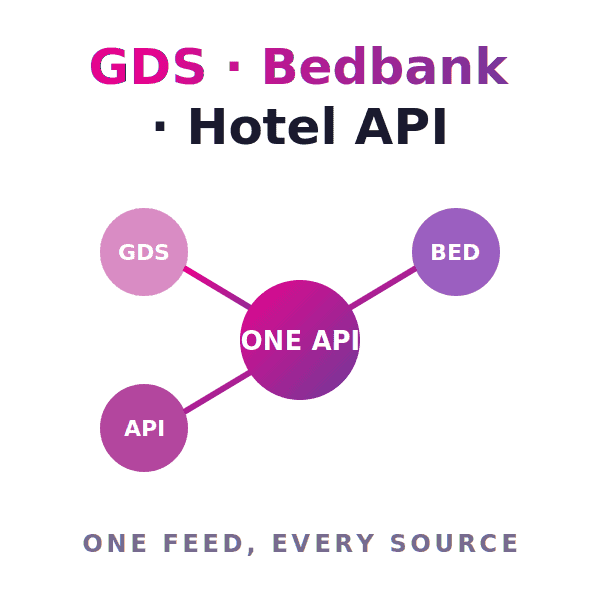
This is what a hotel API aggregator solves. Instead of choosing between GDS, bedbank, and direct, an hotel API aggregator connects all of them — plus hyperlocal sources — and delivers them through a single API, with duplicate listings cleaned up so the same hotel from three sources shows once at the best rate. You get the coverage of all three sources with the integration effort of one. With the bedbank market alone heading toward $118.7 billion by 2034, the number of sources worth blending only grows — making one-API access to all of them more valuable every year.
ZentrumHub connects 100+ suppliers across GDS, bedbanks, and direct sources, deduplicated and delivered through a single API — the coverage of all three, the integration of one.
See the Universal Hotel API →ZentrumHub unifies GDS, bedbanks, and direct suppliers — 100+ in total, 900K+ hotels — into one deduplicated API. The coverage of all three sources, the integration of one. 30M+ daily API calls. 99.99% uptime.


Drop your work email and we’ll send you the 12-page report that breaks down where 6–9 months and $215K+ quietly disappear — free.

