

Table of Contents
The honest answer is: not always. A travel startup with one supplier and a single market can launch without an aggregator — for a while. The trap is not launching without one; it is not knowing the exact moment you have outgrown that choice. Here is that moment, named.
Ask a vendor whether your travel startup needs its product on day one and you already know the answer. So this piece will not pretend. A startup validating a single idea, in a single market, with a single supplier, can launch without a hotel API aggregator — and sometimes should, because the cheapest way to test whether anyone wants your OTA is not to over-build the plumbing before you have a customer.
The useful question is not “aggregator: yes or no,” but “when does the answer flip.” Because it does flip, quickly, and the cost of missing the flip is not a slower launch — it is a rebuild of your foundation while a live business runs on top of it. In a market where OTAs already carry 40%+ of global hotel bookings (Phocuswright, 2024) and are heading toward $107B by 2026 (Skift Research), the startups that win are rarely the ones that launched fastest; they are the ones that did not have to stop and re-lay the foundation at the moment they should have been scaling.
There is a genuine case for launching without an aggregator, and it is worth stating clearly so the rest of this guide is credible. If you are pre-revenue, testing whether a specific audience will book at all, and one supplier’s inventory covers your single target market adequately, a direct integration to that one supplier is a reasonable proof of concept. You are not yet solving a supply problem; you are solving a demand problem — does anyone want this. Building multi-supplier infrastructure to answer a question you can answer with one supplier is premature optimisation. The honest guidance here is the same you would give any startup: do not build the scaled version of anything until the unscaled version has proven the demand.
The caveat that makes this safe rather than reckless: know that you are making a temporary choice, and know exactly what will end it. That ending has a name.
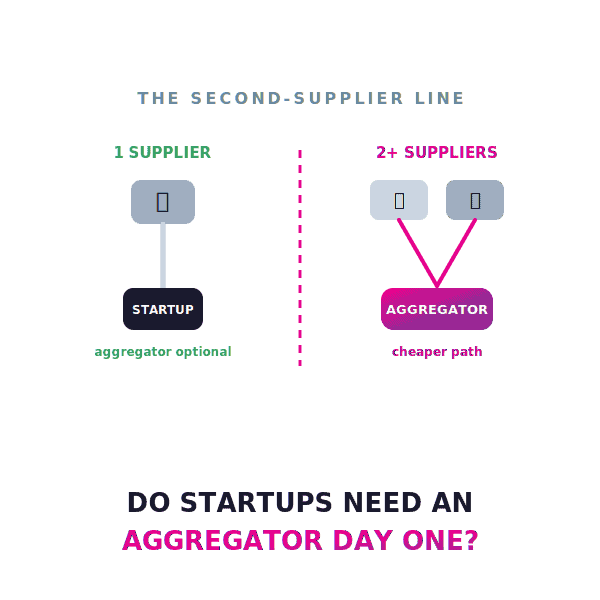
The moment a startup adds its second supplier, everything changes — and it changes suddenly, not gradually. This is the Second-Supplier Line, and which side of it you are on decides whether direct integration is smart or a liability.
The Second-Supplier Line. The jump from one supplier to two is not incremental — it introduces every problem an aggregator solves, all at once.
| Dimension | Direct integration (1 supplier) | Aggregator from day one |
|---|---|---|
| Time to launch | Fast if you build only one | Fast — pre-integrated suppliers, ~15 days |
| Upfront cost | Low for one; ~$215K+ per added supplier | Subscription from day one, no per-supplier build |
| Adding supplier #2 | A second full build + dedup + maintenance | Activate from the existing network |
| Deduplication | Your problem the moment #2 arrives | Built in |
| Maintenance | Yours, per supplier, forever | Absorbed by the platform |
| Path to scale | Re-platform when you outgrow it | Add suppliers without re-architecting |
| Best for | Pre-revenue POC, single market | Any startup that intends to grow supply |
Here is how the day-one shortcut turns expensive. A startup builds a single direct integration, launches, and finds traction. Demand appears in a second market, or customers ask for inventory the one supplier does not carry, so the team adds a second supplier — and discovers the direct-integration stack was never designed for two. Now the same hotel shows twice, rates conflict, formats clash, and every supplier update breaks something. The fix is not a feature; it is a foundation rebuild, and it lands at the exact moment the business is growing and least able to pause. That is the re-platform trap: the day-one saving becomes a year-two crisis, paid back with interest in engineering time, stalled growth, and the opportunity cost of rebuilding instead of scaling. The break-even reality of adding suppliers the hard way is laid out in direct supplier contracts vs aggregator, and the numbers are unforgiving: roughly $215K and 6–9 months per supplier built from scratch.
Start on infrastructure you won’t have to rebuild — one API, add suppliers as you scale.
Explore the Hotel API Aggregator →The classic objection to an aggregator at day one is commitment: why take on a platform subscription before you have revenue? Two things weaken that objection in 2026. First, the commercial model. A bring-your-own-licence aggregator with no per-booking fee means a startup pays for connectivity, not for each transaction — so the cost does not scale punitively as the first bookings arrive, and there is no revenue-share eating the thin early margins. Second, time-to-market. Pre-integrated suppliers mean a startup can be live on many suppliers in around 15 days without writing integration code, which is often faster than building even a single direct integration properly. When the aggregator is both non-punitive on cost and faster to launch, the “too early to commit” argument mostly dissolves — the remaining honest case for going direct is the pure pre-revenue POC described earlier, and even that is a matter of weeks, not a strategy.
Two questions settle it. First: will you ever carry more than one supplier? If the honest answer is yes — and for almost any OTA with ambitions to compete, it is, because no single supplier covers every market well — then you will cross the Second-Supplier Line, and the only question is whether you cross it on infrastructure built for it or on a stack you will have to rebuild. Second: is your current stage a genuine pre-revenue proof of concept, or a real business? A true POC with one supplier can defensibly go direct for a few weeks; a real business that intends to grow should start on an aggregator, because the day-one saving is dwarfed by the re-platform cost it defers. In short: if you are testing whether anyone wants it, one supplier is fine for now; the instant you know they do, you are on the aggregator side of the line.
For a startup that has crossed — or knows it will cross — the Second-Supplier Line, ZentrumHub is the infrastructure that removes the re-platform risk entirely. Through Zentrum Connect, a new OTA connects once and can activate suppliers from a network of 100+ as demand dictates, reaching 900,000+ deduplicated hotels without building or maintaining a single integration. The bring-your-own-licence model means the startup keeps its own supplier contracts and rates, the flat SaaS pricing carries no per-booking fee to erode early margins, and go-live runs in about 15 days. Crucially, the architecture never has to be rebuilt: supplier two, ten and fifty are activations, not projects. A startup starts small on the same foundation it will scale on — which is the entire point of not falling into the trap.
Also Read: Best Hotel API Aggregators in 2026: the ranked comparison by layer →
One API, 100+ suppliers to activate as you grow, your contracts stay yours, no per-booking fees — live in 15 days, no re-platform later.
Not strictly. A pre-revenue startup testing demand with a single supplier in a single market can launch on one direct integration as a proof of concept. But that window is short: the moment you add a second supplier you inherit deduplication, normalisation and multi-supplier maintenance — the problems an aggregator solves. Any startup that intends to grow its supply is usually better starting on an aggregator, because the day-one saving of going direct is dwarfed by the cost of re-platforming once traction arrives.
At the Second-Supplier Line — the point where you add your second supplier. With one supplier there is no duplication and one integration to maintain, so a direct connection is defensible. With two, the same hotel arrives twice in two formats at two prices, and deduplication, normalisation and double maintenance all appear at once. That jump is not incremental; it introduces every problem an aggregator addresses simultaneously, which is why it is the natural decision point rather than any particular booking volume.
For a single supplier at pure proof-of-concept stage, a direct integration can have lower upfront cost than a subscription. The maths inverts the moment you add a second supplier: each additional direct integration runs roughly $215K and 6–9 months fully loaded, plus permanent maintenance, whereas an aggregator activates new suppliers from an existing network at no per-supplier build cost. A bring-your-own-licence aggregator with no per-booking fee also avoids eroding thin early margins, which weakens the cost argument for going direct even at launch.
It is the situation where a startup builds a single-supplier direct stack to launch fast, gains traction, then has to rebuild its entire supply foundation to add more suppliers — at the exact moment it is growing and least able to pause for a rebuild. The day-one saving becomes a year-two crisis, repaid in engineering time and stalled growth. Starting on an aggregator avoids it, because adding suppliers becomes an activation rather than a re-architecture.
Yes — that is the strongest reason to start on one. With a platform like ZentrumHub, a startup connects once and activates as few or as many of the 100+ suppliers as it needs, adding more as demand grows without ever re-architecting. The bring-your-own-licence model keeps supplier contracts yours, flat pricing avoids per-booking fees on early volume, and go-live runs in about 15 days. You begin small on exactly the foundation you will scale on, which removes the re-platform risk entirely.
Drop your work email and we’ll send you the 12-page report that breaks down where 6–9 months and $215K+ quietly disappear — free.