

Table of Contents
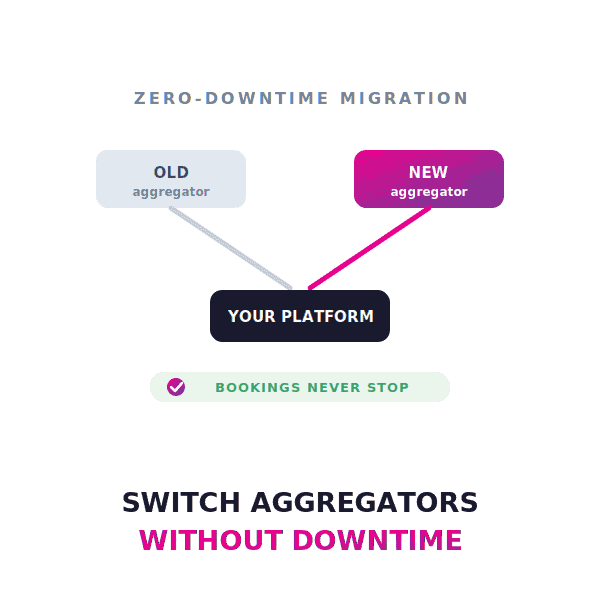
The fear that keeps OTAs on the wrong aggregator is downtime: nobody wants to lose a day of bookings to a migration. But switching does not have to mean going dark. Done right, you run both connections at once and cut over only when the new one has already proven itself.
Plenty of OTAs know their current aggregator is holding them back — thin coverage in a growing market, a per-booking model that taxes every win, support that goes quiet when it matters — and stay anyway, because the alternative feels like open-heart surgery on a running business. The fear is rational but the premise is wrong. Migrating aggregators is not a rip-and-replace with a dark period in the middle; it is a parallel run where the new connection earns its place before the old one is switched off.
This guide is the migration playbook: the five-stage path that keeps bookings flowing throughout, exactly what has to move, a realistic timeline, and the risks with their countermeasures. It matters because the stakes only grow — with OTAs carrying 40%+ of global hotel bookings (Phocuswright, 2024) inside a market heading for $107B by 2026 (Skift Research), staying on the wrong infrastructure gets more expensive every quarter, and the migration only gets bigger the longer it waits.
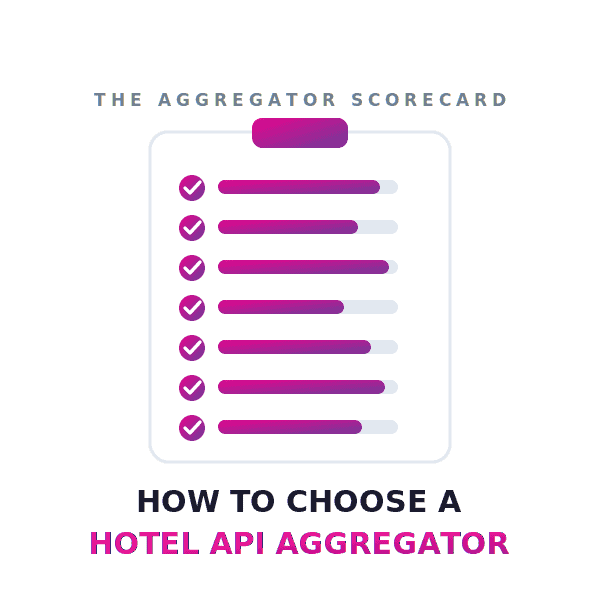
Migration is real work, so it needs a real trigger. The common ones: coverage gaps in markets you are trying to grow, a commercial model whose cost rises as fast as your bookings, deduplication quality that leaves your results page cluttered or your rates uncompetitive, booking failure rates that generate refunds and support load, or support terms that do not match the revenue riding on the platform. If one of those is capping your growth, the cost of staying compounds while the cost of moving stays roughly fixed. The honest test is the one from the evaluation stage: score your current platform on the same seven criteria you would score a new one — the method is in how to choose a hotel API aggregator — and if a challenger wins clearly on the criteria that gate your growth, the migration pays for itself.
The whole method rests on one principle: never switch off the old connection until the new one has proven itself on your real traffic. Five stages, no dark period.
The Zero-Downtime Migration Path: Parallel → Validate → Shadow → Cut → Retire. At no stage do bookings stop.
A migration moves four things, and how portable each one is depends on choices made when you signed the old contract. Supplier credentials and contracts — under a bring-your-own-licence model these are yours already, so they simply re-point to the new platform; if the old aggregator was itself your supplier, this is harder and may mean re-contracting. Property mappings — the deduplication and matching work built up over time; portable if your old contract granted export, a rebuild if it did not. Markup, routing and business rules — usually re-created in the new platform’s configuration, which is fast if documented. Booking and customer history — exported for continuity and reporting. The single biggest determinant of migration pain is whether you owned these assets, which is exactly why the contract questions to ask before signing matter so much: the exit is bought at the entrance.
Exact durations vary with supplier count and how portable your assets are, but the shape is consistent. The point of the table is not the day count — it is that bookings keep flowing through every row.
| Stage | What happens | Bookings served by | Typical effort |
|---|---|---|---|
| Parallel | New aggregator integrated alongside old | Old platform, 100% | Days, on a BYOL platform |
| Validate | Compare on your real searches | Old platform, 100% | 1–2 weeks |
| Shadow | Small traffic share on new platform | Split — old majority, new minority | 1–2 weeks |
| Cut | Progressive shift, rollback ready | Shifting old → new | Days to weeks |
| Retire | Old connection decommissioned | New platform, 100% | Per old contract notice |
Four risks account for most migration trouble, and the parallel-run path defuses each. Coverage gaps — the new platform missing a supplier or market you rely on; caught in Validate, before any traffic moves, by comparing against your current supplier list. Rate or content regressions — subtly worse prices or thinner content; caught in Validate and Shadow by comparing real results side by side. Booking failures at cutover — the classic fear; neutralised by Shadow’s contained blast radius and Cut’s instant rollback, so a problem affects a slice, never the whole business. Contract overlap cost — briefly paying for two platforms; real, but small and deliberate, the insurance premium for zero downtime. The pattern is consistent: every risk is surfaced while the old connection is still carrying the load, so nothing is ever discovered in production with no fallback.
See what a parallel-run migration to one API and 100+ suppliers looks like — no dark period, with seamless access to suppliers such as Hotelbeds Hotel API, RateHawk Hotel API, Expedia Hotel API, and TBO Hotel API.
Explore the Hotel API Aggregator →The deepest source of switching pain is not technical; it is ownership. When an aggregator holds your supplier relationships, leaving means re-contracting with every supplier before you can even start — the platform is a wall around your own inventory. A bring-your-own-licence model removes that wall: because your supplier contracts and rates were always yours, migrating means re-pointing credentials, not renegotiating relationships. The same property that makes a BYOL platform easy to leave makes it easy to join — the Parallel stage is fast precisely because your contracts travel with you. This is the quiet reason ownership questions belong in the contract, not the exit interview: the freedom to switch is a feature you buy at signing, and it is why who holds the supplier relationship shapes every future decision.
Migrations onto Zentrum Connect follow this exact path. Because it is bring-your-own-licence, the Parallel stage is a matter of re-pointing your existing supplier credentials rather than re-contracting, and full go-live runs in 15 days once validation and cutover complete. During the overlap, your team compares the new connection against the old on real traffic — coverage across 100+ suppliers and 900,000+ deduplicated hotels, sub-500ms responses, best-rate accuracy, and booking success against the 99.99% uptime SLA — and only retires the old platform once the numbers hold. ZentrumHub absorbs supplier maintenance from day one, so the migration also ends the treadmill of supplier API changes that may have been part of why you were leaving. The switch is an engineering project with a rollback at every step, not a leap.
Also Read: Best Hotel API Aggregators in 2026: the ranked comparison by layer →
Parallel-run migration, your contracts stay yours, 100+ suppliers on one API, live in 15 days — with rollback at every step.
Yes, with a parallel-run migration. You integrate the new aggregator alongside the existing one, validate it on your real searches, route a small share of live traffic to it, then shift traffic over progressively with instant rollback available — and only decommission the old connection once the new one is stable at full volume. At no stage do bookings stop, because the old platform keeps serving until the new one has proven itself. The overlap is the whole point: it removes the dark period a rip-and-replace would create.
It depends on supplier count and how portable your assets are, but the stages are consistent: a few days to run in parallel on a bring-your-own-licence platform, one to two weeks to validate, one to two weeks to shadow live traffic, then a progressive cutover. On ZentrumHub, full go-live runs in 15 days once validation and cutover complete. Throughout, bookings keep flowing through whichever connection is serving that traffic, so the timeline is about confidence, not downtime.
Not if you are on a bring-your-own-licence model, where your supplier contracts and negotiated rates are yours — migrating means re-pointing credentials to the new platform, not renegotiating. If your current aggregator is itself your supplier and holds the relationships, switching is harder and may involve re-contracting, which is exactly why who owns the supplier relationship is a question to settle before signing. Owning your contracts is what makes any aggregator replaceable.
Property mappings move if your old contract allowed export; if not, the new platform rebuilds them as part of onboarding. Markup, routing and business rules are re-created in the new platform’s configuration, which is quick when they are documented. Booking and customer history is exported for continuity and reporting. The portability of these assets is set by the terms you signed originally, so if a future switch is even a possibility, confirm export rights for data and mappings before you commit to any aggregator.
Switch when the current platform is capping your growth — coverage gaps in markets you are expanding into, a model whose cost scales with your success, weak deduplication, high booking failure, or support that does not match your revenue. Score your current aggregator on the same criteria you would score a new one; if a challenger wins clearly on the factors gating your growth, the cost of staying compounds while the migration cost stays roughly fixed. With a zero-downtime parallel run, the migration risk is low enough that a clear scorecard win usually justifies the move.
Drop your work email and we’ll send you the 12-page report that breaks down where 6–9 months and $215K+ quietly disappear — free.