TL;DR — Key Takeaways
- ✓ The trigger for hotel mapping is your second supplier — the instant you have two sources, the same hotel arrives twice and duplicates begin.
- ✓ With one supplier you usually don’t need mapping. With two or more, you do — there’s no third state.
- ✓ Clear signals you’ve crossed the line: duplicate listings, mismatched prices for one hotel, rising support tickets, and engineers cleaning data by hand.
- ✓ Both B2B and B2C platforms need it — B2C for trust, B2B for competitive pricing across suppliers.
- ✓ The easiest time to solve it is before it scales — and ZentrumHub lets you skip it entirely by delivering already-mapped inventory through one API.
“Do we need hotel mapping yet?” is one of the most common questions a growing OTA asks — and one of the easiest to answer once you know the trigger. It isn’t about how big you are, how many bookings you do, or how much traffic you get. It’s about one thing: how many suppliers you source from.
This guide gives you a precise answer. You’ll see the exact threshold that flips mapping from “optional” to “necessary,” the seven signals that confirm you’ve crossed it, and what every month of delay costs once you have. If you’re new to the concept itself, our primer on what hotel mapping is covers the fundamentals first.
The Two-Supplier Threshold
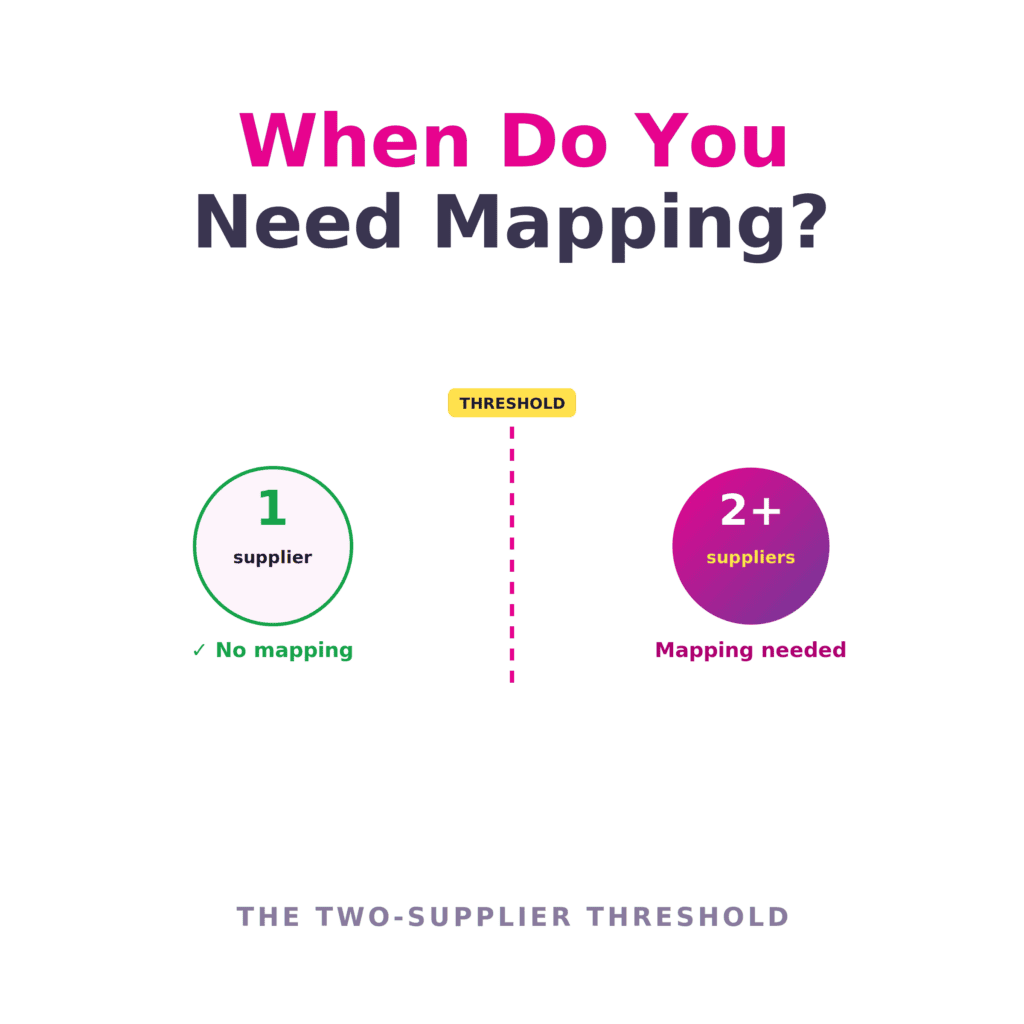
Here’s the rule, as simple as it gets: one supplier, no mapping needed. Two or more suppliers, mapping needed. We call this The Two-Supplier Threshold, and it’s the cleanest answer to the timing question because it maps to the actual mechanism that creates duplicates.
1 supplier
Mapping not needed
Each hotel comes from one source with one ID. Nothing to reconcile, no duplicates. Your inventory is clean by default.
2+ suppliers
Mapping required
The same hotel now arrives from multiple sources with different IDs and names. Without mapping, it lists more than once — and the problem grows with every supplier added.
There’s no comfortable middle ground. The moment a single hotel can reach your platform from two different suppliers, you have a matching problem — even if you only notice it later. As one industry team that built their own solution put it, mapping becomes indispensable the moment you aggregate from more than one source, whether you run a B2B or a B2C business. The only question is whether you solve it deliberately or let duplicates accumulate until customers notice.
When You Don’t Need Mapping (Yet)
It’s worth being honest about the other side: there are real cases where mapping isn’t urgent, and spending on it early would be premature.
🟢 A single supplier
If all your inventory comes from one source, each hotel has one ID and one listing. There’s genuinely nothing to deduplicate yet.
🟢 Non-overlapping inventory
If two suppliers cover entirely different regions with zero shared hotels, duplicates can’t occur. Rare in practice — overlap usually appears as you grow — but possible at the very start.
The catch: both states are temporary. The whole point of adding suppliers is more inventory and better prices, which means more overlap — and the threshold arrives the day you connect source number two. Planning for it early is far cheaper than retrofitting it after duplicates have spread across your catalog.
If you’re weighing up that next supplier, our free report The 5 Hidden Costs of Adding a New Hotel Supplier covers mapping alongside the four other costs that arrive with each new source (no email required).
B2B vs B2C: Both Need Mapping
Some teams assume mapping is only a consumer-facing concern. It isn’t. Both business models hit the Two-Supplier Threshold — they just feel the pain differently.
| Dimension |
B2C Platform |
B2B Platform |
| Main risk of no mapping |
Customer distrust, site looks broken |
Uncompetitive pricing to agents |
| Where it shows |
Search results & booking flow |
Rate comparison & margins |
| Why it matters |
Duplicate listings kill conversion |
Need lowest price across many suppliers |
| Threshold |
2+ suppliers |
2+ suppliers |
For B2C, clean listings protect trust and conversion. For B2B, where the whole value proposition is connecting to as many suppliers as possible to secure the best rate, mapping is what makes that multi-supplier strategy actually work. Either way, the trigger is the same.
The Cost of Waiting
Crossing the threshold and doing nothing isn’t free — it just defers a bill that grows. Here’s what delay accumulates.
Duplicates spread across your catalog
Every new supplier and every new hotel adds more duplicate pairs. What’s a handful at two suppliers becomes thousands at ten — and cleaning a large mess later costs far more than preventing a small one now.
Lost bookings you never see reported
Confused customers leave quietly. The conversions you lose to duplicate listings never show up as an error — they’re simply bookings that didn’t happen, one of the hardest leaks to detect.
Margin left on the table
Without reliable matching, you can’t consistently surface the cheapest valid rate or set smart markups — so you either lose price-sensitive bookings or undercharge on ones you’d have won anyway.
Compounding manual cleanup
The longer you patch by hand, the more entrenched the spreadsheets and workarounds become — and the harder the eventual switch to a real solution.
The pattern matches what we covered in the cost analysis: skipping mapping doesn’t save money, it postpones a larger bill. For the full build-versus-buy math, see our guide on whether to build or buy hotel mapping.
Just crossed the two-supplier line?
Solve mapping before it scales. Zentrum Connect delivers inventory already deduplicated at the property and room level — so the duplicates never reach your platform in the first place.
Explore Zentrum Connect →
What to Do When You Hit the Threshold
Once you’ve crossed it, you have the same three options every OTA faces — and the right one depends on whether mapping is your product or just your plumbing.
Build it — if mapping is core to your business
A standing engineering and data-science commitment. Right only when you intend to own or sell the capability.
Buy it — license a dedicated mapping API
The right fit when mapping is your only gap and your supply is already sorted. Ask whether it matches at the room level and re-checks continuously.
Inherit it — get inventory already mapped
ZentrumHub connects you to 100+ suppliers through one API and delivers inventory already deduplicated at the property and room level — mapping handled by a dedicated partner before delivery. You add suppliers freely without the duplicate problem each one would otherwise create.
For most OTAs that have just crossed the threshold, inheriting clean inventory is the fastest way back to a clean catalog — no project to staff, no engine to maintain. For the deeper comparison, see our build vs buy guide, and for sourcing options the best hotel API providers in 2026.
Frequently Asked Questions
When does an OTA need hotel mapping?
An OTA needs hotel mapping the moment it sources from a second supplier. With one supplier, every hotel has a single ID and listing, so there’s nothing to deduplicate. With two or more suppliers, the same hotel arrives from multiple sources under different IDs and names, creating duplicate listings that mapping resolves. The trigger isn’t your size or booking volume — it’s your supplier count. If you’re at two or more sources, you’ve crossed the threshold and need mapping.
How many suppliers before I need mapping?
Two. One supplier produces no duplicates because each hotel comes from a single source. The second supplier is the trigger — as soon as the same hotel can reach your platform from two sources, you have a matching problem, even if you don’t notice it immediately. The issue then grows with every additional supplier: a handful of duplicates at two sources becomes thousands at ten. That’s why solving it at the two-supplier mark is far cheaper than waiting.
What are the signs I need hotel mapping?
The clearest signs are: the same hotel appearing more than once in search results, one hotel showing several different prices as separate listings, engineers manually cleaning data in spreadsheets, rising support tickets about confusing listings, wrong-hotel or wrong-room bookings, an inability to tell which supplier rate is genuinely cheapest, and an upcoming new supplier integration. Any single one of these means you’ve already crossed the threshold and mapping is no longer optional.
Do small or new OTAs need hotel mapping?
It depends entirely on supplier count, not size. A brand-new OTA sourcing from two suppliers needs mapping just as much as a large one — the duplicate mechanism is the same. A small OTA still on a single supplier doesn’t need it yet. The smartest move for a growing platform is to plan for mapping before adding the second supplier, since solving it early is far cheaper than retrofitting it once duplicates have spread across the catalog.
Does a B2B travel platform need mapping too?
Yes. Both B2B and B2C platforms cross the same two-supplier threshold; they just feel the impact differently. For B2C, duplicate listings erode customer trust and conversion. For B2B, where the strategy is to connect with as many suppliers as possible to secure the best rate and availability, mapping is what makes that multi-supplier approach work — without it, you can’t reliably compare rates for the same hotel and room across sources to offer agents the most competitive price.
Can I avoid setting up mapping at all?
Yes — by sourcing inventory that’s already mapped. When you connect through an aggregator like ZentrumHub, deduplication happens upstream at the property and room level, so the same hotel from multiple suppliers arrives as one clean record. You never build a matching engine or license a separate mapping tool, because duplicates never reach your search results. For most OTAs crossing the threshold, this is the fastest and lowest-risk route to a clean catalog.
Two suppliers or more? You’re past the threshold.
ZentrumHub delivers inventory from 100+ suppliers already deduplicated at the property and room level — so duplicates never reach your platform and you can add suppliers freely. 30M+ daily API calls. 99.99% uptime.