






Table of Contents
The same room arrives from six suppliers at six prices in six formats. A hotel rate aggregation API is the machinery that decides — in milliseconds — which of them your customer actually sees. Here is exactly how that decision works, and why “show the cheapest” is how OTAs lose money.
A traveller searches Dubai for three nights and sees one price per hotel. Behind that single number, the platform just received the same property from six suppliers at six prices — some net, some commissionable, some in the wrong currency, one missing city tax, and two describing different cancellation policies for what looks like the same room. Somebody has to turn that mess into one honest, bookable price. That somebody is the rate aggregation layer.
This guide opens that layer up: what a hotel rate aggregation API actually does, the five-step logic that decides which rate wins, the comparability traps that break naive implementations, and what it costs to build versus inherit. It is written for the people who own the consequences — OTA tech leads, product managers, and founders whose margin lives inside this decision.
A hotel rate aggregation API is the layer of a hotel API aggregator that collects rates for the same property from multiple suppliers, converts them into a comparable form, and selects which rate to surface for each room and rate plan. The aggregator as a whole answers “which hotels exist and who sells them”; the rate aggregation layer answers the harder commercial question — “of all the prices we just received for this exact room, which one should the customer see, and will it still be true at checkout?”
One prerequisite matters enough to state up front: rate aggregation only works after property matching. If your platform has not first recognised that “Grand Hyatt Dubai” from one supplier and “Hyatt Grand — Dubai Creek” from another are the same building, it will compare rates for phantom twins and show the same hotel twice. That matching problem is its own discipline, covered in the guide to why OTAs show duplicate hotels; everything below assumes it is already solved.
Price differences across suppliers are not errors — they are the structure of hotel distribution working as designed. A bedbank holds a static contracted net rate negotiated last season. An OTA-wholesale programme resells a dynamic retail rate that repriced an hour ago. A GDS carries a corporate negotiated rate no leisure channel can see. Layer on top of that: rates quoted in different currencies, taxes and city fees included by one source and excluded by another, promotional rates with stay restrictions, and rate plans that bundle breakfast on one feed and strip it on the next. The result is measurable chaos — 40% of independent hotels report daily rate inconsistencies across their own channels (Phocuswright, 2025), and that is before a platform mixes six suppliers’ views of the same inventory.
For an OTA, this spread is simultaneously the opportunity and the trap. The opportunity: in a market where OTAs are heading toward $107B by 2026 (Skift Research), the platform that consistently surfaces the genuinely best bookable rate wins the comparison shopper. The trap: the platform that surfaces the naively lowest number wins the comparison shopper too — and then loses them at checkout when the number turns out not to be real.
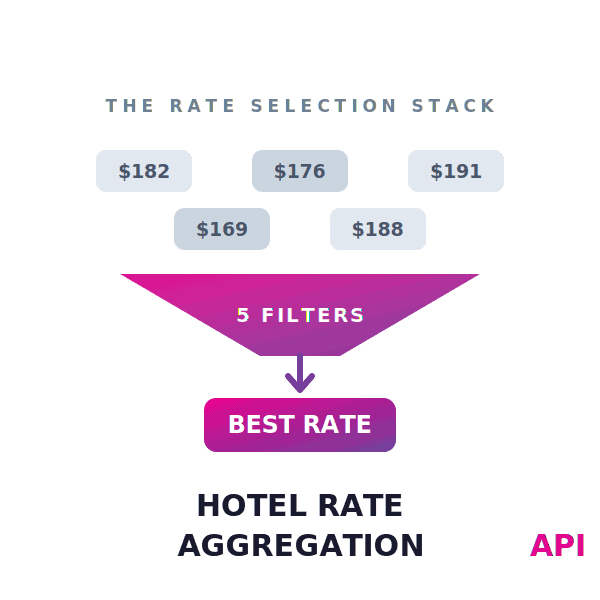
Every serious rate aggregation implementation — built or bought — runs the same five layers in the same order. Miss one and the failure shows up somewhere specific: a wrong tax at checkout, a margin leak, a booking that confirms nothing.
The Rate Selection Stack: Normalise → Qualify → Compare → Prefer → Verify. Every production-grade rate aggregation API runs all five, on every search.
The naive implementation — sort ascending, show the first row — fails for three reasons that only appear at real traffic. First, comparability: the cheapest number is frequently a different product. A non-refundable net rate before markup, quoted excluding city tax, will always beat a flexible commissionable rate with taxes included — and selling the first while implying the second is how platforms earn chargebacks and one-star reviews. Second, margin blindness: on net-rate inventory your revenue is the spread you add; the lowest gross number can be the worst commercial choice once markup rules run. Third, and most expensive, staleness: the cheapest cached rate is statistically the one most likely to have moved, because aggressive prices reprice fastest. Show it without a live recheck and the customer meets a different number at payment — or a booking that confirms and quietly fails. On self-built stacks, 2–7% of bookings fail silently this way, and platforms without failover see failure rates as high as 18%. Each one is a refund, a support ticket and a customer who never returns.
Also Read: Hotel Inventory API: the full request-response cycle and the caching decisions behind it →
Teams that build this layer themselves discover it is not one feature but six subsystems: a currency service with live FX treatment, a tax and fee engine that knows which jurisdictions bill at checkout versus at the desk, room and rate-plan mapping across every supplier vocabulary, business-rule and markup execution, a recheck orchestrator at pre-booking, and monitoring that notices when one supplier’s feed starts lying. Each supplier added multiplies the edge cases, which is a large part of why a single supplier integration runs 6–9 months and $215K+ fully loaded before maintenance begins. Industry data points the same direction from the other side: API-level automation of these operations cuts operational costs by roughly 40% (Bakuun, 2025) — the saving exists precisely because the manual version is that expensive. For a technical tour of how supplier data inconsistency creates this workload, AltexSoft’s hotel API overview is a solid independent reference.
| Dimension | Build it yourself | Included in a demand-side aggregator |
|---|---|---|
| Normalisation | Currency, tax and rate-plan mapping per supplier, by your team | One schema across 100+ suppliers, maintained for you |
| Comparability logic | Room/board/policy matching written and tuned in-house | Built in at property, room and rate-plan level |
| Commercial rules | Markup and routing engine is a separate build | Revenue, POS and relevance controls configurable |
| Rate recheck | Recheck orchestration + failover you must design | Automatic live recheck at pre-booking |
| Speed at scale | Your caching strategy vs 100 parallel supplier calls | Sub-500ms responses across 30M+ daily API calls |
| Cost & timeline | $215K+ and 6–9 months per supplier, then maintenance forever | Flat SaaS, zero per-booking fees, live in 15 days |
The Zentrum Booking Engine puts revenue, POS and relevance controls on top of aggregated best rates.
See the Booking Engine →Zentrum Connect runs the full Rate Selection Stack as standard plumbing. Every response from 100+ suppliers is normalised into one schema, the same property is deduplicated across sources, comparable rate plans are matched at room level, and the best available rate is surfaced with your markup and routing rules applied — in under 500ms. The recheck layer is enforced automatically at pre-booking, which is why booking failure on the platform sits near zero against the 18% that self-built stacks can reach. The whole layer arrives pre-built: platforms bring their own supplier contracts and are live in 15 days, with 3M+ room nights and $650M+ in client revenue already processed through the same machinery.
Also Read: Best Hotel API Aggregators in 2026: The Honest Guide for OTAs →
100+ suppliers normalised, deduplicated and rate-rechecked automatically — sub-500ms, 99.99% uptime, zero per-booking fees. Live in 15 days.
A hotel rate aggregation API collects rates for the same hotel from multiple suppliers, converts them into a comparable form — one currency, one tax treatment, matched room and rate plans — and selects which rate to display for each room. It is the rate-decision layer inside a hotel API aggregator: the aggregator handles supplier connectivity and deduplication, and the rate aggregation layer resolves the commercial question of which of many valid prices the customer should actually see, then verifies it live before booking.
Through five layers: normalise every rate to a comparable basis, qualify out rates the platform cannot sell, compare like with like at room and rate-plan level, apply commercial preference such as margin and supplier reliability, and verify the winner with a live recheck at pre-booking. The best rate is the lowest genuinely comparable, genuinely bookable rate after business rules — which is often, but not always, the lowest raw number in the response.
Because suppliers hold different commercial positions on the same inventory: static contracted net rates at bedbanks, dynamic retail rates at OTA-wholesale programmes, negotiated corporate rates on the GDS, plus differences in currency, tax inclusion, promotions and rate-plan bundling. Phocuswright found 40% of independent hotels see daily rate inconsistencies across their own channels — multi-supplier platforms inherit all of it, which is exactly the problem rate aggregation exists to resolve.
No — and a vendor who promises that is describing the naive implementation this article warns against. Rate aggregation guarantees the best comparable, sellable, verified rate: the lowest number that is genuinely the same product, permitted in your market, commercially sensible after markup, and still true at checkout. A lower raw number usually exists somewhere in the responses; it is excluded precisely because it is a different product, an unsellable rate, or a stale cache entry that would fail at booking.
Zentrum Connect enforces an automatic live rate recheck at the pre-booking step on every transaction. The rate shown at search is re-verified against the supplier before payment, so price movement is caught and handled before the customer commits rather than after. Combined with retry logic and supplier failover across 100+ sources, this keeps booking failure near zero — against failure rates of up to 18% on self-built stacks without recheck and failover — at sub-500ms response times and a 99.99% uptime SLA.


Drop your work email and we’ll send you the 12-page report that breaks down where 6–9 months and $215K+ quietly disappear — free.

