

download
Meet us in ATM Dubai
Booth TT2541
zentrumhub_logo-removebg-preview Main Header

simplifying Travel Technology

Zentrumhub-blackfont-SVG 2 RateHawk Hotel API

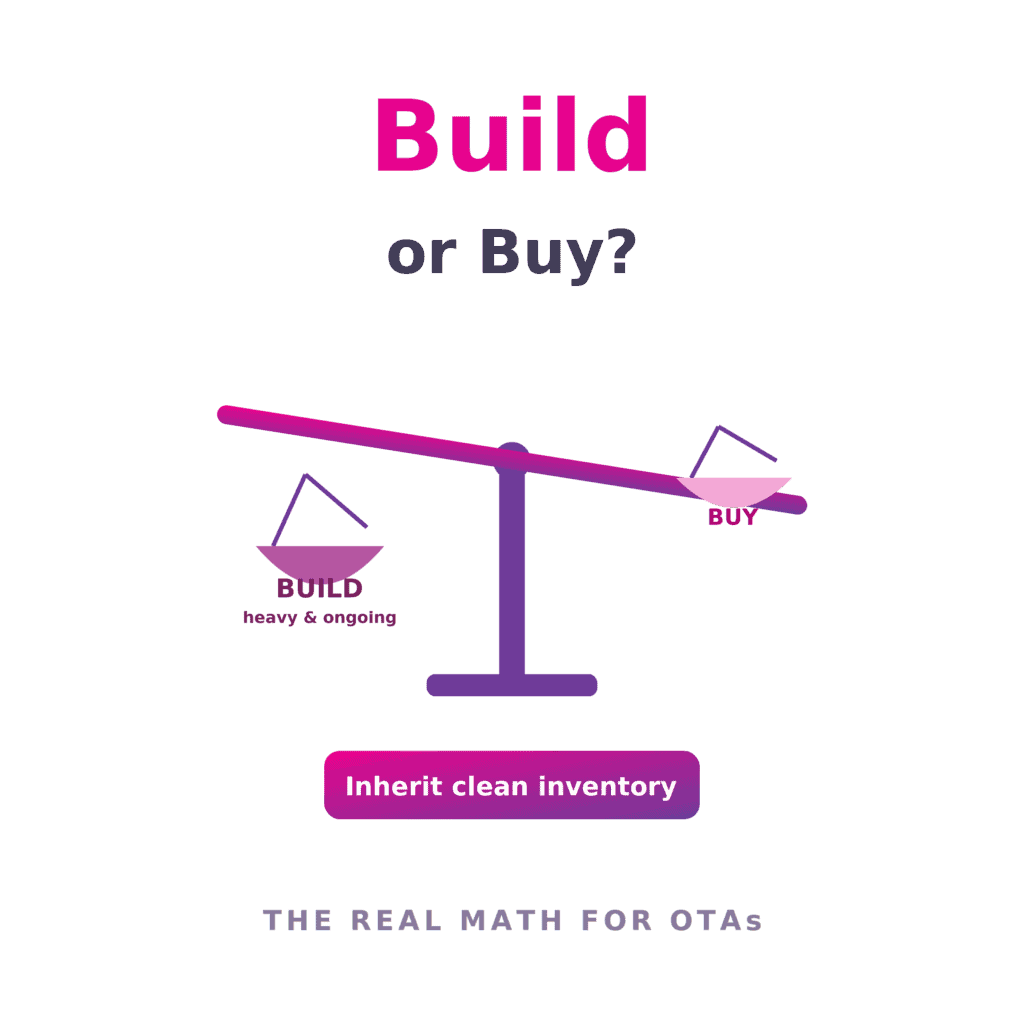
Hotel Mapping: Should You Build It or Buy It?

Hotel Mapping


Hotel Mapping 

Building a mapping engine looks like a smart way to own your data. The real bill — engineering, accuracy, and endless maintenance — is almost always bigger than the subscription you were trying to avoid. Here’s the honest math.

🏗 What Building Really Costs
⚖️ The Decision Framework

▶ See the Real Math →

TL;DR — Key Takeaways
  • ✓ Building hotel mapping in-house means more than code — a matching engine, a master database, accuracy monitoring, and a standing team to maintain it as suppliers change.
  • ✓ Published vendor pricing for a mapping API starts around $399/month for property mapping and $449/month with room mapping — usually a fraction of what manual or in-house mapping costs.
  • ✓ The true comparison isn’t “subscription vs free” — it’s subscription vs the total cost of mapping: salaries, opportunity cost, and the price of every mapping error.
  • ✓ Build only if mapping is core to your product and you have data-science depth to spare. For almost everyone else, buying or inheriting wins.
  • ZentrumHub lets you skip the choice entirely — inventory arrives already mapped through one API, with mapping handled by a dedicated partner before delivery.

Every OTA that adds a second supplier eventually faces the same fork in the road. The same hotel is arriving twice, the duplicates are piling up, and someone asks the obvious question: do we build the mapping ourselves, or pay someone for it? Building feels cheaper and more in your control. That feeling is usually wrong.

This guide breaks down the real cost of each path — what building a hotel mapping system genuinely takes, what buying one costs, and the hidden line items that make the decision clearer than it first looks. If you’re still unsure what mapping involves, start with our primer on what hotel mapping is; this article assumes you already know you need it and are deciding how to get it.

The Three Paths to Hotel Mapping

Before the build-vs-buy question, it helps to see there are actually three options, not two.

Build — own the engine
Your team builds the matching logic, the master property database, and the operations to keep it accurate. Full control, full responsibility, full cost.
Buy — license a mapping API
A specialist mapping provider does the matching; you send your supplier data and receive clean, deduplicated output. You still manage the integration and your supplier relationships.
Inherit — get inventory already mapped
An aggregator delivers inventory that’s already deduplicated before it reaches you, so mapping never becomes a project you run at all. The duplicates simply never arrive.

Most “build vs buy” debates ignore that third path — which, for many OTAs, is the cheapest and lowest-risk of all. We’ll come back to it. First, the honest cost of the two obvious options.

What Building Hotel Mapping Actually Costs

The mistake is pricing a build as a one-time engineering project. Mapping isn’t a feature you ship and forget — it’s a living system. Here’s what the bill really includes.

The matching engine
Fuzzy, multi-signal matching that weighs name, geolocation, address, and attributes together — and, for rooms, parses free-text descriptions into structured fields. This is real data-science and ML work, not a weekend script.
The master database
A single source of truth assigning one canonical ID to every real hotel and room, that every supplier listing maps onto. It has to be designed, populated, and kept consistent at scale.
Continuous re-matching
Suppliers change names, rebrand hotels, and rename rooms constantly. Matching is never “done” — it must run continuously, or your data quietly rots and the errors come back.
Accuracy monitoring + human review
Leading providers cite accuracy of 99.9%+, but you only know yours if you measure it. Ambiguous matches that a confidence threshold can’t settle still need people in the loop — an ongoing operations cost, not a one-off.
The opportunity cost
Every engineer-month on mapping is a month not spent on the product that actually differentiates you. This is the largest and least-counted line item of all.

None of this differentiates you to a single customer. A traveler never books because your mapping is in-house — they book because the listing is clean and the price is right, which buying delivers just as well.

What Buying Hotel Mapping Costs

Buying means licensing a dedicated mapping provider via API. The pricing here is far more concrete than the build side — and that clarity is part of the point.

According to published vendor pricing in the mapping market, a property-level mapping API can start around $399 per month, with room-level mapping from roughly $449 per month and optional modules — content enrichment, post-booking validation — around $199 per month each. Many enterprise vendors don’t publish pricing at all and work on quotes, which sits at a higher tier.

The key reframe: that subscription is almost always a fraction of what the same work costs in-house. One or two operations staff doing manual deduplication can cost more in salary alone than a mapping API — before you count the engineering to build it or the errors it prevents.

What “buying” still leaves on your plate

Buying a mapping API isn’t zero-effort. You still integrate the API, send and receive data, manage every individual supplier relationship and contract, and own the result. It removes the engine — not the supplier-management work. That distinction is exactly what the third path closes.

The Total Cost of Mapping

The build-vs-buy decision only makes sense once you compare the full cost of each — not the sticker price. We call this The Total Cost of Mapping (TCM): every cost a mapping approach carries, visible and hidden. Tally these honestly and the picture usually flips.

Build — Total Cost
  • ML / data-science salaries
  • Master database build
  • Continuous re-matching ops
  • Accuracy monitoring + review
  • Opportunity cost of roadmap
  • Cost of every error you miss
>
Buy / Inherit — Total Cost
  • Predictable subscription (from ~$399/mo)
  • Integration effort (one-time)
  • No engine to maintain
  • Accuracy is the vendor’s job
  • Engineers stay on product
  • Errors handled before delivery
Illustrative — for most OTAs the left column outweighs the right once hidden costs are counted.

The headline subscription is the only cost buyers see clearly, so it dominates the conversation. But it’s often the smallest number in the comparison. The expensive parts of building — salaries, maintenance, opportunity cost, and the price of errors — are invisible until you’re already committed to them.

Mapping is just one of several costs that arrive when you scale suppliers. Our free report The 5 Hidden Costs of Adding a New Hotel Supplier lays out all five — integration, mapping, maintenance, silent booking failures, and opportunity cost — with the math behind each (no email required).

Build vs Buy: Side by Side

A clear comparison across the dimensions that actually decide it:

Factor Build In-House Buy / Inherit
Upfront cost High (engineering + data science) Low (subscription from ~$399/mo)
Time to live Months to quarters Days to weeks
Ongoing maintenance Yours, forever The vendor’s
Accuracy responsibility You measure & fix Contractual / vendor SLA
Engineering focus Diverted to mapping Stays on your product
Control Full Vendor-dependent
Best fit Mapping is your core product Mapping is infrastructure

Build wins on exactly one dimension: control. Every other line favors buying or inheriting — and control only matters if mapping is something you intend to sell, not just use.

How to Decide

The decision comes down to a few honest questions. The more “yes” answers on the build side, the stronger your case to build.

✅ Build if…
  • Mapping is your product — you plan to sell it
  • You have dedicated data-science / ML capacity
  • You have very specific needs no vendor meets
  • You can fund ongoing operations indefinitely
🛒 Buy or inherit if…
  • Mapping is infrastructure, not your differentiator
  • You want clean inventory in weeks, not quarters
  • Your engineers are better spent on product
  • You’d rather a predictable cost than a standing team

For the overwhelming majority of OTAs, mapping is plumbing — essential, invisible, and not a reason customers choose you. That points firmly toward buying or, better still, inheriting.

The Third Option: Inherit Mapping Entirely

Both build and buy still leave you running a mapping process and managing every supplier yourself. There’s a path that removes both at once: get inventory that’s already mapped before it reaches you.

When you source through an aggregator, deduplication happens upstream. The same hotel from five suppliers arrives as one clean record, with rates consolidated behind it — at the property and room level. You never stand up a master database, never tune a matching model, and never chase a supplier rename. The duplicate problem simply doesn’t reach your search results.

Where ZentrumHub fits

ZentrumHub connects you to 100+ hotel suppliers through a single API and delivers inventory already deduplicated at the property and room level — with mapping handled by a dedicated partner before delivery. You get broad coverage and clean data in one move, without building an engine or licensing and wiring up a separate mapping tool on the side.

That turns the whole build-vs-buy question into a non-issue: there’s no mapping project to staff, because the inventory was clean before it arrived.

One fair check before you choose any route: ask how mapping is actually done. Does it work at the room level, not just the property level? Is matching continuous? Those answers separate genuinely clean inventory from a feed that just moved the duplicate problem one layer down. For a broader view of sourcing, see our guide to the best hotel API providers in 2026.

Skip the build-vs-buy question entirely

Zentrum Connect delivers inventory from 100+ suppliers already deduplicated at the property and room level — so there’s no mapping engine to build and no separate tool to license.

Explore Zentrum Connect →

Frequently Asked Questions

How much does hotel mapping cost?
Published vendor pricing for a mapping API starts around $399 per month for property-level mapping, with room-level mapping from roughly $449 per month and optional modules around $199 per month each. Many enterprise vendors price by quote rather than publishing rates, which tends to sit higher. Building in-house has no sticker price but carries far larger hidden costs — engineering and data-science salaries, a master database, continuous re-matching, accuracy monitoring, and the opportunity cost of diverting your team from product.
Should I build hotel mapping in-house or buy it?
Build only if mapping is core to your product — something you intend to sell — and you have dedicated data-science capacity and budget for ongoing operations. For almost everyone else, mapping is infrastructure rather than a differentiator, so buying a mapping API or inheriting already-mapped inventory from an aggregator is cheaper, faster, and lower-risk. The deciding test is simple: do customers choose you because of your mapping? If not, don’t build it.
What’s the real cost of building mapping yourself?
Far more than the initial engineering. A real build needs a fuzzy multi-signal matching engine, a master property and room database, continuous re-matching as suppliers change data, accuracy monitoring, and human review for ambiguous cases — all maintained indefinitely. The largest and least-counted cost is opportunity cost: every engineer-month on mapping is a month not spent on the product that actually wins customers. None of this build work differentiates you, since travelers book based on clean listings and good prices, not on who built the mapping.
Is buying a mapping API cheaper than doing it manually?
Usually, yes. One or two operations staff doing manual deduplication can cost more in salary alone than a mapping subscription that starts around $399 per month — and manual work is slower, error-prone, and doesn’t scale as you add suppliers. A well-built mapping API is typically a fraction of the total cost of the problem it solves, once you factor in the bookings lost to duplicate confusion and the compensation paid for mapping errors.
Can I avoid the build-vs-buy decision altogether?
Yes — by inheriting already-mapped inventory. When you source through an aggregator like ZentrumHub, deduplication happens upstream, so the same hotel from multiple suppliers arrives as one clean record at the property and room level. You never build a matching engine or license a separate mapping tool, because the duplicates never reach your platform. For most OTAs this is the cheapest and lowest-risk path, since it removes both the engineering and the supplier-management overhead at once.

Don’t build a mapping engine. Inherit clean inventory.

ZentrumHub delivers inventory from 100+ suppliers already deduplicated at the property and room level — no matching engine to build, no separate tool to license. 30M+ daily API calls. 99.99% uptime.


Latest Travel
Industry Blogs!

b2b-travel-portal-analytics
charge-sub-agents-api-usage
how-to-choose-hotel-api-aggregator@2x
Free ebook download

Wait — something's for you 👋

Built for travel agencies
The 5 Hidden
Costs
of Adding a New Hotel Supplier
$
$215K+integration cost
6–9 monthsper supplier
2–7% bookingsfail silently
10–15% devcapacity drain
"What CTOs and CEOs miss when they say, 'let's just integrate one more.'"
12-page report · 2026 edition

The real cost most OTAs never calculate.

Drop your work email and we’ll send you the 12-page report that breaks down where 6–9 months and $215K+ quietly disappear — free.


Your email is safe. Unsubscribe anytime.