





Table of Contents
A customer searches your site and the same hotel appears five times — five slightly different names, five different prices. It looks broken, it kills trust, and it quietly loses you bookings. Here’s exactly why it happens, and what deduplication actually does about it.
Open your OTA, search a popular city, and watch what happens to a well-known hotel. There’s a good chance it appears more than once — “The Ritz-Carlton, Dubai” in one row, “Ritz Carlton Dubai DIFC” in another, maybe a third with a different photo and a different price. To you it’s a data quirk. To a customer, it looks like your site is broken, and they hesitate, compare, and often leave.
This is one of the most common problems in multi-supplier hotel retail, and it’s almost never a bug in your code. It’s a structural consequence of sourcing inventory from more than one supplier — and the only real fix has a name: deduplication. The trouble is that deduplication is far harder than “match on name and address,” and the difference between doing it well and doing it badly shows up directly in your conversion and your margin.
This guide explains exactly why duplicates appear, what deduplication does, the two layers it has to work on, and why it’s hard enough that most OTAs are better off inheriting it than building it. With the bedbank market heading toward $118.7 billion by 2034 and OTAs sourcing from ever more suppliers, the duplication problem only grows — and so does the value of solving it properly.
Picture the search results page. A customer looking for a hotel in Dubai sees what looks like five different properties, but they’re all the same building — just supplied by five different sources, each presenting it slightly differently:
Illustrative — five supplier listings for one physical hotel. The customer can’t tell they’re identical, so they don’t trust any of them.
The damage is threefold. The page looks unprofessional, so trust drops. The customer has to do the comparison work your platform should have done, so friction rises. And because the listings carry different prices, the cheapest valid rate is buried among the duplicates instead of shown clearly — so you may even surface a higher rate than you needed to. None of this is visible as an error; it just quietly erodes conversion.
Duplicates aren’t a mistake — they’re the default outcome of multi-supplier inventory. The same hotel is distributed through many suppliers at once, and there is no shared universal hotel ID across the industry. Each supplier identifies that hotel its own way, so when their feeds arrive in your platform, nothing tells you they’re the same building. You have to figure that out yourself.
And the signals you’d use to match them all disagree, slightly:
Because every signal is slightly off, you can’t match on any single one. Match on name alone and you’ll miss “RC Dubai.” Match on coordinates alone and you’ll wrongly merge two hotels next door to each other. Deduplication is a fuzzy, multi-signal problem — which is precisely why it’s hard.
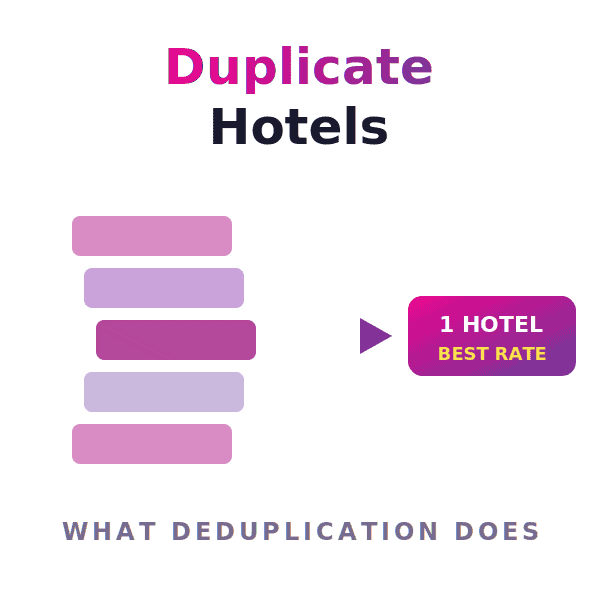
Hotel deduplication is the process of identifying when listings from different suppliers refer to the same physical hotel — and the same room — and merging them into a single record that appears once, with all the supplier rates attached behind it.
Done well, the five Ritz-Carlton rows above collapse into one clean listing. Behind that single result sit all five suppliers’ rates, so your platform can show the customer one hotel at the best available price — and you keep the others as fallbacks. The customer sees clarity; you keep the choice. That’s the whole job: turn many noisy listings into one trustworthy result without throwing away the rate competition underneath.
Hotel deduplication is the process of recognising that listings from different suppliers are the same hotel (and the same room), then merging them into one record shown once — with the supplier rates consolidated behind it so the best price can be surfaced.
Most discussions of deduplication stop at “match the hotels.” But there are actually two layers, and the second is the one that quietly decides your pricing — and it’s the one many systems skip.
“The Two Layers of Deduplication” — a ZentrumHub framework. Property-level gets you a clean list; room-level gets you the best price on the same room.
The room-level layer is where real money sits. If you only deduplicate at the property level, you collapse the five Ritz-Carlton rows into one listing — good — but underneath, you may still be comparing a “Deluxe King” from one supplier against a “Standard Double” from another and picking the cheaper number, even though they’re different rooms. Room-level matching ensures you compare like with like, so the price you show is genuinely the best rate for the room the customer actually wants.
This is the upside nobody mentions: good deduplication isn’t just cosmetic cleanup. At the room level, it becomes a pricing advantage — consistently surfacing the cheapest valid rate for the same room across all your suppliers, which directly improves both conversion and competitiveness.
Because no single signal is reliable, deduplication combines several and weighs them together. A credible approach involves:
None of this is a weekend project. It’s a standing system with its own database, matching logic, accuracy monitoring, and operations team — increasingly assisted by machine learning, but never fully hands-off. Which raises the real question for an OTA: should you build all of this, or inherit it?
Poor deduplication isn’t a cosmetic issue — it has measurable business cost:
A confused customer is a customer who leaves. Duplicate listings make your platform look unreliable, bury the best price, and shift comparison work onto the buyer — and every one of those frictions costs bookings you never see reported as “lost.” It’s one of the quietest revenue leaks in the whole stack.
Here’s the honest framing. Deduplication done properly — master database, multi-signal fuzzy matching, room-level resolution, continuous re-matching, and a review operation — is a substantial, ongoing engineering and operations commitment. It’s hard enough that companies exist to do nothing but this. For most OTAs, building it in-house means diverting serious resources into a problem that doesn’t differentiate you to customers.
The alternative is to inherit it. An aggregator that deduplicates before delivery hands you inventory that’s already clean — the five Ritz-Carlton listings arrive as one, with the rates consolidated behind it — so the duplicates never reach your search results in the first place. You get the benefit without building the machine.
One honest caveat: deduplication quality varies, so it’s worth asking any hotel API aggregator how they do it. Do they match at the room level, not just the property level? Is matching continuous? What’s their accuracy on ambiguous cases? The right answers are what separate clean, trustworthy inventory from a feed that just moved the duplicate problem one layer down.
This is exactly where ZentrumHub takes the problem off your plate. Mapping issues start the moment you add a second supplier — the instant you have two sources, the same hotel arrives twice and someone has to resolve it. Rather than leave that to you, ZentrumHub provides hotel mapping built in, delivered through a dedicated mapping partner, so inventory reaches you already matched and deduplicated.
In practice, that means you don’t run a separate mapping project, stand up a master database, or maintain matching logic as suppliers change their data. The mapping is handled before delivery — so whether you connect two suppliers or a hundred, you get one clean record per hotel without building or buying mapping on the side. That’s the difference between adding suppliers freely and being held back by the duplicate problem every new source creates.
Zentrum Connect deduplicates 100+ suppliers at the property and room level before delivery — so your search results show one clean listing at the best rate, not five confusing ones.
See Zentrum Connect →Zentrum Connect unifies 100+ suppliers and deduplicates them at the property and room level before the inventory ever reaches you — so customers see clean results and you surface the cheapest valid rate every time. 30M+ daily API calls. 99.99% uptime.


Drop your work email and we’ll send you the 12-page report that breaks down where 6–9 months and $215K+ quietly disappear — free.

