

Zentrumhub-blackfont-SVG 2 RateHawk Hotel API

What Is Hotel Mapping? Why the Same Hotel Appears Multiple Times โ€” Explained

hotel-mapping
 

The moment you add a second hotel supplier, the same property starts showing up twice. Hotel mapping is the layer that fixes it โ€” here is exactly how it works, why duplicate listings quietly cost you bookings, and what every OTA needs to know before it scales past one supplier.

๐Ÿงญ How Mapping Works
๐Ÿ’ธ The Real Cost of Bad Data
โ–ถ See the Matching Engine โ†’
TL;DR โ€” Key Takeaways
  • โœ“ Hotel mapping merges the same property from multiple suppliers into one record โ€” so a hotel arriving under three different names and IDs appears once on your site.
  • โœ“ The problem starts the moment you connect a second supplier โ€” each source uses its own property codes and naming conventions, creating duplicates automatically.
  • โœ“ Unmapped inventory confuses travelers, breaks price comparison, and causes booking errors โ€” a single mapping mistake can cost an OTA roughly โ‚ฌ1,500 to fix.
  • โœ“ Industry standards like GIATA MultiCodes give properties a universal ID, and modern hotel data mapping runs on AI/ML with claimed accuracy above 99.9%.
  • โœ“ You don’t have to build mapping yourself โ€” once you scale past two suppliers, ZentrumHub can connect you with a dedicated mapping partner and deliver clean, deduplicated inventory through one API.

Search for a hotel on any large travel site and you expect one clean result per property. Behind that single listing, though, is a problem most travelers never see: the same hotel often arrives from four or five different suppliers, each with its own name, its own ID, and its own slightly different details. Left alone, that one hotel shows up on your site four or five times.

Hotel mapping is the infrastructure that collapses all those versions into one. This guide explains what hotel mapping is, why duplicates appear the instant you add a second supplier, how the matching process works under the hood, and what it costs OTAs that get it wrong โ€” plus the practical path to getting clean inventory without building the mapping layer yourself.

Market Context: Hotel Data & Mapping 2026
1.43M+
properties mapped in GIATA’s hotel database โ€” the industry’s largest mapping reference
GIATA, 2026
~โ‚ฌ1,500
average cost of a single hotel mapping error in Germany, once rebooking & transfers are counted
AltexSoft / GIATA, 2023
2%
of hotels make a major change each year โ€” name, chain, or contact โ€” that mapping must catch
GIATA via AltexSoft
40%+
of global hotel bookings flow through OTAs and digital channels that depend on clean inventory
Phocuswire, 2024
99.9%+
mapping accuracy claimed by leading AI/ML-based hotel mapping providers
Industry reports, 2026

What Is Hotel Mapping?

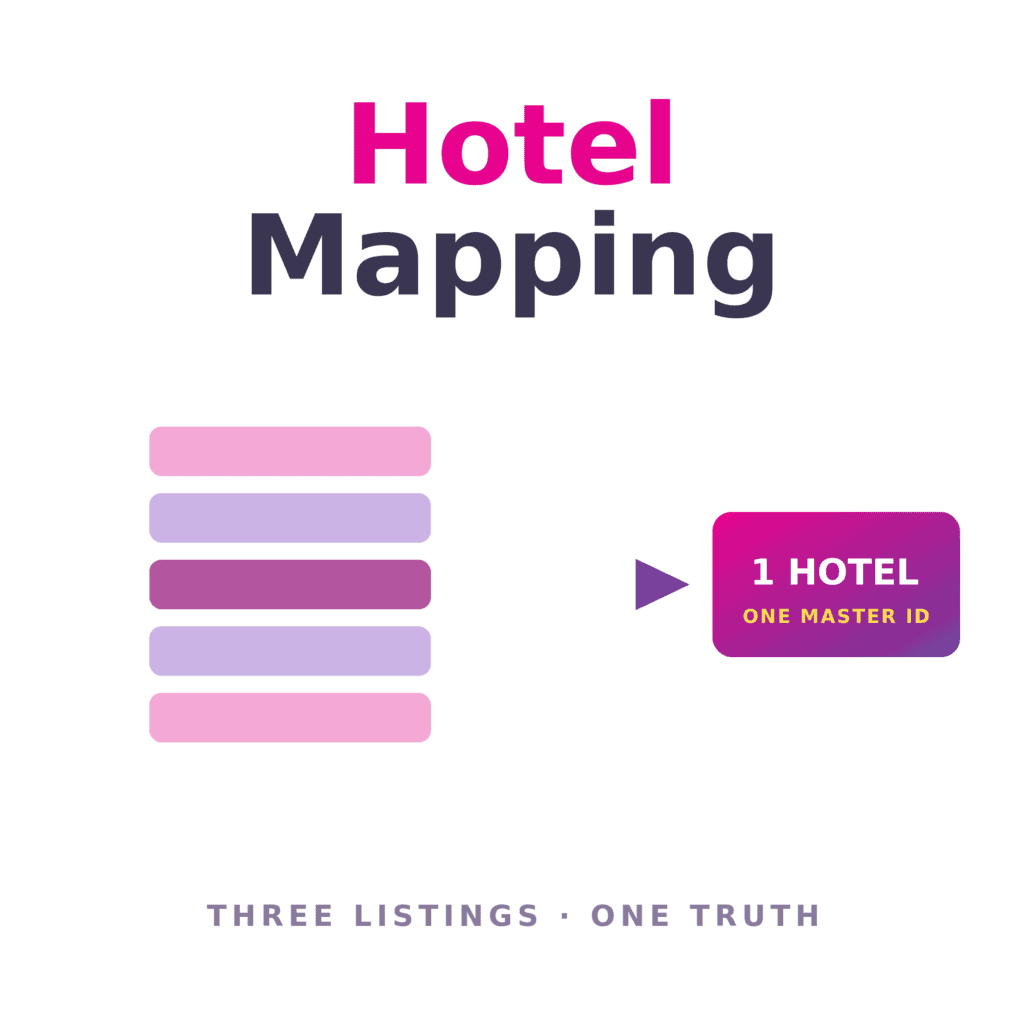
Hotel mapping is the process of matching the same hotel property from multiple suppliers and merging it into a single record under one unique ID.

OTAs and travel platforms source hotel inventory from many channels at once โ€” bedbanks, GDSs, OTA-wholesale APIs, and larger consolidators. Each channel maintains its own catalog, so the same physical hotel is contracted and listed independently across several of them. When you pull all those feeds together, you don’t get one clean list. You get the same hotels repeated, each tagged with a different supplier ID and a slightly different name. This is the foundational problem that sits underneath every hotel API integration the moment more than one source is involved.

Consider one property distributed three ways:

One hotel โ€” three supplier listings โ€” one truth
Supplier A ยท ID 88231
Grand Beach Resort
Supplier B ยท ID HB-4471
Grand Beach Hotel & Spa
Supplier C ยท ID 30962
Grand Beach Resort Dubai
โ†’
Mapped ยท One Master ID
Grand Beach Resort
ZH-ID 7740021

All three are the same building. Without mapping, a traveler sees three separate listings and has no way to tell which to trust. Hotel mapping recognizes that these records describe one property, links them together, and assigns a single identity โ€” so the hotel appears once, with the best available rate surfaced from across all three sources.

Definition: property code

A property code (or supplier hotel ID) is the unique identifier a supplier assigns to each hotel in its catalog. Because every supplier issues its own codes, the same hotel carries a different code in every feed โ€” which is exactly why mapping is needed to reconcile them. You can find this and 75+ related terms in our hotel supplier terminology guide.

Why Duplicate Hotel Listings Happen

Duplicate hotel listings aren’t a bug in your platform โ€” they’re the unavoidable result of multi-supplier sourcing. Here is why they appear.

Every supplier uses its own IDs
There is no shared, universal hotel ID that all suppliers use by default. Each one numbers its catalog independently, so the same hotel has no common key to match on across feeds.
Naming conventions differ
One supplier lists “Hilton Garden Inn Dubai Mall,” another “HGI Dubai โ€” Mall District,” another “Hilton Garden Inn (Downtown Dubai).” Same hotel, three strings that don’t match on text alone.
Details drift between sources
Addresses are formatted differently, geolocation coordinates vary by a few meters, and star ratings or contact details don’t always agree. Each small inconsistency makes automatic matching harder.
Suppliers change constantly
Industry data compiled by AltexSoft puts the figure at around 2% of hotels changing their name, chain affiliation, or contact details every year. A mapping that was correct last quarter can silently break when a property rebrands.
The problem scales with ambition
Duplicate density rises with every supplier you connect. (Illustrative.)
1 supplier
no duplicates
2 suppliers
duplicates begin
5 suppliers
messy results
10 suppliers
unusable without mapping

The practical takeaway: one supplier, no duplicates. Two suppliers, duplicates begin. Ten suppliers, your search results are a mess of repeated hotels unless something is actively reconciling them โ€” which is why mapping becomes unavoidable the moment you get serious about connecting multiple hotel supplier APIs.

The Matching Problem: How Hotel Mapping Actually Works

At its core, mapping answers one deceptively hard question: are these two records the same hotel or not? We call this The Matching Problem โ€” and it’s harder than it looks, because you can’t rely on names or IDs. Here is how a modern mapping engine resolves it, step by step.

๐Ÿ“ฅ
INGEST
Pull all supplier records
โ†’
๐Ÿ“
COMPARE
Geo, address, phone โ€” not names
โ†’
๐Ÿง 
AI SCORE
ML confidence that records match
โ†’
๐Ÿ†”
MASTER ID
One identity, all records linked
โ†’
๐Ÿ”„
RE-CHECK
Stay current as hotels change
1
Ingest supplier data
The system pulls hotel records from every connected supplier via API or file upload, each carrying its own ID, name, address, and attributes.
2
Compare static attributes
Rather than trusting names, the engine compares stable signals that don’t change with wording: geolocation coordinates, address, postal code, and phone number. Two records sharing a precise location and matching contact details are almost certainly the same hotel โ€” even if their names read differently.
3
Score and match with AI/ML
Fuzzy-matching and machine-learning models weigh all the signals together and produce a confidence score that two records refer to one property. High-confidence matches merge automatically; ambiguous cases are flagged for review.
4
Assign a unique ID
Every confirmed property gets one master identifier, and all the supplier records describing it are linked to that ID. This is the single source of truth your search results are built on.
5
Keep it current
Because hotels change, good mapping re-checks continuously and pushes corrections โ€” so the master record stays accurate as suppliers update their data.
Where industry standards fit:

GIATA MultiCodes are universal property codes used across much of the travel distribution ecosystem โ€” a shared ID system that lets different players exchange hotel data without re-mapping from scratch. GIATA’s database alone maps over 1.43 million properties, which is why its codes have become a de facto industry reference.

Mapping is only one of the costs that lands after you connect a new supplier. For the full picture, our free report The 5 Hidden Costs of Adding a New Hotel Supplier breaks down all five โ€” integration overrun, hotel mapping, ongoing maintenance, silent booking failures, and opportunity cost โ€” with the honest math on when building it yourself makes sense (no email required).

Hotel Mapping vs Room Mapping

Hotel mapping solves duplication at the property level. But the same problem exists one level deeper โ€” at the room level โ€” and solving the hotel doesn’t solve the room.

Hotel mapping matches the building. Room mapping matches the room types inside it. A traveler can land on the correct, deduplicated hotel and still see a confusing list of overlapping room options, because each supplier names rooms differently.

One room โ€” three supplier names โ€” one category
SUPPLIER A
Deluxe King Room
SUPPLIER B
King Deluxe
SUPPLIER C
Superior King Room
โ†’
Mapped room category
1 King ยท Deluxe
๐Ÿ› 1 King Bed ๐Ÿ’ฐ Best rate shown

Listed as three separate products, these fragment your price comparison and bury the best offer. Room mapping standardizes room attributes โ€” room type, bed type, view, board basis, occupancy, amenities โ€” so identical rooms are grouped and the cheapest rate for each true room type rises to the top. Here is how the two compare:

Dimension Hotel Mapping Room Mapping
What it matchesThe property / buildingRoom types within a property
Duplicate it removesSame hotel listed multiple timesSame room under different names
Key matching signalsGeo, address, phone, postal codeRoom name, bed type, view, occupancy
Example collision“Grand Beach Resort” vs “…Hotel & Spa”“Deluxe King” vs “King Deluxe”
When you feel the painSearch results pageRoom selection / checkout
Typical difficultyHigh โ€” but a solved categoryHigher โ€” less standardized data

The two work best together. Hotel mapping gets the traveler to the right hotel; room mapping lets them confidently pick the right room at the best price. For the deeper layer, see our full guide to hotel room mapping.

Why Hotel Mapping Matters for OTAs

Mapping looks like a back-office data chore. In practice, hotel mapping for OTAs touches conversion, margin, and trust at every step of the funnel. With Phocuswire reporting that over 40% of global hotel bookings now flow through OTAs and digital channels, the quality of your underlying data is no longer a back-office concern โ€” it’s a revenue one.

๐ŸŽฏ
Cleaner search, higher conversion
Duplicate listings force travelers to compare the same hotel against itself. That friction kills confidence and drives abandonment. One clean result per hotel makes the decision easy.
๐Ÿ’ฐ
Better rates and margins
When the same hotel arrives from several suppliers, each has a different net rate. Mapping lets you compare those rates for one property โ€” surface the lowest to win the booking, or the higher-margin offer when you can.
โœ…
Fewer booking errors
Mismatched or stale property data leads to wrong bookings, complaints, and compensation costs. Accurate mapping cuts that failure rate directly.
๐Ÿค–
A foundation for AI
Recommendation engines, personalization, and analytics all depend on structured, deduplicated data. Feed an AI model duplicate properties and it can’t reliably understand what’s what. Clean mapped data is the foundation everything else is built on.

Adding more suppliers and watching duplicates pile up?

That’s the signal you’ve outgrown manual fixes. ZentrumHub delivers clean, deduplicated hotel inventory from 100+ suppliers through one API โ€” and can connect you with a dedicated mapping partner when you need it.

Explore Zentrum Connect โ†’

The Real Cost of Bad Mapping

Bad mapping is expensive in ways that never appear on an invoice. The cost shows up as cancelled bookings, support hours, and lost trust.

Anatomy of a โ‚ฌ1,500 mapping error

AltexSoft, citing GIATA, estimates the average mapping error in Germany at roughly โ‚ฌ1,500. Here is where that money goes when a traveler is booked into the wrong property:

Cancel
Refund or eat the cost of the wrong booking
Rebook + transfer
Pay for the correct hotel and the traveler’s transfer
Operations + trust
Support time, plus the reputational hit
Wrong-hotel bookings
The worst failure: a traveler books, arrives, and it’s the wrong property โ€” or the room they paid for doesn’t exist as described. Every one of these is a refund, an apology, and often a lost customer.
Engineering time drain
When mapping isn’t handled by a system, developers spend their weeks manually identifying and correcting duplicate records instead of building product. That’s opportunity cost on your most expensive team.
Stale data
Around 2% of hotels change materially each year. Without continuous re-mapping, those changes go uncaught and you sell outdated information โ€” which loops straight back into booking errors and complaints.

The pattern is consistent: mapping you skip doesn’t save money โ€” it defers a larger bill to later, paid in refunds, churn, and engineering hours.

Manual vs Automated Hotel Mapping

You can map inventory two ways. Only one of them scales.

Manual mapping means staff comparing supplier records by hand and matching them in spreadsheets or an internal tool. It’s viable at tiny scale, but slow, error-prone, and it collapses the moment your inventory or supplier count grows. Every new supplier multiplies the work, and every hotel that changes must be caught by a human.

Automated mapping uses AI/ML to compare attributes, score matches, and merge records continuously โ€” with leading providers claiming 99.9%+ accuracy and mapped inventory turned around in as little as 24 hours. It handles millions of properties, re-checks constantly, and frees your engineers entirely.

Factor Manual Mapping Automated Mapping
SpeedSlow (days to weeks)Fast (continuous / ~24 hrs)
AccuracyHuman-error prone99.9%+ claimed
Scales to many suppliersNoYes
Handles hotel changesOnly if caught manuallyRe-checked automatically
Engineering burdenHigh and ongoingMinimal
Viable at scaleNoYes

For any OTA running more than a couple of suppliers, automated mapping isn’t a luxury โ€” it’s the only realistic option.

How to Get Hotel Mapping for Your OTA

You don’t have to build a mapping engine to get clean inventory. There are three practical routes.

1. Build it in-house
Possible if you have a strong engineering team and time to spare โ€” but you’re committing to building and maintaining a matching system, an ID database, and a continuous re-check pipeline forever. For most OTAs, the cost and distraction outweigh the control.
2. License a dedicated mapping provider
Specialist mapping platforms handle deduplication as a service or via API. This is the right call when mapping is your specific, isolated problem and your inventory is already sorted.
3. Use an aggregator that delivers already-clean inventory
The moment your real goal is more inventory through fewer integrations, an aggregator solves mapping and supply together. ZentrumHub connects you to 100+ hotel suppliers through a single API and delivers deduplicated inventory โ€” and when you need dedicated mapping, ZentrumHub can connect you with a specialist mapping partner. You get clean data and broad coverage without building or maintaining the layer yourself.

The deciding factor is usually your supplier count. One or two suppliers and strong engineering? In-house can work โ€” though it’s worth weighing the full build vs buy cost of hotel mapping first. Scaling past two suppliers and wanting coverage fast? An aggregator that hands you clean inventory through one integration is the path of least resistance โ€” and least ongoing cost. For a wider view of who supplies what, see our guide to the best hotel API providers in 2026.

Frequently Asked Questions

What is hotel mapping in simple terms?
Hotel mapping is the process of recognizing when the same hotel has been listed by different suppliers and merging those listings into one. Because OTAs source inventory from many suppliers โ€” and each uses its own hotel names and IDs โ€” the same property shows up multiple times. Mapping matches those records using stable signals like location and address, then assigns one unique ID so the hotel appears a single time on your site, with the best available rate surfaced from across all the suppliers that offer it.
Why do OTAs get duplicate hotel listings?
Duplicates happen because there’s no universal hotel ID shared across all suppliers by default. Each supplier โ€” bedbanks, GDSs, OTA-wholesale APIs, consolidators โ€” maintains its own catalog with its own IDs and naming conventions. When an OTA combines these feeds, the same hotel arrives several times under different names and codes with no common key to link them. The problem starts as soon as you connect a second supplier and grows with every supplier you add, which is why mapping becomes essential at scale.
What’s the difference between hotel mapping and room mapping?
Hotel mapping matches and deduplicates at the property level โ€” making sure one hotel appears once. Room mapping works one level deeper, matching identical room types inside a hotel that different suppliers name differently, like “Deluxe King” versus “King Deluxe.” Hotel mapping gets the traveler to the right hotel; room mapping ensures they can compare room options cleanly and see the best price for each genuine room type. They solve related but distinct problems and work best together.
How accurate is automated hotel mapping?
Leading AI/ML-based mapping providers claim accuracy figures of 99.9% and higher, with some quoting up to 99.999%. Accuracy matters because mapping errors are expensive โ€” a single mistake can cost an OTA around โ‚ฌ1,500 once cancellation, rebooking, and transfer costs are counted. Automated systems reach this accuracy by comparing stable attributes (geolocation, address, contact details) rather than names, scoring matches with machine learning, and continuously re-checking as hotels change. No system is perfect, so the best providers combine automation with checks on ambiguous cases.
What is GIATA MultiCodes and why does it matter?
GIATA MultiCodes are universal property codes that act as a shared ID system across much of the travel distribution ecosystem. Because many suppliers, bedbanks, GDSs, and OTAs reference the same MultiCode for a given hotel, players can exchange data without re-mapping everything from scratch. GIATA’s database maps over 1.43 million properties, which is why its codes have become a de facto industry reference for hotel identity. For an OTA, the practical value is a common backbone that makes matching across suppliers faster and more reliable.
Does ZentrumHub provide hotel mapping?
ZentrumHub’s focus is delivering clean, deduplicated hotel inventory from 100+ suppliers through a single API, so the duplicates created by multi-supplier sourcing are already handled by the time inventory reaches you. When an OTA needs dedicated hotel or room mapping as a standalone capability, ZentrumHub can connect you with a specialist mapping partner. The practical result is the same: you get accurate, mapped inventory and broad coverage without building or maintaining a mapping engine yourself.

Adding a second supplier? Don’t inherit a duplicate problem.

ZentrumHub gives your OTA clean, deduplicated inventory from 100+ hotel suppliers through one API โ€” and connects you with a dedicated mapping partner when you need one. 900K+ hotels. 3M+ room nights booked. 99.99% uptime.


Latest Travelโ€จIndustry Blogs!

hotel-mapping
hotel deduplication
hotel API maintenance
Free ebook download

Wait โ€” something's for you ๐Ÿ‘‹

Built for travel agencies
The 5 Hidden
Costs
of Adding a New Hotel Supplier
$
$215K+integration cost
โ—ท
6โ€“9 monthsper supplier
โŠ˜
2โ€“7% bookingsfail silently
โœ“
10โ€“15% devcapacity drain
"What CTOs and CEOs miss when they say, 'let's just integrate one more.'"
12-page report ยท 2026 edition

The real cost most OTAs never calculate.

Drop your work email and we’ll send you the 12-page report that breaks down where 6โ€“9 months and $215K+ quietly disappear โ€” free.

Your email is safe. Unsubscribe anytime.