TL;DR — Key Takeaways
- ✓ Hotel room mapping matches identical room types across suppliers — so “Deluxe King,” “King Deluxe,” and “Superior King Room” collapse into one comparable room.
- ✓ It’s the layer below hotel mapping: hotel mapping gets the right building, room mapping gets the right room — and most platforms skip it.
- ✓ Without it, your platform compares unlike rooms and can surface the wrong “cheapest” price — quietly leaking margin and trust.
- ✓ Done right, room mapping surfaces the genuinely lowest rate for the exact same room across every supplier — a direct conversion and pricing advantage.
- ✓ You don’t have to build it — ZentrumHub delivers room-level deduplicated inventory through one API, with mapping handled by a dedicated partner before delivery.
Say you’ve already solved the bigger, more visible problem: the same hotel no longer appears five times in your search results. Good. But click into that one clean hotel and look at the room list. There’s a strong chance the same room is still listed two or three times — “Deluxe King Room” from one supplier, “King Deluxe” from another, “Superior King Room” from a third — each at a slightly different price.
Hotel room mapping is the layer that fixes this. It matches room types across suppliers the way hotel mapping matches properties — and it’s where the real pricing advantage lives. This guide explains what room mapping is, why it’s harder than property-level mapping, how the matching actually works, and how to get it without building a mapping engine yourself. If you haven’t yet, start with our companion guide on what hotel mapping is for the property-level foundation.
What Is Hotel Room Mapping?
Hotel room mapping is the process of matching identical room types from different suppliers and merging them into one standardized room, so the same room appears once with the best available rate.
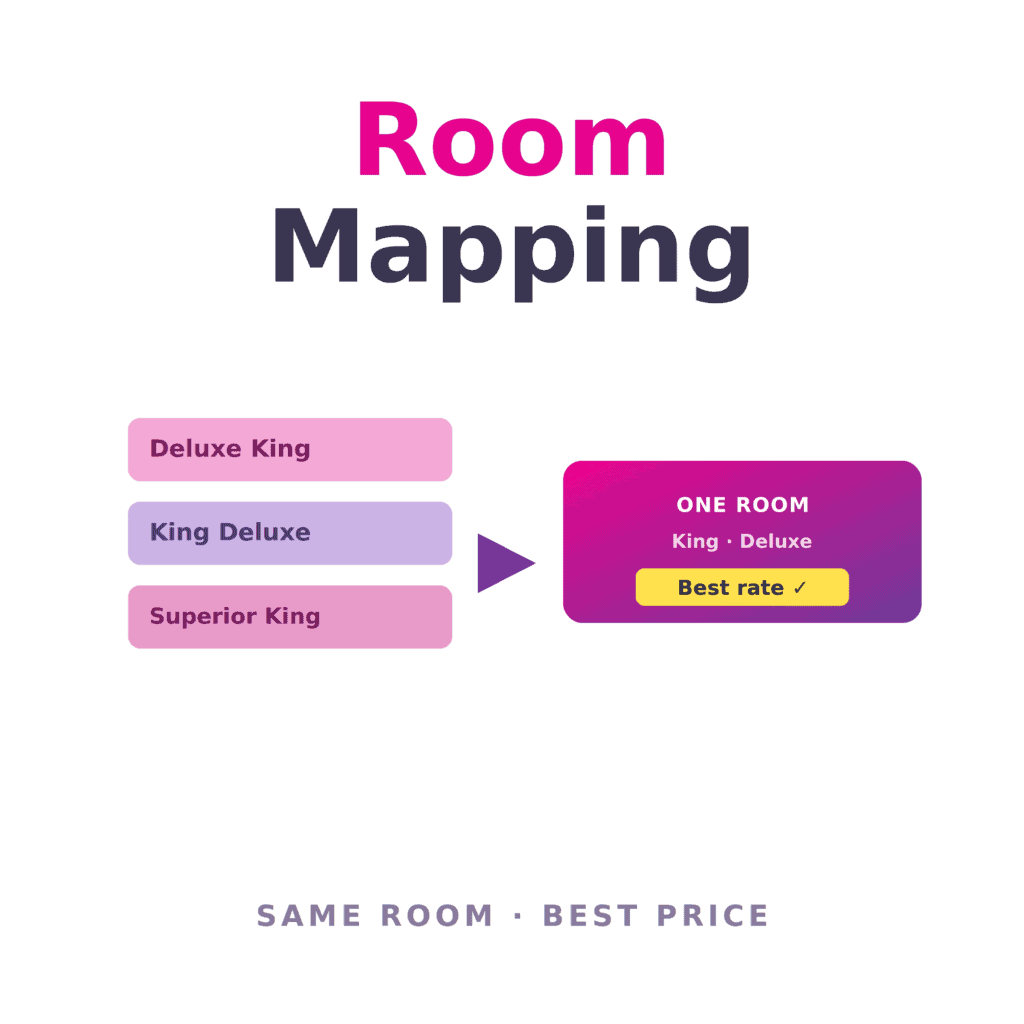
Every supplier describes rooms in its own words. The same physical room — one king bed, deluxe category, city view, breakfast included — might be called “Deluxe King” by one source, “King Deluxe Room” by another, and “Superior King, 1 King Bed” by a third. To your platform, those look like three different products. Room mapping recognizes they are one, and unifies them.
Here is what that consolidation looks like:
One room — three supplier names — one comparable category
Supplier A · $182
Deluxe King Room
Supplier B · $171
King Deluxe
Supplier C · $178
Superior King, 1 King Bed
→
Mapped Room · One Category
King · Deluxe · City View
Best rate: $171
All three rows are the same room. Until they’re mapped, your platform can’t reliably tell that the $171 from Supplier B and the $182 from Supplier A are the same product — so it can’t confidently put the cheaper one in front of the customer. Room mapping makes that comparison possible, and surfaces the genuinely lowest valid rate.
Definition: room type
A room type is a sellable room category defined by its attributes — bed configuration, room class, view, board basis, and occupancy. Two listings are the same room type when these attributes match, regardless of what each supplier calls it.
Room Mapping vs Hotel Mapping
These two are easy to confuse, and the difference matters. Hotel mapping deduplicates at the property level — making sure one hotel shows once. Room mapping works one level deeper, inside that hotel, matching the rooms. You need both, in that order.
| Dimension |
Hotel Mapping |
Room Mapping |
| What it matches | The property / building | Room types inside a property |
| Question it answers | “Same building?” | “Same sellable room?” |
| Matching signals | Geo, address, phone, postal code | Bed type, view, class, board, occupancy |
| Example collision | “Grand Beach Resort” vs “…Hotel & Spa” | “Deluxe King” vs “King Deluxe” |
| Where you feel it | Search results page | Room selection & checkout |
| Difficulty | High | Higher — less standardized data |
| Main payoff | Clean, trustworthy listings | Cheapest valid rate per room |
Property-level mapping gets you a clean list. Room-level mapping gets you the best price on the same room. Skip the second and you’ve solved the visible problem while leaving the profitable one untouched.
Why Room Mapping Is Harder Than Hotel Mapping
Hotel mapping has anchors: a hotel sits at fixed coordinates, with a stable address and phone number. Rooms have none of that. A room is just words and attributes — and suppliers describe them with almost no shared standard. That’s what makes room mapping the harder layer.
No physical anchor
There’s no latitude/longitude for a room. The only evidence you have is the supplier’s description string and a handful of attribute fields — and both vary wildly.
Dozens of names for one room
The same room can be written dozens or hundreds of ways across suppliers — abbreviations (“dlx qn”), reordered words, marketing adjectives, and localized language all describing one product.
Subtle but real differences
“Deluxe King” and “Deluxe King with Balcony” look almost identical but are not the same sellable room. Over-merging is as damaging as under-merging — you’d sell a room the guest didn’t book.
Board basis and policy hide in the name
“Room only” vs “breakfast included” vs “non-refundable” can be baked into the room string or split into separate fields. Getting this wrong means comparing a refundable breakfast rate against a non-refundable room-only rate as if they were equal.
This is why room mapping leans on AI and machine learning rather than rules. There are too many variations to script by hand — the system has to learn what makes two descriptions the same room and what makes them genuinely different.
Room mapping is one of the costs that arrives the moment you add suppliers — and it’s rarely the one teams budget for. Our free report The 5 Hidden Costs of Adding a New Hotel Supplier walks through all five, including the mapping and maintenance load, with the honest math on when building it yourself is worth it (no email required).
The Attributes That Define a Room
Two rooms are “the same” only when their core attributes match. These are the signals a mapping engine weighs — and the ones that, if ignored, lead to bad merges.
🛏 Bed configuration
One king, two queens, a twin, a sofa bed — the single most decisive attribute. A “King” and a “Twin” are never the same room, whatever else matches.
⭐ Room class
Standard, superior, deluxe, suite. Marketing words vary, but the tier the supplier intends has to line up for a valid match.
🌊 View
Ocean, city, garden, pool. A sea-view room and a city-view room at the same class and bed type are still different sellable products.
🍳 Board basis
Room only, breakfast, half board, full board, all-inclusive. This changes the price meaningfully and must be matched, not assumed.
👥 Occupancy
Max adults and children the room sleeps. A double sold for two isn’t the same as the same room configured for three.
🧩 Special features
Balcony, accessibility, connecting rooms, smoking status. Small flags that quietly make two near-identical rooms genuinely distinct.
The art of room mapping is weighing these together: enough must match to merge, but a single decisive difference — bed type, board basis, a balcony — has to keep two rooms apart. Get the balance wrong and you either fragment your listings or sell a room the guest didn’t choose.
Why Room Mapping Matters: The Pricing Advantage
Hotel mapping cleans up your listings. Room mapping makes you money. With travelers comparing prices across roughly six platforms before booking, per channel-management research from Aiosell, the platform that shows the clearly cheapest valid rate for the room a traveler actually wants is the one that wins the booking.
💰
The cheapest valid rate, every time
When the same room from every supplier is grouped, your platform can compare like with like and surface the genuinely lowest price — not the lowest-looking one that’s actually a different room.
🎯
Higher conversion
A clean, comparable room list lets travelers decide with confidence instead of puzzling over near-duplicate options. Clarity at the room level is where hesitation turns into bookings.
📊
Smarter, dynamic markups
Once you can see every supplier’s rate for the same room, you can set dynamic markups against real market pricing instead of flat, guessed margins — protecting both competitiveness and profit.
🛠
Fewer errors, less manual work
Accurate room matching cuts wrong-room bookings and the compensation they trigger, and removes the manual cleanup that otherwise falls on your team — letting you add suppliers without adding overhead.
Want the cheapest valid rate surfaced automatically?
Zentrum Connect deduplicates inventory at the property and room level before it reaches you — so your platform shows one clean room at the best price, not three near-duplicates.
Explore Zentrum Connect →
How to Get Room Mapping for Your OTA
Room mapping is harder to build than hotel mapping, so the build-versus-buy decision tilts even further toward buying or inheriting. There are three routes.
1. Build it in-house
Means building NLP-style parsing, an ML matching model, a verification workflow, and continuous re-matching — then maintaining it as suppliers change room names forever. Realistic only with serious data-science resources and a reason to own it.
2. License a dedicated room-mapping provider
Specialists offer room mapping as an API. The right fit when mapping is your only gap and your inventory and supply are already handled. Ask how they match — room level, not just property level — and whether matching is continuous.
3. Use an aggregator that delivers room-level clean inventory
When your goal is more inventory through fewer integrations, an aggregator solves supply and mapping together.
ZentrumHub connects you to 100+ suppliers through one API and delivers inventory deduplicated at both the property and room level — with mapping handled by a dedicated partner before delivery, so the duplicates never reach your search results.
For most OTAs, room mapping is exactly the kind of hard, undifferentiated infrastructure worth inheriting rather than building. For a wider view of sourcing options, see our guide to the best hotel API providers in 2026.
Frequently Asked Questions
What is hotel room mapping?
Hotel room mapping is the process of matching identical room types from different suppliers and merging them into one standardized room. Because each supplier names rooms differently — “Deluxe King,” “King Deluxe,” “Superior King Room” — the same room appears multiple times in raw inventory. Room mapping parses each listing into attributes like bed type, view, class, and board basis, then groups the ones that are genuinely the same room so your platform can show it once and surface the cheapest valid rate across all suppliers.
What’s the difference between room mapping and hotel mapping?
Hotel mapping works at the property level — making sure the same hotel appears once across suppliers. Room mapping works one level deeper, matching the room types inside that hotel. Hotel mapping uses physical anchors like geolocation and address; room mapping has no physical anchor, so it relies on parsing attributes like bed type, view, and board basis. You need both: hotel mapping gets the traveler to the right hotel, and room mapping ensures they see one clean room list at the best price.
Why is room mapping harder than hotel mapping?
A hotel has fixed coordinates, a stable address, and a phone number to anchor matching. A room has none of that — only a description string and a few attribute fields, which suppliers write in dozens of different ways. On top of that, small differences matter: “Deluxe King” and “Deluxe King with Balcony” are different sellable rooms, so the engine must avoid both under-merging and over-merging. That combination of no anchor, high naming variation, and low error tolerance is why room mapping relies on AI/ML rather than simple rules.
How does room mapping help me show the cheapest price?
Without room mapping, your platform can’t be sure that a low price from one supplier is for the same room as a higher price from another — so it might surface a cheap-looking rate that’s actually a different, lesser room. Room mapping groups the identical room across all suppliers, letting you compare like with like and display the genuinely lowest valid rate for the exact room the customer wants. That accurate comparison is both a conversion advantage and the basis for smarter, dynamic markups.
Should I build room mapping or use a provider?
Building room mapping means standing up attribute parsing, a machine-learning matching model, verification, and continuous re-matching — then maintaining it as suppliers constantly rename rooms. It’s harder than property-level mapping and rarely differentiates an OTA to its customers, so most are better off inheriting it. You can license a dedicated room-mapping API, or use an aggregator like ZentrumHub that delivers inventory already mapped at the room level, so duplicates never reach your search results.
Does ZentrumHub handle room-level mapping?
Yes. ZentrumHub delivers inventory deduplicated at both the property and room level through a single API, with mapping handled by a dedicated partner before delivery. That means the same room from multiple suppliers arrives already matched and consolidated, so your platform shows one clean room with the cheapest valid rate — without you building parsing logic, a matching model, or a re-matching pipeline yourself.
One room. One listing. The best rate.
Zentrum Connect unifies 100+ suppliers and deduplicates them at the property and room level before inventory ever reaches you — so customers see clean rooms and you surface the cheapest valid rate every time. 30M+ daily API calls. 99.99% uptime.