






Table of Contents
The sticker price on a hotel booking API is never the real price. Setup is one line; per-booking fees, payment margins and maintenance are the three that decide your unit economics for years. Here is what each layer actually costs — and the math that says build or buy.
“How much does a hotel booking API cost” has no single number, and any vendor who gives you one is quoting the layer that flatters them. The honest answer is a range built from four cost layers and shaped by which pricing model you sign — and the model, not the headline price, is what determines whether the API is cheap or ruinous at scale.
This guide breaks the cost into its real components, gives usable ranges for each, and lays out the build-vs-buy math so you can judge any quote against the alternative of doing it yourself. With OTAs carrying 40%+ of global hotel bookings (Phocuswright, 2024), the API you pay for becomes load-bearing infrastructure fast, and a pricing mistake compounds with every booking that runs through it.
A hotel booking API typically costs anywhere from a low monthly SaaS fee to six figures a year, depending on the pricing model and your booking volume. Flat-SaaS platforms charge a predictable subscription with no per-booking fee, so cost is decoupled from volume. Per-booking and revenue-share models charge little or nothing upfront but take a cut of every transaction, so cost rises directly with your success. Building your own instead of licensing one runs roughly $215K and 6–9 months per supplier integration, plus permanent maintenance. The right figure for you depends less on the sticker price than on which model matches your growth curve.
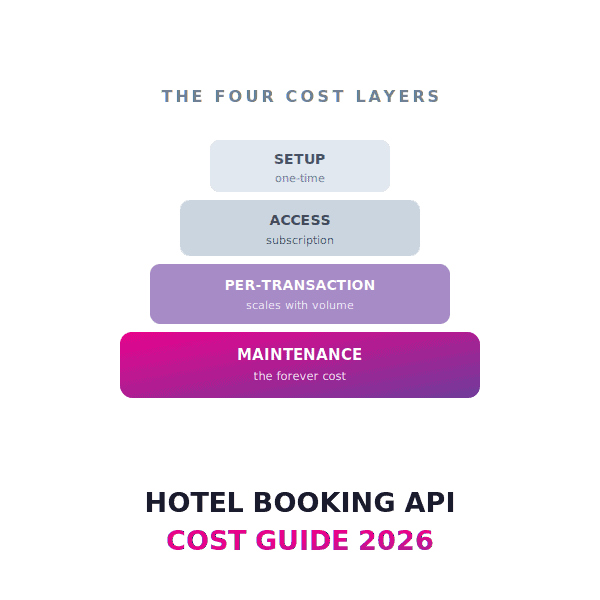
Every hotel booking API price is built from four layers. Vendors love to quote the first and stay quiet on the other three — which is exactly backwards, because the last three are where the real money goes.
The Four Cost Layers. Setup gets quoted; access, per-transaction and maintenance decide the real total.
The same capability is sold three ways, and the model decides your unit economics as you grow.
| Model | How you pay | Best when | Watch out for |
|---|---|---|---|
| Flat SaaS | Fixed subscription, no per-booking fee | You have or expect volume | A real cost from day one, pre-revenue |
| Per-booking | A fee on each transaction | Very low volume / testing | Becomes a growth tax at scale |
| Revenue share | A % of booking value | Almost never, for the buyer | Scales fastest against you |
| Build in-house | $215K+ & 6–9 months per supplier | Single supplier, deep pockets | Permanent maintenance burden |
Also Read: Hotel API aggregator pricing: how the aggregation layer is priced →
Almost never in the sense people mean. Searches for a “free hotel booking API” are common, but a genuinely free API with live, bookable inventory is rare — and for a simple reason: the suppliers behind it are commercial businesses, and real transactional access carries real cost. What you will find labelled “free” usually falls into one of three buckets. Static content APIs — hotel descriptions and images, no live rates or booking. Sandbox tiers — free to test against fake data, not to take real bookings. Limited trials — a capped number of calls before pricing kicks in. All three are useful for evaluation, none is a free way to run a business. The honest reframe is not “free vs paid” but “which pricing model” — and there, a flat-SaaS API with no per-booking fee and a real sandbox from day one is often the most cost-effective path, because you build and test at no marginal cost and only pay predictable subscription once live.
Any API price should be judged against the cost of building the same thing yourself, because that is the true alternative. The build figure is not the headline salary of one engineer — it is the fully loaded cost of a production-grade integration: search, recheck, book, manage, plus idempotency, retry, failover, deduplication and error handling, for one supplier. That runs roughly $215K and 6–9 months. Then multiply, because one supplier is rarely enough — each additional source is another build of similar size. Then add maintenance, which never ends: supplier APIs change constantly, and every change is engineering time you keep spending forever. Against that baseline, a licensed booking API spanning 100+ suppliers for a predictable subscription is not the expensive option — it is the one that collapses the per-supplier build and the perpetual maintenance into a single line. The deeper break-even, supplier by supplier, is laid out in direct supplier contracts vs aggregator.
Flat SaaS, zero per-booking fees, 100+ suppliers on one integration — priced on your real volume.
Explore the Hotel Booking API →Five costs rarely appear on the pricing page and reliably appear on the invoice. Payment-gateway margins — on net-rate models, the spread on card processing quietly eats margin per booking. Overage charges — call or booking volumes above your tier, priced at a premium. Support tiers — the response-time you actually need often sits above the default. Price escalation — annual uplift and re-quote triggers that a contract silent on the subject leaves to the vendor. Exit costs — data and mapping export fees that function as a toll if you ever leave. None of these is inherently dishonest, but all of them belong in your total-cost calculation before signing, not after. Modelling every candidate at two and five times your current volume, with these five included, is the only way the real price becomes visible.
ZentrumHub prices the hotel booking API on flat SaaS with zero per-booking fees — which places it deliberately on the side of the pricing table that does not tax growth. Across the four cost layers: setup is light because suppliers are pre-integrated; access is a predictable subscription; there is no per-transaction fee to scale against your success; and maintenance is absorbed by ZentrumHub, not billed back to you, because the platform handles every supplier API change permanently. One integration reaches 100+ suppliers and 900,000+ deduplicated hotels, so the per-supplier build cost disappears entirely, and bring-your-own-licence means your supplier rates stay yours rather than being marked up inside the API. The honest positioning: for a pre-revenue startup, a flat subscription is a real day-one line item — but for any platform with volume or a growth plan, decoupling cost from bookings is the model that wins over any realistic horizon. Exact pricing is quoted against your real volume, not gated behind a mandatory call to reveal a number.
Also Read: Hotel Booking API Integration: the four-call sequence, step by step →
Flat SaaS, zero per-booking fees, 100+ suppliers, maintenance absorbed — no call required to see a number.
It ranges from a modest monthly SaaS fee to six figures a year, driven by the pricing model and your booking volume rather than a single sticker price. Flat-SaaS platforms charge a predictable subscription with no per-booking fee; per-booking and revenue-share models charge less upfront but take a cut of every transaction, so cost scales with volume. Building your own instead runs roughly $215K and 6–9 months per supplier plus permanent maintenance. Model any quote at your expected future volume, because the model matters more than the headline number.
Rarely, in the sense of live, bookable inventory at no cost — because the suppliers behind a booking API are commercial. What is labelled “free” is usually a static content API (no live rates or booking), a sandbox tier (fake data for testing), or a limited trial (capped calls before pricing starts). All are useful for evaluation, none is a free way to operate. The more useful question is which pricing model fits you; a flat-SaaS API with a free sandbox lets you build and test at no marginal cost before paying a predictable subscription.
For any platform with volume or a growth plan, flat SaaS with no per-booking fee is usually best, because it decouples cost from bookings — your unit economics improve as you scale rather than degrade. Per-booking models can suit very low-volume testing, but they become a growth tax as bookings rise, and revenue-share scales fastest against the buyer. The exception is a pre-revenue startup, for which a fixed subscription is a real day-one cost; even then, the moment volume arrives, flat SaaS tends to win. Always model each option at two and five times your current volume.
Because a production-grade integration is far more than pulling availability. It includes the full four-call sequence — search, recheck, book, manage — plus idempotency, retry, failover, deduplication and error handling, all of which are their own subsystems. That runs roughly $215K and 6–9 months for a single supplier, and each additional supplier is a similar build. On top sits permanent maintenance, because supplier APIs change constantly. Licensing one API that spans many suppliers replaces both the per-supplier build and the perpetual maintenance with a single predictable cost.
Five appear on the invoice more often than the pricing page: payment-gateway margins on net-rate bookings, overage charges above your tier, support tiers above the default response time, annual price escalation, and exit or data-export fees. None is necessarily unfair, but all belong in your total-cost calculation before you commit. The way to surface them is to ask for a fully loaded quote at your expected future volume — two and five times today’s — with every fee included, and to read the escalation and offboarding terms in the contract, not the brochure.


Drop your work email and we’ll send you the 12-page report that breaks down where 6–9 months and $215K+ quietly disappear — free.

