






Table of Contents
The order your results appear in is a commercial decision, whether you make it deliberately or not. Sort by lowest price alone and your volume flows to whichever supplier happens to be cheapest, never to the deals you negotiated. This guide shows how to turn result order into a lever you control.
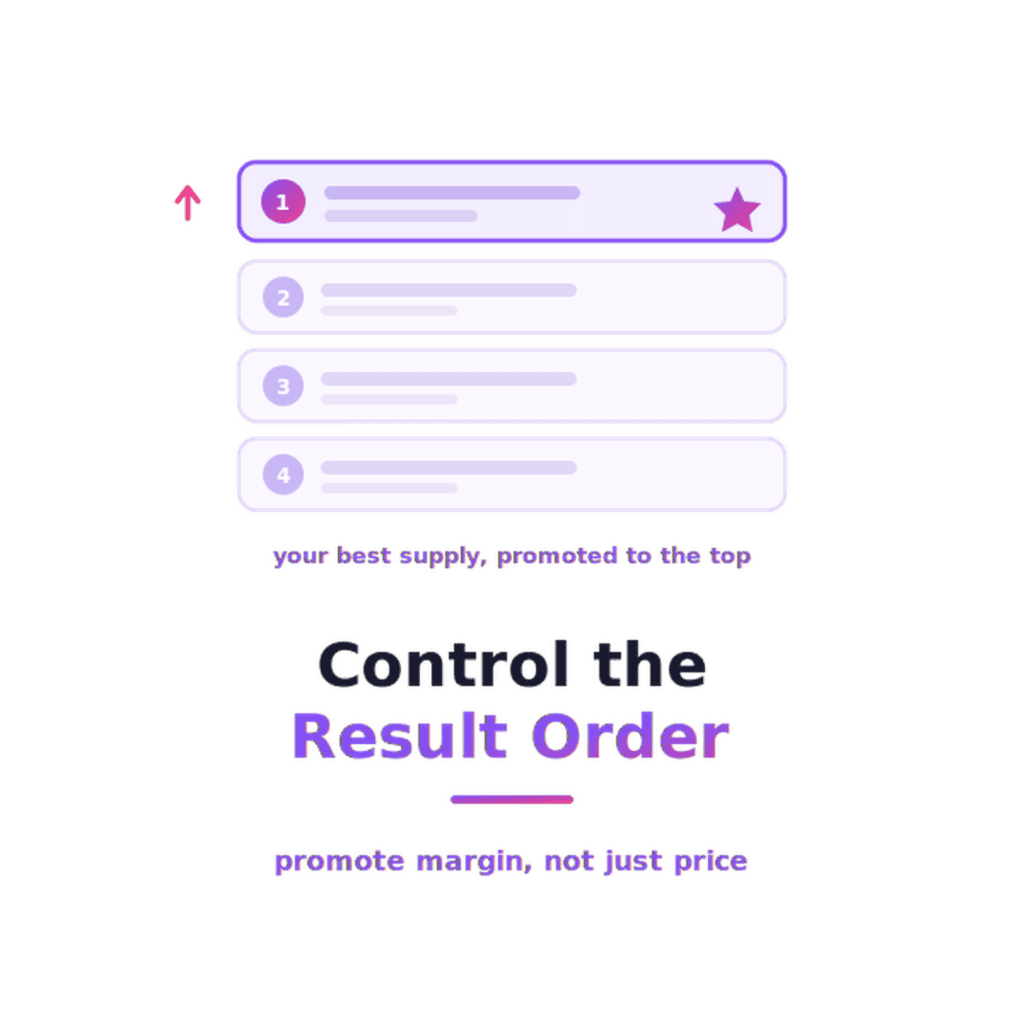
Result relevance is the ability to control the order hotels and rates appear in your search results, rather than defaulting to lowest price alone. It lets you promote a preferred supplier that pays you better, favour your own directly contracted rates, order by the margin a result earns you and gate low-quality content out of the top spots. Because most bookings come from the first results an agent sees, ordering is one of the most direct commercial levers a B2B platform has.
Written for B2B travel agency owners and founders
Almost every booking an agent makes comes from the top handful of results. They search, they glance at the first few options and they book one of them. That behaviour is not a quirk, it is how people use search. It means the order your results appear in quietly decides where your volume goes. If you are not choosing that order deliberately, something else is choosing it for you, usually a simple sort by lowest price that ignores everything you know about which supply is actually best for your business.
This guide is written for the owner who wants to take that decision back. It explains why result order is a commercial lever, what it costs to leave it on autopilot, then how the relevance controls inside B2B travel agency software let you order results around your commercial goals rather than price alone.
Result order matters because attention is front-loaded. The first result gets far more bookings than the fifth, the fifth gets far more than the twentieth and whatever sits at the top captures a disproportionate share of volume. This gives ordering real commercial power. Move a supplier up and it wins more bookings. Move it down and it wins fewer. The ranking is not a neutral display choice, it is a decision about where your business flows.
Most platforms hand that power to a single default rule, lowest price first, then leave it there. That feels fair and simple, but it means every commercial insight you hold about your suppliers is thrown away at the exact moment it matters most. The supplier who pays you a better commission, the one who confirms reliably, the direct contract you fought for, none of them get any advantage in the ordering unless you build one. Taking control of result order is how you put your commercial knowledge back into the results your agents actually book from.
Sorting only by lowest price looks like it serves the customer, but it quietly works against your business in three ways. It sends volume to whichever supplier is cheapest on a given search, which is often not the supplier who earns you the most or serves you the most reliably. It undermines any better-commission or override deal you negotiated, because those deals only pay off when the supplier actually wins bookings, which a pure price sort rarely allows. It can also promote a cheap but low-quality result with poor content or unreliable terms above a slightly dearer but far better option.
The result is a platform optimised for a number that is not the one you care about. You care about margin, reliability and the value of your supplier relationships, while a price-only sort optimises for headline price regardless of any of those. Relevance controls exist to close that gap, letting you order results around what actually matters to your business while still keeping a competitive price in front of the agent.
The most common relevance move is to promote a preferred supplier. You may have a supplier who pays you a better commission, gives you an override for volume or simply confirms bookings more reliably than the rest. Left to a price sort, that supplier only wins when it happens to be cheapest, which wastes the relationship. Promoting it in the ordering means it surfaces near the top whenever it is competitive, so it wins the volume that makes your deal with it worthwhile.
On ZentrumHub you can order results to favour a preferred supplier, so your best relationships get the visibility they deserve rather than being buried by a marginally cheaper competitor. This is not about hiding better prices from agents, it is about giving a strong, reliable, well-priced supplier the top-of-list position it has earned, so the deal you negotiated actually delivers volume.
An agency negotiates an override with a supplier that pays a bonus once volume passes a threshold. Under a pure price sort the supplier rarely won the top spot, so the threshold was never reached. By promoting that supplier in the ordering whenever it is competitive, the agency steers enough volume to it to trigger the override, turning a deal that looked good on paper into one that actually pays.
Order results around margin, reliability and your own contracts, not price alone.
See the B2B Travel Portal →A more sophisticated approach orders results by the margin each one actually earns you rather than by its headline price. Two results at a similar selling price can deliver very different margins depending on the supplier cost and commission behind them, while a price-only sort treats them as identical. Margin-optimised ordering recognises the difference and gives the more profitable result the better position, so your ranking is aligned with your profit rather than just your price.
Done sensibly this is invisible to the agent and good for you. The agent still sees strong, competitive options at the top, they simply see the ones that happen to earn you more first, among results that are genuinely comparable to them. It is the difference between a platform that maximises the customer’s saving at your expense and one that balances a competitive offer with your own profitability. This pairs directly with the pricing rules in our guide to markup and margin control.
For a given hotel, two suppliers return almost the same selling price, but one carries a far higher commission, so it earns the agency significantly more per booking. A price-only sort would order them at random relative to each other. Margin-optimised ordering puts the higher-earning one first, so across thousands of near-identical choices the agency captures meaningfully more margin without the agent ever seeing a worse price.
If your agency holds direct contracts with hotels, those rates are among your most valuable assets. Result ordering is how you make sure they get used. A direct rate you negotiated should not have to compete for attention on equal footing with a third-party version of the same hotel. Promoting your own contracted inventory in the ordering means the rate you worked for is the one your agents see and book first, so the effort of contracting turns into actual volume.
This works alongside the ability to suppress a third-party version of a hotel you hold directly, which we cover in our guide to controlling which hotels and suppliers your sub-agents see. Between promoting your own contracts in the ordering and suppressing the versions that undercut them, you protect the direct relationships that differentiate your agency from every competitor buying the same aggregated inventory.
Relevance is not only about which supplier earns you most, it is also about protecting the agent’s experience. A result with missing photos, a vague room description or unreliable terms can be cheap, but putting it at the top of the list damages trust and often leads to a poor booking or a cancellation. Ordering that takes content quality into account keeps these weak results out of the prime positions, so what an agent sees first is not just competitively priced but actually good to book.
This closes the loop between relevance and trust. The best result order serves your commercial goals and the agent’s confidence at the same time, promoting supply that is profitable, reliable and well presented, while keeping cheap-but-poor options from spoiling the top of the list. To see how relevance fits alongside pricing, supply and the wider booking experience, start with the pillar guide to B2B travel agency software.
Promote your best suppliers, order by real margin, favour your own contracts and keep poor content out of the top spots, all without a worse experience for your agents. See it configured for your agency.
Result relevance is the ability to control the order in which hotels and rates appear in your search results, rather than defaulting to lowest price alone. It lets you promote a preferred supplier that pays you better, favour your own directly contracted rates, order by the margin a result earns you and keep poor-quality content out of the top positions. Because most bookings come from the first few results an agent sees, controlling that order is one of the most direct commercial levers a B2B booking platform has.
Because it optimises for a number you do not actually care about most. Lowest-price sorting sends volume to whichever supplier is cheapest on a given search rather than the one who earns you the most or serves you most reliably, it undermines any better-commission or override deal you negotiated because those deals only pay when the supplier wins bookings, while it can push a cheap but low-quality result above a slightly dearer but far better one. You care about margin, reliability and your supplier relationships, none of which a pure price sort takes into account.
By promoting it in the result ordering so it surfaces near the top whenever it is competitive, rather than only when it happens to be cheapest. If a supplier pays you a better commission, gives you an override for volume or confirms bookings more reliably, a pure price sort wastes that relationship. On ZentrumHub you can order results to favour that supplier, giving it the visibility its deal has earned so it wins the volume that makes the relationship worthwhile, without hiding better-priced options from your agents.
Margin-optimised ordering ranks results by the margin each one earns you rather than by its headline price. Two results at a similar selling price can deliver very different margins depending on the supplier cost and commission behind them, while a price-only sort treats them as identical. Margin-optimised ordering gives the more profitable of two comparable results the better position, so your ranking is aligned with your profit. Done sensibly it is invisible to the agent, who still sees strong, competitively priced options first, simply the ones that earn you more among genuinely comparable choices.
Yes. If your agency holds direct contracts with hotels, you can promote that contracted inventory in the result ordering so the rate you negotiated is the one your agents see and book first, rather than competing on equal footing with a third-party version of the same hotel. Combined with the ability to suppress the third-party version that would undercut it, promoting your own contracts turns the effort of direct contracting into actual booked volume and protects the relationships that set your agency apart from competitors buying the same aggregated inventory.
Turn result order into a commercial lever without hurting the agent experience.
'+ '| Lever | Use it to | In place |
|---|---|---|
| Promote a preferred supplier | Give a better-commission or more reliable supplier the top spot when competitive | |
| Order by margin | Rank comparable results by what they actually earn you | |
| Favour your own contracts | Surface your directly negotiated rates first | |
| Gate poor content | Keep results with weak photos or unreliable terms out of the top | |
| Protect the agent experience | Make sure the top results are still competitively priced and good to book |
Checklist by ZentrumHub. zentrumhub.com/blog/hotel-search-relevance-ordering. Book a demo at zentrumhub.com/book-time
'+ ''; var w = window.open('', '_blank'); w.document.write(html); w.document.close(); w.focus(); setTimeout(function(){ w.print(); }, 350); }