






Table of Contents
Your sub-agents book on the platform that is fastest and clearest. Slow search loses them before results even load. A hotel page showing the same room four times at four prices makes them doubt the whole system. This guide shows how search speed and room deduplication drive conversion.
Room deduplication is the process of collapsing the same hotel room into a single clean listing when it arrives from several suppliers under slightly different names. Along with fast search, it is one of the biggest drivers of conversion in a B2B booking platform. Slow search loses agents before results load. A page cluttered with near-identical duplicate rooms erodes their trust and their willingness to book. Get both right and your agents book more, because the experience answers their question instead of confusing them.
Written for B2B travel agency owners and founders
A sub-agent choosing where to book is making a quiet comparison every time they search. If your platform returns results in a blink and shows them clean, clear rooms, booking feels effortless and they come back. If it stalls on a spinner or buries the right room under a dozen near-identical copies, they feel friction. That friction sends them to whichever competing platform feels smoother. The search experience is not a cosmetic detail. It is where bookings are won or lost.
This guide is written for the owner who wants their platform to be the one agents prefer. It covers the two search-quality factors that matter most, speed and room deduplication, explains why each is hard and why it pays, then shows how the booking experience inside B2B travel agency software is built to convert rather than frustrate.
A B2B agency can have the best rates and the widest inventory in its market and still lose bookings at the search step. That is because an agent does not experience your supplier network or your pricing rules directly. They experience the search box, the results list and the hotel page, so if those feel slow or confusing the quality underneath never gets a chance to matter. Search quality is the shop window. A poor one keeps buyers out no matter how good the stock is.
This matters more in B2B than many owners realise, because your agents are professionals doing this all day and they book against alternatives. A consumer might tolerate a slow, messy site once. A sub-agent comparing platforms will simply route their volume to the one that lets them work fastest. Small improvements in speed and clarity compound into a real share of an agent’s bookings, which is why the two factors in this guide deserve serious attention.
Hotel search is slow by nature. To show a full set of results your platform has to query many suppliers at once, wait for each to respond, then combine and deduplicate what comes back. The more suppliers you connect for better coverage and price, the more work each search involves, so breadth and speed pull against each other unless the platform is engineered to handle both. This is why a naive multi-supplier setup often feels sluggish.
Speed still cannot be sacrificed, because every second of waiting loses users, with the loss faster on the mobile devices many agents work from. A search that resolves in around a second feels instant and keeps the agent moving. One that takes several seconds invites them to give up or switch tabs. ZentrumHub is engineered for sub-second search across the supplier network, so an agency gets both wide coverage and a fast experience rather than trading one for the other. Deduplication actually helps here too, because collapsing duplicates reduces the size of the response the agent has to load.
Now the clarity problem, which is subtler and just as damaging. When you connect several suppliers, the same hotel room arrives from each of them described slightly differently. One supplier calls it “Deluxe King”, another “Deluxe King Room”, a third “Deluxe Room, 1 King Bed” and a fourth “DLX KNG”, each at a slightly different price. To your platform these look like four different rooms. To the agent looking at the page, they look like chaos.
The damage is real. An agent faced with a wall of near-identical rooms cannot tell whether they are genuinely different or the same room repeated, so they hesitate. They wonder if the site is broken. Worse, they wonder if it is hiding the real price somewhere in the noise. That hesitation is where bookings die, because a confused buyer does not buy. A hotel page is supposed to answer one question, which room and what price, while a duplicate-laden page poses a new question instead of answering it.
Without deduplication, a single room type can appear as “Deluxe King”, “Deluxe King Room”, “Deluxe Room 1 King Bed” and “DLX KNG” at four close but different prices. The agent cannot tell if these are four rooms or one, loses confidence in the page and often leaves to check a platform that shows it cleanly.
Sub-second search and one clean line per real room, so booking feels effortless.
See the Booking Engine →Room deduplication solves this by recognising that those four listings are the same real room and collapsing them into one clean entry, with the best qualifying rate winning. Instead of four confusing near-duplicates, the agent sees a single “Deluxe King” line at the best available price. The page becomes readable, the choice becomes obvious and the booking becomes easy. This is genuinely hard to do accurately at scale, which is one of the strongest reasons to use a platform that has solved it rather than attempting it yourself.
ZentrumHub handles this through a dedicated mapping partner, matching rooms across suppliers so each hotel page shows one line per genuine room type with the best rate surfaced. The effect on a cluttered page is dramatic, turning a wall of repetition into a short, clear list an agent can act on immediately. The same mapping resolves duplicate hotels as well as duplicate rooms, which we cover from the supply angle in our guide to hotel supplier integration.
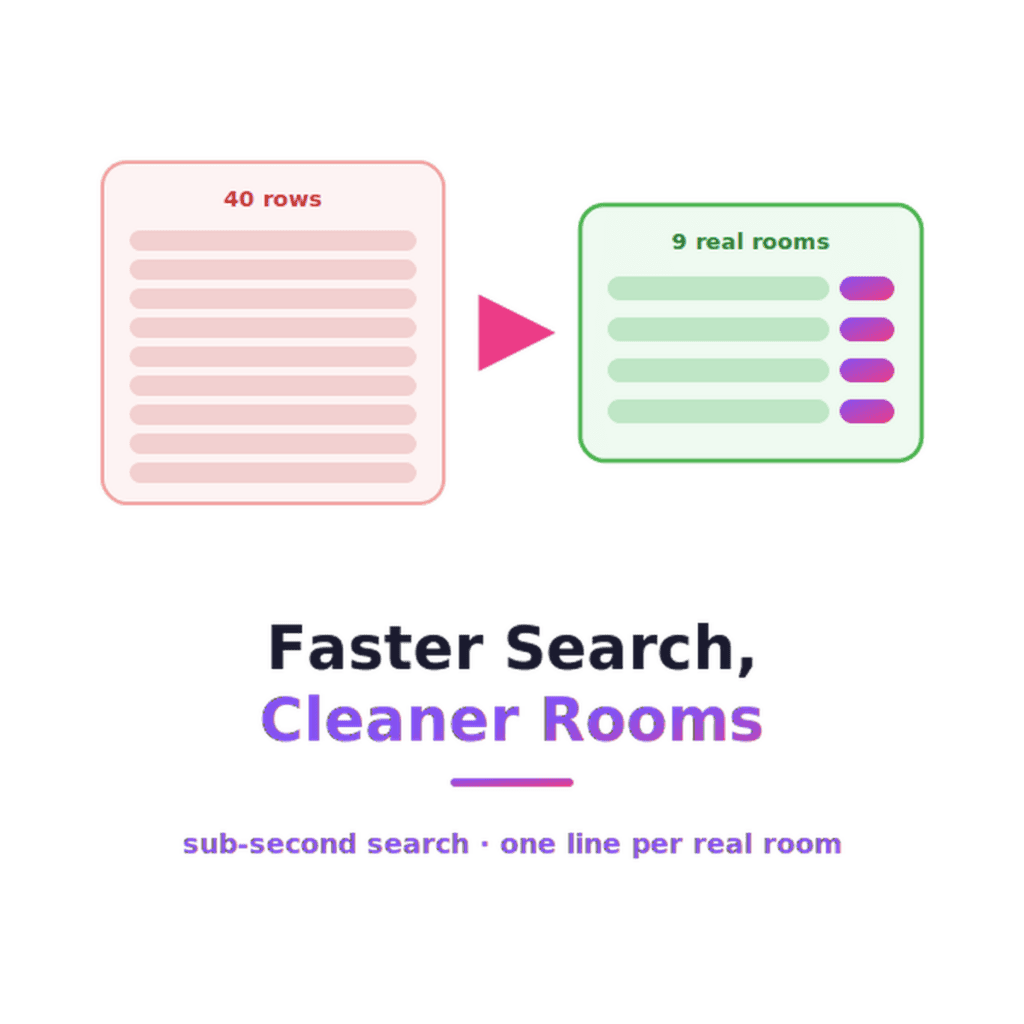
An OTA aggregating twelve suppliers had hotel pages showing as many as forty room rows, most of them duplicates of the same handful of real rooms. With deduplication enabled, a typical page collapses to around nine genuine room types, each showing the best rate. Time on the hotel page falls because agents find what they need faster, conversion rises because the choice is clear and support contacts about confusing duplicate rooms drop away.
Conversion is lost at the very start of the journey too, not only in the results. If an agent types a city or hotel name and the search box does not help them land on the right destination quickly, they stumble before a single result loads. A weak or slow destination lookup produces mismatched searches, zero-result pages and frustration, all before the agent has seen any inventory at all.
A fast, accurate auto-suggest fixes this by helping the agent select the exact city, area or property as they type, so the search that follows is the one they intended. It is a small feature with an outsized effect, because it removes the friction at the top of the funnel where a surprising share of searches are abandoned. Together, a sharp auto-suggest at the start, sub-second results in the middle and clean deduplicated rooms at the end make the whole journey feel effortless, which is exactly what keeps an agent booking with you.
Underneath speed and clarity sits the same thing that runs through everything a B2B agency does, which is trust. A fast, clean search tells an agent that the platform is capable and well run. That impression carries over into their confidence that a booking will hold and a price will be honoured. A slow, cluttered search tells them the opposite, so doubt at the search step becomes doubt about the whole operation.
So investing in search quality buys more than a few extra bookings on the margin. It builds the everyday confidence that makes an agent default to your platform without thinking about it, which is the most valuable position a B2B business can hold. To see how the search experience fits alongside pricing, supply and reliability in one platform, start with the pillar guide to B2B travel agency software. The NobleStay launch story shows how quickly a clean booking experience can go live.
Sub-second search across your whole supplier network, clean deduplicated rooms and a sharp destination lookup, so every agent journey feels effortless. See it configured for your agency.
Room deduplication is the process of recognising when the same real hotel room has arrived from several suppliers under slightly different names and collapsing them into a single clean listing with the best qualifying rate. Without it, one room type can appear as “Deluxe King”, “Deluxe King Room”, “Deluxe Room 1 King Bed” and “DLX KNG” at four close prices, which confuses the agent. With it, the agent sees one clear line per genuine room type, which makes the page readable and the booking easy. It is technically hard to do accurately at scale, so most agencies rely on a platform that has solved it.
Because a full search has to query many suppliers at once, wait for each to respond, then combine and deduplicate the results. The more suppliers you connect for better coverage and price, the more work each search involves, so a naive multi-supplier setup tends to feel slow. Speed still cannot be sacrificed, since every second of waiting loses users, faster on mobile. A well-engineered platform delivers sub-second search across the whole network, so you get both wide coverage and a fast experience, while deduplication helps by shrinking the response the agent has to load.
Directly, because agents book on the platform that lets them work fastest. Every second of search delay loses users, faster on the mobile devices many agents use. A search that resolves in around a second feels instant and keeps the agent moving toward a booking, while one that takes several seconds invites them to give up or switch to a competing platform. Since your agents are professionals booking against alternatives all day, small speed improvements compound into a real share of their volume.
Yes. A hotel page is meant to answer one question, which room and what price, while a page full of near-identical duplicate rooms poses a new question instead of answering it. Faced with a wall of repetition, an agent hesitates, wonders whether the site is broken or hiding the real price, then often leaves. Collapsing duplicates into one clean line per real room removes that hesitation, so time on the page falls, the choice becomes obvious and more agents complete the booking. Support contacts about confusing duplicate rooms drop away too.
Because conversion is lost at the very start of the journey, not only in the results. If the search box does not help an agent land on the right city, area or property as they type, they produce mismatched searches and zero-result pages before seeing any inventory. A fast, accurate auto-suggest guides them to the exact destination they intended, removing friction at the top of the funnel where a surprising share of searches are abandoned. Combined with sub-second results and clean deduplicated rooms, it makes the whole journey feel effortless.


Drop your work email and we’ll send you the 12-page report that breaks down where 6–9 months and $215K+ quietly disappear — free.

