






Table of Contents
More suppliers means more inventory means more bookings — right? Not quite. Hotel inventory overlaps so heavily that your tenth supplier may add almost no new hotels while costing as much as your first. Here’s how many suppliers an OTA actually needs.
Ask an OTA founder how their supply strategy is going and you’ll often hear a number: “We’re up to nine suppliers, going for fifteen.” Supplier count has become a scoreboard — more feels like progress, like a wider net catching more bookings. It’s one of the most intuitive beliefs in the business, and it’s mostly wrong.
Here’s why. Hotel inventory overlaps enormously. The same property is sold by many suppliers, so each new supplier you add overlaps heavily with the ones you already have. Your second supplier might add a lot of genuinely new hotels. Your sixth adds far fewer. Your twelfth might add almost nothing you didn’t already have — while costing exactly as much to build and maintain as the first.
So the real question was never “how many suppliers.” It’s “how much unique, competitive coverage does each one add” — and that’s a curve that flattens fast. This guide maps that curve, lays out the 4–6 Supplier Rule, and shows why complementarity matters far more than count. With the bedbank market heading toward $118.7 billion by 2034 and dozens of suppliers competing for your integration, knowing where the curve flattens is what keeps you from paying for coverage you already have.
The belief goes: each supplier brings inventory, inventory brings choice, choice brings bookings — so more suppliers must mean more revenue. The logic is clean. The flaw is that it assumes each supplier brings new inventory. In reality, they overlap.
Major hotels are distributed through many channels at once. A popular property in a popular city might be available from a dozen suppliers simultaneously. When you add a new supplier, a large share of what they bring is hotels you already sell from someone else. You don’t get a dozen times the inventory from a dozen suppliers — you get a lot of the same hotels, a dozen times over.
This is why supplier count is a vanity metric. “Fifteen suppliers” sounds impressive, but if suppliers seven through fifteen mostly duplicate one through six, you’ve multiplied your cost without multiplying your bookable, unique coverage. The number that matters isn’t how many suppliers you have — it’s how many distinct, competitively-priced hotels you can sell.
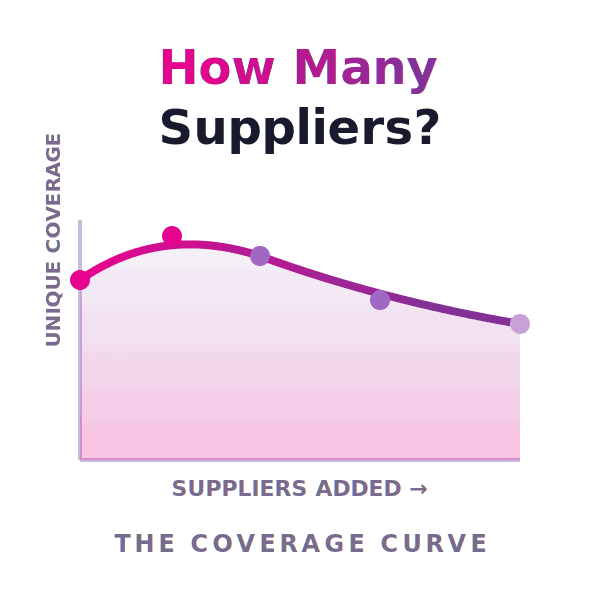
Plot unique coverage against supplier count and you get a shape every OTA should have in their head: a steep climb that quickly flattens. We call it the Coverage Curve, and it’s the single most useful mental model for supply decisions.
“The Coverage Curve” — a ZentrumHub mental model. The shape is illustrative; the exact point of diminishing returns depends on which suppliers you choose and how much they overlap.
The curve has two halves. On the left, each supplier earns its keep — real new coverage for the cost. On the right, you’re paying full integration and maintenance cost for slivers of new inventory, most of which you already had. The art of supply strategy is knowing where you are on this curve, and not paying right-side prices for left-side value.
Here’s the rule of thumb the Coverage Curve points to: most OTAs get the large majority of their bookable, competitive coverage from roughly four to six well-chosen suppliers — provided those suppliers are complementary rather than overlapping.
The emphasis is on “well-chosen.” Four complementary suppliers — one strong in your home region, one for a key outbound market, one bedbank for net leisure rates, one for chains — can cover more genuine ground than ten suppliers that all happen to be strongest in the same place. The 4–6 Rule isn’t a hard limit; it’s a reminder that the right number is smaller than instinct says, and that which suppliers matters far more than how many.
If your suppliers are complementary, four to six of them usually deliver the bulk of the competitive coverage you need. Beyond that, you’re typically adding cost faster than unique inventory — unless the marginal cost of each new supplier is near zero.
If count is the wrong metric, complementarity is the right one. The goal is a set of suppliers that fill each other’s gaps — in geography, hotel type, and rate type — rather than stacking on the same strengths. Choose for these dimensions:
A useful test before signing any new supplier: “What unique, competitive coverage does this add that I don’t already have?” If the honest answer is “not much,” you’ve found a right-side-of-the-curve supplier — and unless it’s free to add, it’s not worth the integration.
Get the number wrong in either direction and it costs you — just in different ways.
The sweet spot is enough complementary suppliers to cover your markets competitively — and no more. For most OTAs integrating one by one, that’s a small number done well, and the same logic shapes whether to go direct or via an aggregator for each. But that entire calculation rests on one assumption: that adding a supplier is expensive. Change that assumption and the whole picture shifts.
The 4–6 Rule exists because each supplier you integrate yourself carries a real, recurring cost — so you ration them, and stop where the coverage stops justifying the spend. But what if adding a supplier cost almost nothing?
That’s what a hotel API aggregator does to the math. When you connect once and gain access to many suppliers, the marginal cost of the 7th, 20th, or 50th supplier drops toward zero — there’s no new integration to build or maintain. The maintenance tax the 4–6 Rule was protecting you from largely disappears, so the right-side-of-the-curve suppliers that weren’t worth a dedicated build suddenly are worth having, because they cost you nothing extra to access.
With one important caveat: more suppliers still means more duplicate listings, which is why deduplication matters even more with an aggregator. Raw breadth without deduplication just gives you the same hotel many times. The value isn’t supplier count — it’s unique, competitive, deduplicated coverage. A good hotel API aggregator delivers exactly that: the breadth of many suppliers, cleaned into one record per hotel at the best rate.
If you integrate suppliers one by one, follow the 4–6 Rule — fewer, complementary, done well. If you use an aggregator, the question changes from “how many can I afford to maintain?” to “how much unique deduplicated coverage can I get?” — and the answer is far more, for far less.
ZentrumHub connects 100+ suppliers through one API, deduplicated into one clean record per hotel — so you get unique, competitive coverage without the per-supplier maintenance tax.
See ZentrumHub’s Suppliers →ZentrumHub connects 100+ suppliers through one API and deduplicates them into one clean record per hotel — so you get unique, competitive coverage across your markets without the per-supplier build and maintenance. 30M+ daily API calls. 99.99% uptime.


Drop your work email and we’ll send you the 12-page report that breaks down where 6–9 months and $215K+ quietly disappear — free.

