






Table of Contents
“It’s a REST API — three months, one developer.” Every OTA has said it. Six months later the supplier is half-live, two engineers are blocked, and hotel margins still haven’t moved. This is the real cost of integrating hotel suppliers one by one — the part nobody puts in the proposal.
There’s a conversation that happens in every growing OTA. Someone says: “We need to add Hotelbeds. How long — about three months and one developer? Great, let’s ship it.” Everyone nods. The line item goes in the budget at fifteen, maybe twenty-five thousand dollars. The board approves it.
Six months later, that supplier is half-integrated. Two developers are blocked. Support tickets about failed bookings are stacking up. And someone on the leadership team is explaining why hotel margins still haven’t moved. If you’ve run an OTA for any length of time, you’ve lived some version of this.
This is not an argument against adding suppliers — diverse inventory is the difference between an OTA that thrives and one that merely survives, and with the global bedbank market projected to reach $118.7 billion by 2034, the suppliers worth connecting keep multiplying. This is about what adding them one by one actually costs — and why that number is almost always three to five times what the proposal said.
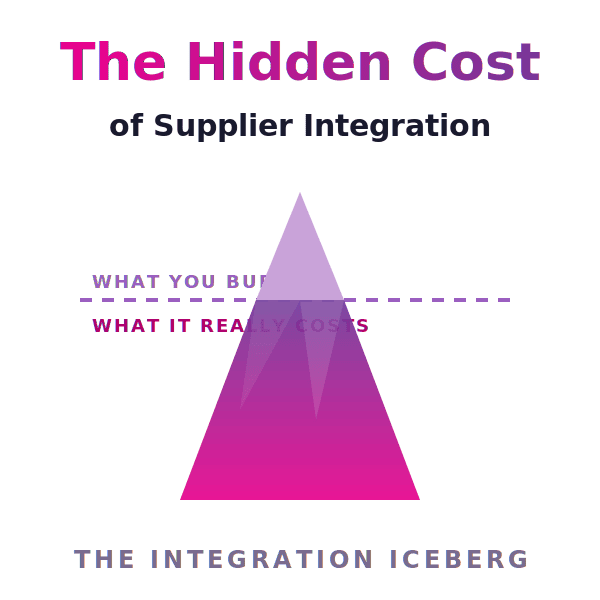
Here’s the mental model that explains the gap. A hotel supplier integration is an iceberg. The part everyone sees and budgets for — the contract, the API key, the initial build estimate — is the tip above the waterline. It’s real, but it’s a fraction of the mass.
Below the waterline sit five costs that don’t appear in the proposal but hit your P&L anyway: the build overrun, hotel mapping, perpetual maintenance, failed bookings, and opportunity cost. The reason integration projects blow their budget isn’t bad estimating — it’s that everyone estimates the tip and forgets the iceberg.
“The Integration Iceberg” — a ZentrumHub framework. Cost figures below are drawn from patterns across 100+ supplier integrations.
The first assumption that breaks is “it’s a REST API, our team can do it in 8–12 weeks.” The flaw isn’t the team’s ability — it’s the belief that a hotel supplier is one API. It isn’t. A real supplier is six distinct workflows: static content, search, pre-book, booking, cancellation, and reconciliation. Each behaves differently, and none of them standardise across suppliers.
Hotelbeds authenticates one way; RateHawk another; Amadeus another. Rate limits differ. Currencies differ. Cancellation-policy parsing — the rules for what a guest can cancel, when, and at what penalty — is a small project on its own, and it’s different for every supplier. Your team doesn’t write one integration five times; it solves five genuinely different problems and calls them by the same name.
| Supplier type | Vendor quote | Reality |
|---|---|---|
| Modern REST aggregator | 6–8 weeks | 12–16 weeks |
| Legacy bedbank | 8–12 weeks | 16–24 weeks |
| GDS (Amadeus, Sabre) | 12 weeks | 24–36 weeks |
A “3-month” integration that takes six means one developer blocked for an extra $15K–$30K. Multiply by five suppliers and you’ve burned roughly $90K–$150K before earning a cent in margin. The detail of why these run long is in our hotel API integration guide.
“We’ll just match hotels by name and address.” This sentence has cost OTAs more money than almost any other. The moment you have a second supplier, you have the same hotel arriving twice — with two different IDs, slightly different names (“The Ritz-Carlton, Dubai” versus “Ritz Carlton Dubai DIFC”), addresses off by a word, coordinates off by 200 metres, and different amenity lists.
Without deduplication, the same hotel shows up three to seven times on your booking engine. Customers get confused and conversion drops. Worse: when the rates differ across suppliers for the same room, your flow can surface the wrong one — and you quietly bleed margin on every booking. Doing this properly means a master hotel database, fuzzy-matching logic, manual review queues, continuous re-matching as suppliers change their data, and a content-ops function to run it.
This is the single most underestimated line in the whole project, because it’s invisible until you have two suppliers — and by then you’ve already shipped the duplicates to customers.
“After the build, maybe 5% of dev time for upkeep.” In reality, supplier APIs change constantly. Auth methods get updated — Hotelbeds alone made four major auth changes in three years. Endpoints deprecate. Rate structures shift. Cancellation policies get more granular. Compliance rules change. Each change is a fire your team didn’t start but has to put out, on the supplier’s timeline, not yours.
The industry benchmark is that 10–15% of your engineering capacity goes to keeping existing integrations alive. For five suppliers, that’s roughly a full developer-year — $60K–$90K annually that was never in the original business case.
And here’s the part that catches everyone: it’s non-linear.
The cruelest part of the maintenance cost is that it scales with your success. The more suppliers you add to grow, the more of your team disappears into keeping them running.
“Edge cases are rare.” They aren’t. In real production traffic, 2–7% of bookings fail for reasons that have nothing to do with your code: a rate changes between search and book, a supplier times out, a currency mismatches at confirmation, a room type changes, a cancellation policy is misread, a reconciliation gap opens up. These aren’t bugs you can fix once — they’re the permanent friction of talking to live third-party systems.
Every failure compounds into four costs at once: a frustrated customer, a support ticket (commonly $15–$30 to resolve), a finance reconciliation task, and an engineering debugging session. A travel agency doing 500 bookings a day at a 4% failure rate burns around $2,000 a month in support cost alone — before you count churn and reputation damage.
Fixing it yourself isn’t a patch. It’s a booking state machine with retry logic, idempotency guarantees, multi-supplier failover, a reconciliation engine, and supplier-specific refund automation — months of senior engineering, $50K–$100K to build properly. Most OTAs discover this layer only after the failed bookings start arriving.
This is the one that never makes the spreadsheet, and it’s the largest. While your engineering team spends 6–12 months on supplier plumbing, your competitors are launching features, improving conversion, and expanding into markets — building the things customers actually choose them for.
Here’s the uncomfortable truth: hotel API integration is table stakes. It’s necessary, but it is not differentiating. No customer has ever picked a platform because of how cleanly it integrated Hotelbeds. Every engineering hour spent on integration is an hour not spent on the thing that actually wins you the customer.
TravClan grew 4× in daily bookings after moving to an aggregated API model — not because they hired more developers, but because their developers stopped fighting integrations and started building product. The full story is in the TravClan case study.
Add the iceberg up. For a travel company connecting five hotel suppliers in year one, the difference between the budgeted number and the real number looks like this:
| Cost category (5 suppliers, Year 1) | DIY, one by one | Via one API layer |
|---|---|---|
| Initial integration | $75K–$150K | One integration, days |
| Hotel mapping & dedup | $40K–$80K | Included |
| Year-1 maintenance | $50K–$90K | Included |
| Failure / reconciliation infra | $50K–$100K | Included |
| Opportunity cost | 6–12 mo delayed roadmap | Negligible |
| Total Year-1 cost | $215K–$420K+ | A fraction |
These aren’t projections — they’re patterns observed across 50+ travel companies and 100+ supplier integrations. Your numbers will vary, but the shape holds: the budgeted cost is the tip; the real cost is the iceberg.
The full report behind this article — built for CEOs and CTOs, with the complete cost breakdown, the honest build-vs-aggregator math, and when DIY genuinely makes sense.
It would be dishonest to claim direct integration is never the right call. It is — in two specific cases.
One: you’re a $100M+ GMV OTA with a 30-plus-person engineering team that can genuinely absorb the cost and the maintenance. Even then, it’s worth noting that several of the largest travel companies — RateHawk, Rakuten, TravClan, Akbar Travels — chose an aggregated API anyway, because opportunity cost beat build cost even at their scale.
Two: you have one bespoke private-rate contract that genuinely requires a custom connection a third party can’t carry. That’s a real exception — but it’s one integration for a strategic reason, not a strategy of integrating everything yourself.
For everyone else — which is most OTAs and agencies — the math points the other way. A hotel API aggregator lets you integrate once and add the second, fifth, or fiftieth supplier in days, with mapping, maintenance, and failure-handling already solved. You stop paying the iceberg on every supplier and start spending that engineering capacity on the product that actually differentiates you.
ZentrumHub connects 100+ hotel suppliers through one API — mapping, maintenance, and failover already solved. Your team writes zero new integration code.
See the Universal Hotel API →ZentrumHub connects 100+ hotel suppliers through one API, with mapping, maintenance, and failover built in. Integrate once, add suppliers in days, and put your engineers back on the product that wins customers. 30M+ daily API calls. 99.99% uptime.


Drop your work email and we’ll send you the 12-page report that breaks down where 6–9 months and $215K+ quietly disappear — free.

