


Table of Contents
An agent in one country will not book confidently on a portal that speaks another country’s language and prices in another country’s currency. As soon as an agency sells across markets, localization stops being a nice touch and becomes the thing that decides whether cross-border agents trust you enough to book. This guide covers how to do it.
Localizing a B2B travel portal means adapting it to each market you sell into across four layers. Language, so agents work in the words they think in. Currency, so prices appear in the money they use, with the margin protected against exchange-rate moves. Content, so hotel information is relevant to the market. And commercial terms, so pricing and payment fit local expectations. Because each market can run on its own channel, a single platform can present a fully localized experience to each audience without a separate build for every country.
Written for B2B travel agency owners and founders
Growth eventually means selling beyond your home market. The moment you do, a gap opens between what your platform offers and what a foreign agent expects. An agent in a different country reads a different language, thinks in a different currency, books different destinations and works to different commercial norms. A portal that ignores all of that asks the agent to do the adapting, so agents who have to work harder to use your platform simply use a competitor’s instead.
This guide is written for the owner expanding across borders. It breaks localization into four practical layers, explains why each one matters for trust and conversion and shows how the per-channel model inside B2B travel agency software lets one platform serve many markets in their own terms. The currency layer connects directly to our guide on multi-currency and exchange-rate buffers.
Localization is really about trust, because a buyer trusts what feels familiar. When an agent opens a portal in their own language, priced in their own currency, showing hotels they recognise, the whole experience signals that this platform understands their market and is built for them. That familiarity lowers the friction of every booking and makes the agent comfortable committing, which is the entire game in a competitive market.
A poorly localized portal signals the opposite. A foreign language, an unfamiliar currency and irrelevant content all quietly say this platform was built for somewhere else, so an agent who feels like an afterthought books like one, tentatively and rarely. The cost of poor localization is not usually a complaint, it is silence, the bookings you never win from markets where the experience did not feel like it was meant for them. Getting localization right removes that invisible barrier.
The most obvious layer is language. Agents work fastest and most confidently in the language they think in, while a portal in a foreign language forces them to translate as they go, which is slower, more error-prone and more tiring. For a professional making many bookings a day, that friction adds up, making your platform the harder one to use compared to a competitor that speaks their language natively.
Good language localization goes beyond a machine translation of the interface. It means the whole experience, the labels, the messages, the terms, reading naturally to a native speaker, so nothing feels awkward or ambiguous at the moment of booking. When an agent never has to pause to work out what a button means or whether they have understood a cancellation term, the platform disappears into the background and lets them work, which is exactly what you want.
Currency is where localization meets your margin. Agents convert better when they see prices in the currency they use, because they can judge value instantly without converting in their head or worrying about what their card will charge. Selling in local currency removes a real point of hesitation from the booking. For a cross-border agency it is one of the highest-impact localization moves you can make.
The complication is that selling in many currencies while buying in one exposes you to exchange-rate risk, because the rate can move between quoting a price and settling the booking. This is why local-currency selling has to be paired with a protective exchange-rate buffer, so you present prices in the agent’s currency without letting a rate swing erode your margin. Doing both together, local-currency pricing for conversion and a per-pair buffer for protection, is covered in depth in our guide to multi-currency and exchange-rate buffers.
An agency expanding into a new market sets that market’s channel to sell in the local currency, so agents there see familiar prices and convert more readily. Because it buys inventory in a different currency, it applies a protective buffer on that currency pair, sized to how much the pair typically moves. The agents get a fully local-currency experience that lifts their booking rate, while the agency keeps its margin intact through normal exchange-rate movement.
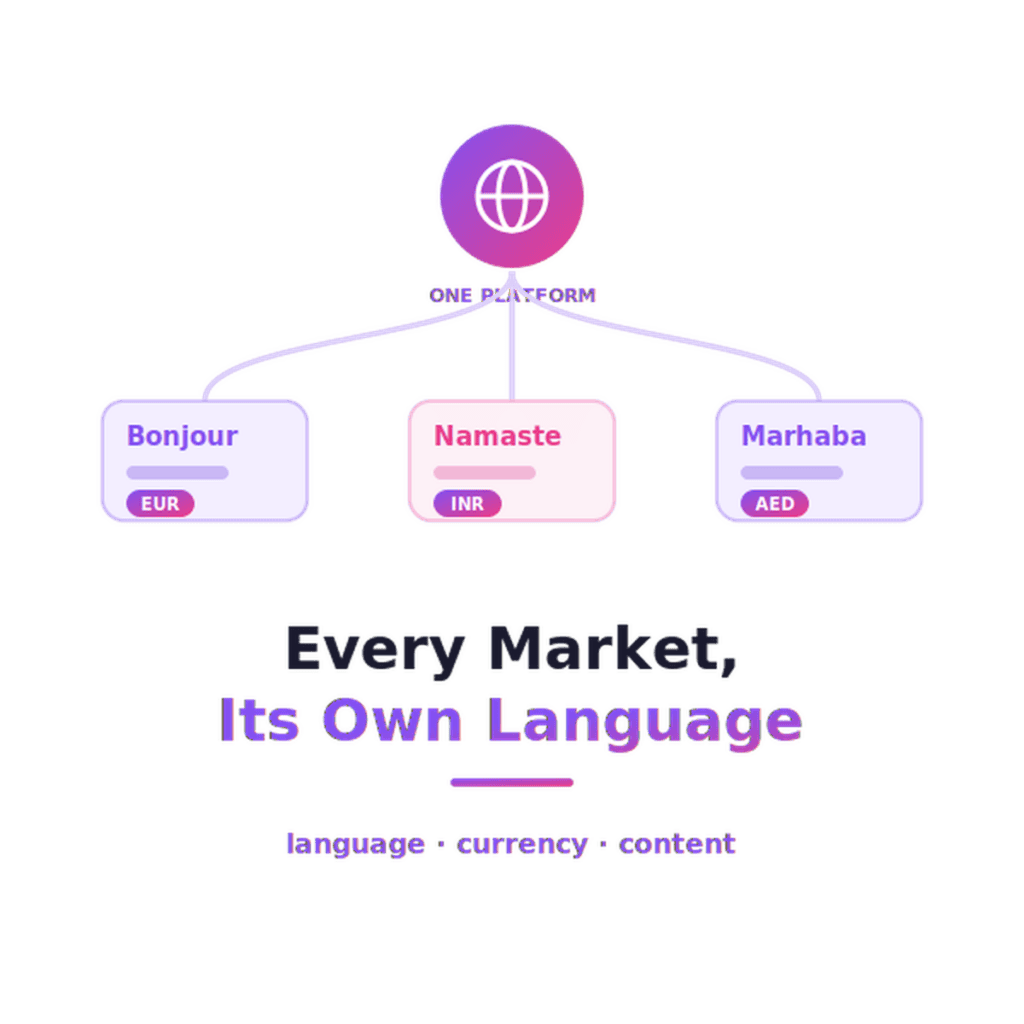
Language, currency and content localized per market, all from one platform.
See the B2B Travel Portal →Localization is not only about translating what you show, it is about showing what is relevant. Different markets book different destinations, so an agent in one country cares about a different set of hotels and cities than an agent in another. A portal that surfaces the destinations and supply relevant to a given market feels tailored to that agent, while one that shows the same generic set to everyone feels like it was not thinking about them specifically.
This is where the supplier set and the way results are presented can be shaped per market. An agency can lean into the suppliers and destinations that matter most to a particular market on that market’s channel, so the content an agent sees reflects where they actually send travellers. Relevance of content, not just accuracy of translation, is what makes a localized portal feel genuinely built for its market rather than merely translated into its language.
The deepest layer of localization is commercial. Different markets carry different expectations about how business is done, from pricing structure to payment norms to the kind of terms agents expect. A market where agents are used to a particular commercial model will respond better to a portal that matches it than to one that imposes a foreign way of working, however well translated the interface is.
Because pricing and terms can be set per market on that market’s channel, an agency can adapt its commercial approach to local norms without running separate systems. The markup, the fee structure and the way pricing is presented can all fit what a given market expects, so the platform feels commercially native rather than a foreign model dropped into a new country. This commercial fit, sitting underneath the visible layers of language and currency, is often what turns a market from a trickle of bookings into a real, growing channel. The per-market pricing model that makes it possible is covered in our guide to per-channel pricing.
The reason all of this is practical rather than overwhelming is that each market can run on its own channel. A channel carries its own language, its own currency and buffer, its own supplier and content emphasis and its own commercial terms, all on top of a single integration. That means adding a new market is a matter of configuring a channel for it rather than building a new platform, so localization scales with your ambition instead of multiplying your systems.
This is also what makes localization compatible with a white-label strategy, since a branded partner in another market can be given a fully localized instance of their own. One integration can therefore present a French-language, euro-priced experience to one audience and an entirely different localized experience to another, each feeling native to its market. To see how per-market localization sits within the wider platform, start with the pillar guide to B2B travel agency software. The branded-portal angle is covered in our guide to white-label portals.
Localize language, currency, content and commercial terms per market on one platform, adding each new market as a channel. See it configured for your agency.
Adapting it to each market across four layers. Language, so agents work in the words they think in, with the whole experience reading naturally to a native speaker rather than just machine-translated. Currency, so prices appear in the money they use, paired with an exchange-rate buffer to protect your margin. Content, so the destinations and supply shown are relevant to that market. And commercial terms, so pricing and payment fit local expectations. Because each market can run on its own channel, one platform can present a fully localized experience to each audience without a separate build per country.
Because translating the interface only addresses one of four layers. An agent also needs prices in their own currency, content relevant to the destinations their market books and commercial terms that match how business is done locally. A portal can be perfectly translated and still feel foreign if it prices in the wrong currency, shows irrelevant hotels or imposes an unfamiliar commercial model. True localization adapts all four layers together, so the platform feels built for the market rather than merely translated into its language.
Only if you sell in local currency without protecting against exchange-rate movement. Selling in the agent’s currency lifts conversion, because they can judge value instantly, but if you buy inventory in a different currency the rate can move between quoting and settling and erode your margin. The answer is to pair local-currency selling with a protective exchange-rate buffer on each currency pair, sized to how much that pair typically moves. Done together, you get the conversion benefit of local pricing while keeping your margin intact through normal rate movement.
No. That is the point of a per-channel model. Each market can run on its own channel, carrying its own language, currency and buffer, supplier and content emphasis and commercial terms, all on top of a single integration. Adding a new market becomes a matter of configuring a channel rather than building a new platform, so localization scales with your ambition instead of multiplying your systems. The same structure lets you give a branded partner in another market a fully localized instance of their own without a separate build.
Directly, because a buyer trusts what feels familiar. When an agent opens a portal in their own language, priced in their own currency and showing hotels they recognise, the experience signals it was built for their market, which lowers friction and makes them comfortable booking. A poorly localized portal signals the opposite, its cost usually silence rather than complaint, the bookings you never win from markets where the experience did not feel meant for them. Good localization removes that invisible barrier and turns cross-border markets into real channels.
Four layers of localizing a portal for a market. Score each market you serve.
'+ '| Layer | What good looks like | Done |
|---|---|---|
| Language | Whole experience reads naturally to a native speaker | |
| Currency | Prices in local currency, margin protected by a buffer | |
| Content | Destinations and supply relevant to the market | |
| Commercial terms | Pricing and payment fit local expectations | |
| Delivery | Each market runs on its own channel, one integration |
Checklist by ZentrumHub. zentrumhub.com/blog/multi-language-localization-b2b-travel. Book a demo at zentrumhub.com/book-time
'+ ''; var w = window.open('', '_blank'); w.document.write(html); w.document.close(); w.focus(); setTimeout(function(){ w.print(); }, 350); }