




Table of Contents
A white-label B2B travel portal lets your agency sell hotels online under your own brand. It also lets you give your partners branded portals of their own, without building a booking engine yourself. This guide explains how it works, what you can brand and why it is usually the fastest route to live hotel revenue.
A white-label B2B travel portal is a fully branded hotel booking front end covering search, results, hotel pages, booking, payment and vouchering. It runs on someone else’s technology but carries your name or your partner’s. It lets a travel agency sell hotels online without engineering a booking engine. It also lets that agency power its partners’ booking sites too. On a modern platform a white-label portal is a configuration exercise with a go-live measured in weeks. ZentrumHub’s benchmark is around 15 days rather than the several quarters an in-house build takes.
Last updated: September 2026 · Written for B2B travel agency owners and founders
For many travel agencies the gap between having no online hotel product and having one feels enormous. It means a booking engine, supplier integrations, a payment flow, vouchering and deduplication, all of it engineered and then maintained. White-label closes that gap. Instead of building the machinery, you put your brand on a platform that already has it. You are then selling hotels online within a few weeks.
This guide is written for the owner weighing that route. It explains what a white-label portal is and what you can brand. It shows why the model launches so much faster than building. And because you run a B2B agency, it covers how the same capability lets you give your own partners branded portals. Throughout, it uses the white-label engine inside B2B travel agency software as the working example.
A white-label B2B travel portal is a complete hotel booking front end. It includes the search box, the results list, the hotel detail pages, the booking and payment flow and the confirmation and vouchering. It arrives as a ready product that carries your branding instead of the provider’s. Your customers and sub-agents see your name, your colours and your domain. The technology powering all of it sits underneath, invisible to them.
The point is that everything hard has already been solved. The supplier connections, the deduplication that stops the same hotel appearing four times, the sub-second search and the booking reliability are the parts that take a team quarters to build and then forever to maintain. In a white-label model they come included. You supply the brand and the commercial rules. The platform supplies the engine.
White-label is meaningful only if the branding runs deep enough that customers see your business rather than the provider’s. On ZentrumHub that covers the elements that matter. Your logo and brand colours appear across the interface. The portal sits on your own domain. The booking experience stays consistent with the rest of your business. The result is a portal that reads unmistakably as yours to anyone using it.
Just as important is what your customers never see. They do not see the suppliers behind the rates. They do not see your markup logic. They do not see that other agencies run on the same platform. A well-built white-label portal presents one coherent product to the user while keeping the commercial machinery private. That is exactly what you want when the portal represents your brand to your buyers.
The strongest argument for white-label is time. Building a hotel booking platform in-house is a multi-quarter engineering programme before you take a single booking. That is before you count the ongoing maintenance. A white-label portal turns that build into configuration. You are branding and setting rules on an engine that already works, so the timeline drops from quarters to weeks.
On ZentrumHub the go-live benchmark is around 15 days, backed by the full supplier network from day one. For an agency that difference is not just convenience. It is months of revenue you capture instead of forgo. It is months your competitors do not gain on you. It also removes the biggest risk in the build-versus-buy decision, which is the danger that an in-house build overruns. In-house builds very often do.
A traditional offline agency that has never sold hotels online configures a white-label storefront. It sets the brand, the domain, the markup rules and the supplier set, then goes live on a branded booking engine backed by the full supplier network in around 15 days. What would have been a multi-quarter build in-house, with all its risk of overrun, becomes a two-week configuration and a live revenue stream.
Your brand, your domain and 100+ suppliers behind it, without building the engine.
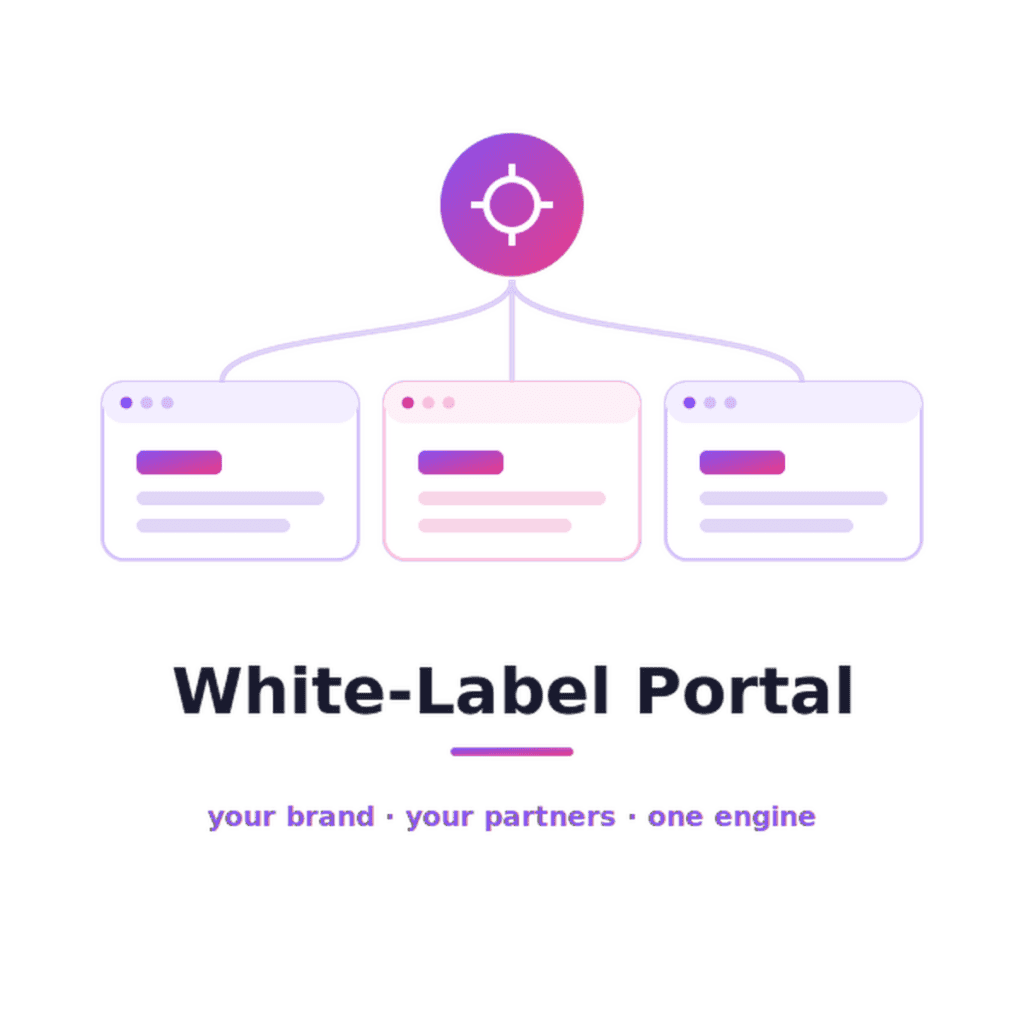
See the Booking Engine →Here is where white-label becomes a growth engine rather than just a launch shortcut. For a B2B agency the same capability that brands a portal for you can brand one for each of your partners. That might be an airline, a bank loyalty programme, a large corporate or a sub-agency that wants to sell under its own name. Each partner gets its own branded instance. Because ZentrumHub runs each one on its own channel, each carries its own branding, its own supplier set and its own commercial terms, all from your single integration.
The commercial significance is large. A partner is no longer a bespoke technical project that you have to build and support. A partner becomes a configuration. That means you can say yes to partnership opportunities you would otherwise have to decline. It also means you can onboard a new branded partner in the time it takes to set up a channel rather than the time it takes to build a product.
A banking partner wants to offer hotels to its loyalty members under its own brand. The agency spins up a second white-label instance on its own channel, with the bank’s branding, its own supplier set and its own commercial terms. There is no new product programme. When a corporate client later wants the same thing, it is simply another channel. Each partnership adds a revenue stream while costing only a configuration.
Different partners want different commercial models. A good white-label platform supports both. Some partners want you to price the product. You apply your markup and you keep the margin. Other partners price on their own side and want your rates delivered clean, at net, with no markup added. The platform has to handle either case without a separate build.
On ZentrumHub revenue rules switch on or off per channel. For a partner where you take the margin, your markup and commission rules apply as normal. For a partner who prices themselves, you switch your revenue rules off for that channel and deliver net rates so they add their own margin downstream. The same integration serves both models at once. A marked-up channel and a net channel run side by side. That is what lets you structure each partnership the way a given partner wants.
An agency runs its own white-label portal with a standard markup. At the same time it powers a white-label partner who prices on their own side, so for that partner’s channel the revenue rules are switched off and net rates flow through untouched. Two white-label portals, two commercial models and one integration, all configured rather than coded.
White-label suits the large majority of B2B travel agencies. It fits anyone who wants to sell hotels under their own brand quickly, power partner portals and avoid carrying an engineering team to build and maintain booking technology. If your competitive edge is your relationships, your markets and your service rather than your software, white-label lets you put your energy there while the platform handles the technology.
| White-label makes sense when… | Building in-house makes sense when… |
|---|---|
| You want to launch in weeks, not quarters | You have a permanent engineering team |
| You want to power branded partner portals | You need highly unusual, bespoke workflows |
| You would rather not maintain booking tech | Owning the technology is your core strategy |
| Your edge is relationships and markets | You operate at a scale that justifies the cost |
For the full cost comparison of the two paths, see the section on building in-house versus buying a platform in our pillar guide to B2B travel agency software.
Launching a white-label portal on a channel-based platform follows a clear sequence. The same sequence applies whether you launch your own portal or a partner’s.
| Step | What you do |
|---|---|
| 1. Create the channel | Set up the portal’s channel, yours or a partner’s. |
| 2. Apply branding | Add the logo, the colours and the domain. |
| 3. Choose supply | Assign the supplier set for that portal. |
| 4. Set pricing | Apply markup. For net rates, switch the revenue rules off. |
| 5. Configure payment | Set up how bookings are paid and settled. |
| 6. Go live | Activate and start taking branded bookings. |
Because each step is configuration, the whole process fits inside that roughly 15-day window for a straightforward launch. Every subsequent partner portal is faster still, since you are repeating a process you already know. For how branding fits into onboarding a reselling sub-agent, see our guide to onboarding sub-agents on your B2B portal.
Launch a branded hotel portal in around 15 days, then power partner portals as easily as adding a channel. There are 100+ suppliers behind every one. See it configured for your agency.
It is a complete, branded hotel booking front end covering search, results, hotel pages, booking, payment and vouchering. It runs on a provider’s technology but carries your brand or your partner’s. Customers see your name, your colours and your domain, while the engine, the supplier connections and the deduplication sit underneath, invisible to them. It lets an agency sell hotels online without building or maintaining booking technology. It also lets that agency power branded portals for its partners too.
Far less time than building. An in-house booking platform is a multi-quarter engineering programme before your first booking. A white-label portal is configuration on an engine that already works. ZentrumHub’s go-live benchmark is around 15 days, backed by the full supplier network from day one. Every subsequent partner portal is faster still, because you are repeating a process you already know rather than building something new.
Yes. This is one of white-label’s biggest advantages for a B2B agency. On ZentrumHub each partner runs on its own channel with its own branding, its own supplier set and its own commercial terms, all from your single integration. An airline, a bank loyalty programme, a corporate or a reselling sub-agency can each have a portal under their own brand. A partner becomes a configuration rather than a bespoke build, so you can onboard branded partners quickly and say yes to opportunities you would otherwise decline.
Yes. Revenue rules switch on or off per channel. For a partner where you take the margin, your markup applies as normal. For a partner who prices themselves, you switch your revenue rules off for their channel and deliver net rates so they add their own margin downstream. The same integration runs marked-up channels and net channels side by side, so you can structure each partnership the way that partner prefers without a separate build.
For most agencies, yes. White-label lets you launch in weeks instead of quarters. It avoids the cost and the risk of a build that overruns. It also removes the burden of maintaining supplier integrations and deduplication yourself. Building in-house makes sense mainly for very large agencies that have a permanent engineering team, highly unusual requirements or a strategy centred on owning the technology. If your edge is your relationships, your markets and your service rather than your software, white-label is usually the better route.


Drop your work email and we’ll send you the 12-page report that breaks down where 6–9 months and $215K+ quietly disappear — free.

