


Table of Contents
Inventory is what your agency sells — so how you connect suppliers decides your rates, your reliability and your speed to market. This guide compares direct contracts against a single-API aggregator, shows how many suppliers you actually need, and explains how to add them without breaking live bookings.
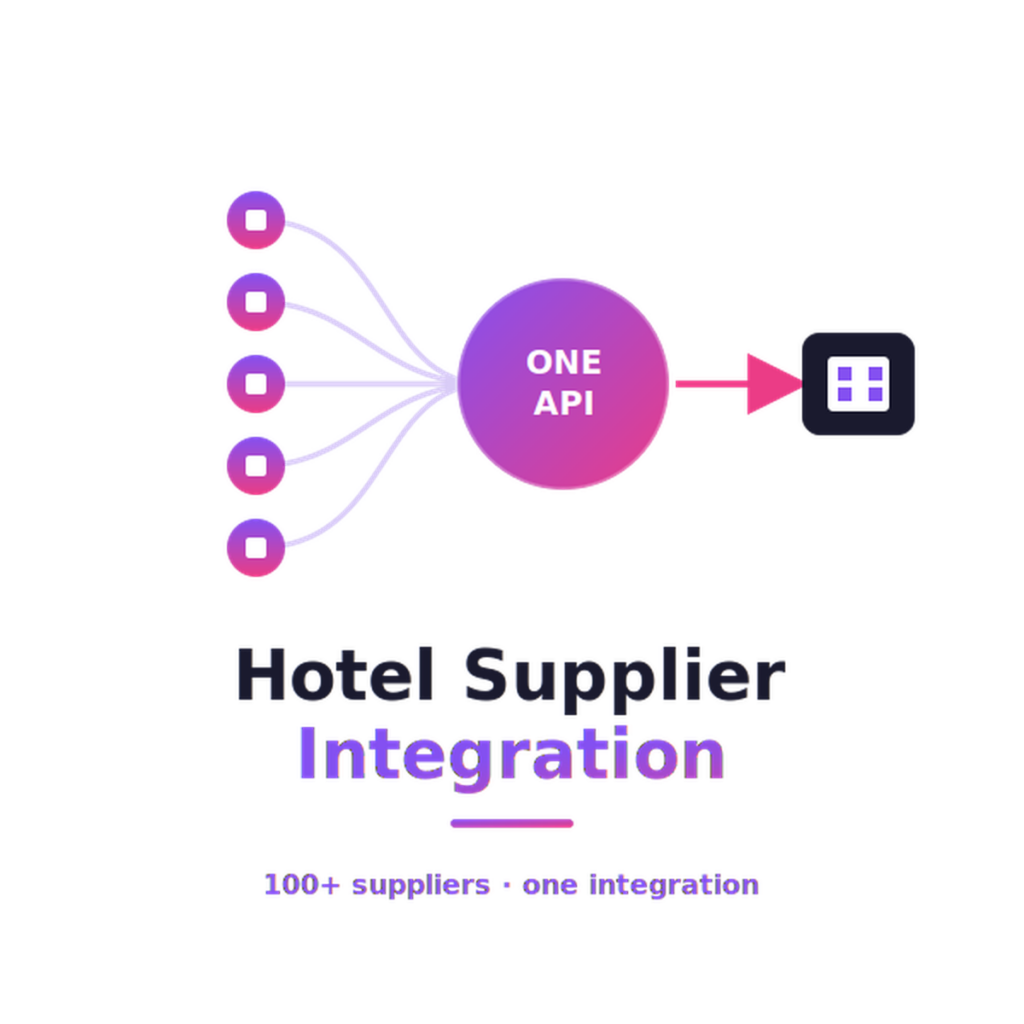
Hotel supplier integration is the process of connecting a travel agency’s platform to hotel suppliers — bedbanks, wholesalers, GDS and direct-connect providers — so their rates and availability appear in the agency’s booking flow. An agency can integrate each supplier directly, which means a separate technical project per supplier, or connect to an aggregator that delivers 100+ suppliers through one integration. For most B2B agencies, a single-API aggregator is faster, cheaper to maintain, and easier to control.
Last updated: September 2026 · Written for B2B travel agency owners and founders
Ask any B2B travel agency owner what limits their growth and, sooner or later, the answer comes back to inventory. Too few suppliers and your rates are not competitive and your availability has gaps. Too many direct integrations and your engineering cost and maintenance burden spiral. The way you connect suppliers is one of the most consequential technical decisions an agency makes — and one of the easiest to get wrong.
This guide is for the owner making that decision. It explains the supplier types, weighs direct contracts against a single-API aggregator, answers the question every agency asks — how many suppliers do I actually need — and shows how modern B2B travel agency software lets you add, control and deduplicate suppliers without a developer on standby.
Hotel supplier integration is the technical process of connecting your booking platform to a hotel supplier’s system — usually through an API — so that the supplier’s live rates, availability and content flow into your search results and your customers can book them. Each supplier exposes its inventory in its own format, with its own rules for searching, booking, cancelling and confirming, so integration also means translating all of that into one consistent experience for your agents.
The reason it matters commercially is simple: your inventory is your product. The breadth of your supply decides how competitive your rates look and how often you can fulfil a request; the reliability of your integrations decides how often a booking actually completes. Get supplier integration right and everything downstream — pricing, distribution, conversion — has a solid foundation. Get it wrong and no amount of marketing fixes a thin, unreliable catalogue.
Not all supply is the same, and a strong agency catalogue blends types. Understanding the categories helps you decide what to prioritise.
| Supplier type | What it gives you | Best for |
|---|---|---|
| Bedbanks / wholesalers | Net rates on large leisure inventory | Margin and leisure breadth |
| GDS | Branded chains, corporate rates | Business travel, chain coverage |
| OTA / retail feeds | Wide coverage, strong content | Filling gaps, content quality |
| Regional specialists | Deep inventory in one market | A core destination you sell heavily |
| Direct-connect / hyperlocal | Unique rates, direct relationships | Exclusive or contracted inventory |
The practical takeaway: a competitive agency usually needs a bedbank or two for net-rate margin, a GDS or retail feed for chains and coverage, and a regional specialist wherever it has a core market. Reaching all of those directly is a lot of integrations — which is exactly the problem the next section addresses.
Here is the core decision. Integrating a supplier directly means building to their specific API, mapping their content, certifying the connection, and then maintaining it forever as they change their system — repeated for every supplier you add. A single-API aggregator does that work once and exposes many suppliers through one normalised connection, so you integrate a single API and reach the whole network.
| Consideration | Direct contracts | Single-API aggregator |
|---|---|---|
| Integrations to build | One per supplier | One, total |
| Time to add supply | Weeks to months each | Toggle on from the network |
| Maintenance | Ongoing, per supplier | Handled by the aggregator |
| Deduplication | You build it | Built in |
| Rate on a given hotel | Whatever that one supplier gives | Best of many, compared |
| Best for | A few strategic exclusive deals | Broad, competitive coverage fast |
The two are not mutually exclusive — a mature agency often runs an aggregator for breadth and keeps one or two direct contracts for genuinely exclusive rates. But for the coverage that makes an agency competitive, ZentrumHub’s universal hotel API reaches 100+ suppliers and 900,000+ deduplicated hotels through one integration, and the deeper supplier layer is described on Zentrum Connect.
Skip the build-per-supplier. Connect once, compare the best rate across the network, and add supply by toggling it on.
See the 100+ Suppliers →More suppliers is not automatically better. Every supplier you add brings overlapping inventory, more duplicates to resolve, and — if you integrate directly — more to maintain. The right number is the smallest set that gives competitive rates and reliable coverage across the destinations you actually sell.
For most agencies that lands in the range of four to six well-chosen suppliers: one or two net-rate bedbanks for margin, one broad retail or GDS feed for chains and coverage, and one or two regional specialists for core markets. Beyond that, each additional supplier tends to add duplicates faster than it adds genuinely new hotels — unless you are entering a new region, where a local specialist earns its place immediately. The value of an aggregator here is that testing a new supplier costs you almost nothing: you enable it, watch what unique inventory and rate wins it brings, and keep it only if it pays its way.
An agency selling mostly Europe and the Gulf runs six suppliers: two bedbanks for net-rate leisure margin, one GDS feed for corporate chains, one broad retail feed for coverage, and two regional specialists for its strongest markets. When it enters a new region, it enables a local supplier from the aggregator network for that channel only, measures the unique inventory it adds over a month, and keeps it if it earns its place — all without a new integration project.
The risk every owner worries about when adding supply is that a new, unproven feed will disrupt live bookings — bad content, wrong prices, failed confirmations reaching real customers. The answer is a proper test-to-live path, and it is a capability you should insist on.
On ZentrumHub, every supplier is added in a TEST environment first. You validate its content, its rates, its booking and cancellation behaviour against real scenarios, and only promote it to LIVE once you are satisfied — while your existing suppliers keep serving live traffic untouched throughout. A new supplier is proven before a single customer sees it, which turns adding supply from a risk into a routine.
An agency adds a new wholesaler in TEST, runs two weeks of real search-and-book scenarios to confirm content quality and booking reliability, and only then promotes it to LIVE. Its existing suppliers serve live traffic the entire time. The new feed reaches customers only after it has proven itself — so onboarding never puts live revenue at risk.
Suppliers fail — feeds slow down, booking APIs start erroring, rates go stale. When it happens, the question is how fast you can react. If disabling a bad supplier means a developer and a code release, you lose bookings and frustrate agents for hours. If it is a control in your back office, the problem is contained in a minute.
ZentrumHub gives you a provider-level switch. If a supplier starts timing out or failing at booking, you disable that provider and traffic instantly reroutes through the rest of your network, with no interruption to the customer. You re-enable it once the supplier confirms the fix. Control sits with your operations team, where it belongs, rather than in an engineering queue.
A supplier’s booking API degrades on a Friday evening. Ops disables the provider in under a minute; the weekend’s bookings flow through the remaining suppliers; the provider is switched back on Monday once it confirms the fix. What would have been a weekend of failed bookings and emergency calls becomes a single click and a note in the log.
The same channel-level control lets you run different supplier sets for different audiences — for example, a curated set of premium suppliers for a corporate channel and the full network for your public site — all from one integration.
The unavoidable side effect of connecting multiple suppliers is duplication: the same hotel arrives from several suppliers under different IDs, names and room descriptions. Left unresolved, your search results show the same property three or four times at different prices, your agents lose trust in the catalogue, and you cannot reliably present the best available rate. Solving this — hotel mapping and deduplication — is genuinely hard, which is why it is one of the strongest reasons to use an aggregator rather than build.
ZentrumHub resolves duplicates through a dedicated mapping partner. The same hotel is matched across suppliers and shown once, with the best qualifying rate winning, and each hotel page shows one clean line per genuine room type instead of a wall of near-identical entries. That is what lets a multi-supplier catalogue feel like a single, trustworthy product to your agents.
A hotel in Dubai arrives from four of an agency’s suppliers at four different net rates. Deduplication matches them as one property, compares the rates, and surfaces the cheapest qualifying one as the lead price — while the room list collapses from a confusing set of near-duplicates into one clean line per real room type. The agent sees one hotel, the best price, and a clear choice of rooms.
For the full picture of why duplication happens and how mapping resolves it, see our guide to why OTAs show duplicate hotels.
Put it together and the strategy for most B2B agencies is clear. Connect a single-API aggregator for broad, competitive, deduplicated coverage that you can expand by toggling suppliers on. Keep a small number of direct contracts only where you have genuinely exclusive rates worth the integration effort. Choose four to six suppliers deliberately rather than collecting feeds, and lean on TEST-to-LIVE onboarding and a provider kill-switch so adding and managing supply never threatens live bookings.
That approach gives you the rates and reliability to compete without the engineering cost and maintenance drag of integrating everything yourself — and it scales as you enter new markets. To see how supplier connectivity fits alongside markup, sub-agents and white-label in a complete platform, start with our pillar guide to B2B travel agency software, or explore the B2B travel portal directly.
100+ suppliers, 900,000+ deduplicated hotels, safe TEST-to-LIVE onboarding and a provider kill-switch — all from a single API. See it configured for your agency.
Hotel supplier integration is the process of connecting a travel agency’s booking platform to hotel suppliers — bedbanks, wholesalers, GDS and direct-connect providers — through APIs, so their live rates, availability and content appear in the agency’s search and booking flow. It can be done one supplier at a time (direct integration) or through an aggregator that delivers many suppliers via a single connection. Because inventory is what an agency sells, the breadth and reliability of these integrations directly shape how competitive and dependable the agency is.
Most agencies do well with four to six deliberately chosen suppliers: one or two net-rate bedbanks for margin, a GDS or broad retail feed for chains and coverage, and one or two regional specialists for core markets. Beyond that, each additional supplier tends to add duplicate inventory faster than genuinely new hotels — unless you are entering a new region, where a local specialist earns its place. Using an aggregator makes it cheap to test a new supplier and keep it only if it adds unique value.
For broad, competitive coverage, an aggregator is usually better: it delivers 100+ suppliers through one integration, handles deduplication, and lets you compare the best rate across suppliers, without a separate build and ongoing maintenance for each one. Direct contracts make sense for a small number of genuinely exclusive rates worth the integration effort. Many mature agencies run both — an aggregator for breadth and a few direct deals for exclusivity.
Use a platform with a proper test-to-live path. On ZentrumHub, every supplier is added in a TEST environment where you validate its content, rates and booking behaviour against real scenarios, and only promote it to LIVE once you are satisfied — while your existing suppliers keep serving live traffic untouched. This means a new, unproven feed never reaches customers until it has been verified, so onboarding a supplier does not put live revenue at risk.
Duplicates are resolved through hotel mapping and deduplication. When the same hotel arrives from several suppliers under different IDs and names, the platform matches them as one property and shows it once, with the best qualifying rate winning, and collapses near-identical room entries into one clean line per genuine room type. ZentrumHub handles this through a dedicated mapping partner, which is one of the strongest reasons to use an aggregator rather than build deduplication yourself, since accurate mapping at scale is technically hard.
Plan your supplier mix and stress-test any aggregator before you commit.
'+ '| Item | Done |
|---|---|
| 1-2 net-rate bedbanks for margin identified | |
| GDS or broad retail feed for chains & coverage | |
| Regional specialist(s) for your core markets | |
| Target of 4-6 deliberate suppliers, not more |
| Question for the vendor | Yes |
|---|---|
| Can I add a supplier in TEST before LIVE? | |
| Do existing suppliers keep serving during onboarding? | |
| Can I validate content, rates & booking behaviour first? |
| Question for the vendor | Yes |
|---|---|
| Can I disable a failing supplier myself, instantly? | |
| Does traffic reroute to other suppliers automatically? | |
| Can I run different supplier sets per channel? |
| Question for the vendor | Yes |
|---|---|
| Are duplicate hotels mapped to one property? | |
| Does the best qualifying rate win? | |
| One clean line per real room type? |
Checklist by ZentrumHub - zentrumhub.com/blog/hotel-supplier-integration-travel-agency - Book a demo at zentrumhub.com/book-time
'+ ''; var w = window.open('', '_blank'); w.document.write(html); w.document.close(); w.focus(); setTimeout(function(){ w.print(); }, 350); }