





Table of Contents
A B2B travel agency never has just one customer. It has a public site, a sub-agent network, corporate clients and white-label partners. Every one of them deserves its own price. This guide shows how per-channel pricing lets you run all of them from a single integration.
Per-channel pricing is the ability to set different rates for different audiences from one platform. Each audience runs on its own channel. Every channel carries its own markup, its own commission model, its own supplier set and its own result ordering. That means your public website, your sub-agent network, a corporate client and a white-label partner can each be priced completely differently while running on a single integration, with one consolidated view of the business behind them.
Last updated: September 2026 · Written for B2B travel agency owners and founders
Most travel platforms treat pricing as a single global setting. You pick a markup and it applies to everyone who touches the system. For a business that sells to one type of customer, that is fine. For a B2B travel agency it is a straitjacket, because a B2B agency sells to several very different audiences at once. Charging them all the same either leaves money on the table with some or prices you out with others.
This guide is written for the owner who needs to price each audience on its own terms. It explains what per-channel pricing is, why one flat price across audiences quietly costs you. It also shows how the channel model inside B2B travel agency software lets you run many pricing models from one integration without a developer.
Per-channel pricing means your platform can apply different pricing to different audiences, with each audience running on its own channel. A channel is a self-contained context inside the platform. It holds its own markup rules, its own commission model, its own supplier set and its own search behaviour, all running on your single integration.
The important word is scoped. When a rule is scoped to a channel, it applies only to that channel and nothing else. So a change you make for your sub-agent network does not touch your corporate portal. A promotion on your public site does not leak into a partner feed. Each audience is priced in its own sealed context, while you keep one consolidated view across all of them.
A single global markup assumes every audience has the same price sensitivity and the same commercial relationship with you. They do not. A retail customer on your public site will accept a full retail margin. A high-volume sub-agent who could buy direct from an aggregator will not. Pricing them like a retail customer simply pushes their bookings elsewhere. A corporate client wants a transparent service fee rather than a hidden markup. A white-label partner who prices on their own side wants net rates with no markup at all.
Force one number across all of them and you lose at both ends. You are too expensive for the price-sensitive audiences, so you lose their volume. You are also potentially too cheap for the ones who would happily pay more, so you give away margin. The only way to win with a mixed customer base is to price each audience for what it is, which is exactly what per-channel pricing lets you do.
On ZentrumHub the channel is the unit that makes all of this manageable. You do not maintain separate platforms or separate integrations for each audience. You create a channel for each one, then set that channel’s pricing, supply and behaviour. Everything specific to an audience lives in its channel. Everything the audiences share lives in the single integration underneath.
This is what turns pricing from a global compromise into a precise, per-audience lever. It also keeps the whole thing legible, because when you want to understand or change how a particular audience is priced, you look at one channel rather than untangling a web of global rules. The same structure underpins how you onboard sub-agents and partners, which we cover in the guide to onboarding sub-agents on your B2B portal.
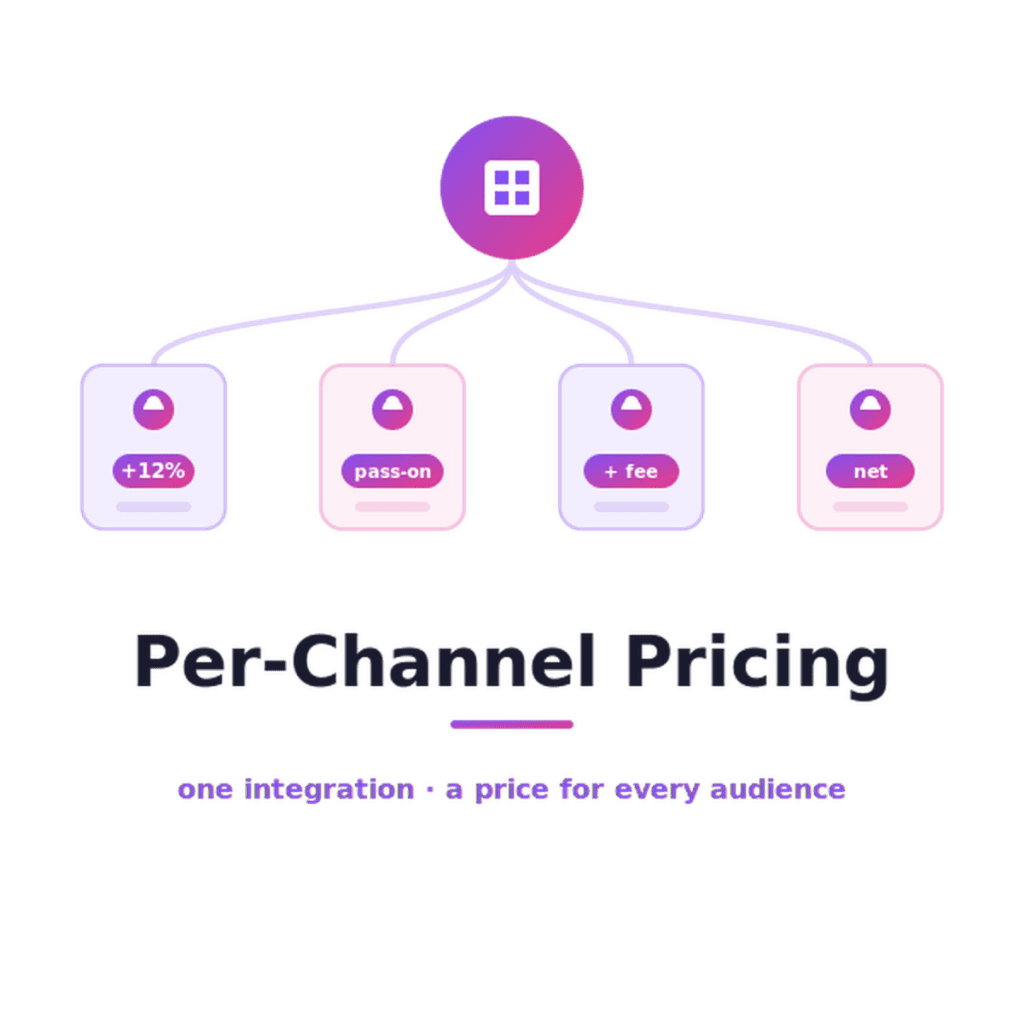
An agency runs four channels off a single ZentrumHub integration. The public B2C site carries a 12 percent markup. The sub-agent network runs on pass-on commission. The corporate portal charges a transparent service fee. The white-label partner receives net rates with the revenue rules switched off. Four price books, four audiences and one integration, all reporting into a single view.
Public, sub-agent, corporate and white-label pricing from one integration, changed by you in seconds.
See the B2B Travel Portal →The clearest way to understand per-channel pricing is to see how the same platform serves four common audiences, each on its own terms.
| Channel | Pricing model | Why it fits |
|---|---|---|
| Public B2C site | Standard markup | Retail buyers accept a full retail margin |
| Sub-agent network | Pass-on commission | Keeps agents competitive so they book more |
| Corporate portal | Transparent service fee | Corporates want visible, auditable pricing |
| White-label partner | Net rates, rules off | Partner adds their own margin downstream |
Notice that these are not just four different markup percentages. They are four different pricing philosophies, from full retail margin to zero markup, all running side by side. For the mechanics of the sub-agent model in particular, see our guide to markup and margin control.
Per-channel control is about more than the number you add to a rate. Because the whole channel is scoped, several other things can differ between audiences. Using them well is what separates a basic setup from a well-run one.
Supplier set can vary, so a corporate channel might see a curated set of premium and reliable suppliers while your public site sees the full network. Result ordering can vary, so one channel sorts by lowest price while another sorts to promote the supply that earns you the most margin. Revenue rules can be switched off entirely for a net-rate partner. And search behaviour can be tuned per channel. All of these settings live inside the channel alongside its pricing, so each audience gets an experience shaped for it rather than a single global compromise.
On the public site a search sorts by lowest price and shows the full supplier network at a 12 percent markup. On the corporate channel the same search shows a curated set of reliable suppliers, sorts to favour the agency’s higher-margin contracts and adds a transparent service fee instead of a hidden markup. One platform, one integration and two experiences built for two very different buyers.
The final piece is control. Per-channel pricing is only useful if you can actually change it yourself, quickly, when a relationship or a market shifts. On ZentrumHub every channel rule is a back-office setting that goes live on save. If a strategic sub-agent earns better terms, you adjust their channel and it is live in seconds. If a corporate renegotiates their fee, you change their channel alone and no other audience is affected.
Because pricing power is sensitive, the same platform lets you restrict who can change a channel and record every change, so pricing stays an accountable, controlled function rather than a free-for-all. To see how per-channel pricing fits alongside supply, sub-agents and white-label in one platform, start with the pillar guide to B2B travel agency software.
Give your public site, sub-agents, corporate clients and white-label partners their own pricing, supply and ordering from a single platform. See it configured for your agency.
Per-channel pricing is the ability to price different audiences differently from one platform. Each audience runs on its own channel. Every channel carries its own markup, its own commission model, its own supplier set and its own result ordering. So your public site, sub-agent network, corporate portal and white-label partners can each be priced completely differently while running on a single integration with one consolidated reporting view behind them.
Yes. Each sub-agent runs on its own channel, so you can give every one a different markup or commission split without affecting anyone else. A high-volume agent can get better terms than a casual one. A strategic agent can get a more generous pass-on split. Because the rules are scoped to the channel, a change you make for one sub-agent never touches another. Every change is a back-office edit that goes live in seconds.
No. That is the point of the channel model. You run every audience from a single integration. Each channel simply holds its own pricing, supply and behaviour on top of that one connection. You do not maintain a separate platform for your public site, another for sub-agents and another for corporate. One integration serves all of them, which keeps cost and maintenance low while still giving each audience its own pricing.
Quite a lot. Because the whole channel is scoped, the supplier set can vary, so a corporate channel might see only curated premium suppliers while the public site sees the full network. Result ordering can vary, so one channel sorts by lowest price while another promotes higher-margin supply. Revenue rules can be switched off for a net-rate partner. Search behaviour can be tuned per channel too. Each audience gets an experience shaped for it rather than one global compromise.
Immediately. Every channel rule on ZentrumHub is a back-office setting that goes live on save, so you never wait for a developer or a code release. If a sub-agent earns better terms you adjust their channel and it is live in seconds. Because the change is scoped to that channel no other audience is affected. The platform also lets you restrict who can change pricing and records every change, so the speed does not come at the cost of control.


Drop your work email and we’ll send you the 12-page report that breaks down where 6–9 months and $215K+ quietly disappear — free.

