



Table of Contents
A travel distributor does not really sell trips. It sells inventory and technology to a network of other agents who sell the trips. That is a different business. It needs a platform built for reselling at scale rather than one built to serve travellers. This guide covers what that platform must do.
B2B travel software for a distributor or consolidator has to do more than a platform for a single agency. It must onboard and manage a large network of sub-agents, price each one independently, share supplier commission fairly through pass-on models, charge partners for the platform capacity they actually use and report on every client separately. These are the economics of reselling at scale. A platform that handles them lets a distributor grow its network without the operation collapsing into chaos.
Written for B2B travel distributor and consolidator owners
There is a meaningful difference between an agency that sells hotels to travellers and a distributor that sells hotels to other agencies. The first serves end customers. The second serves a network of resellers, each of whom has their own pricing, their own customers and their own commercial relationship with you. As that network grows from a handful of agents to dozens or hundreds, the demands on the underlying platform change completely, so software that was fine for a single agency starts to buckle.
This guide is written for the distributor or consolidator owner running that reselling business. It covers the five capabilities that separate a platform built for distribution from one built for a single agency, plus how the capabilities inside B2B travel agency software support reselling at scale. The distributor and wholesaler use cases are also described on the B2B travel software and hotel wholesalers pages.
The core difference is that a distributor sits one layer up in the chain. A single agency worries about its own customers and its own margin. A distributor worries about a whole population of agents, each running their own little business on top of yours, each needing their own pricing, access and reporting. Your product is not really the hotel booking. Your product is the inventory, the technology and the terms you offer your agents. Your success depends on how well you serve them at scale.
That shift changes what matters. Onboarding stops being a one-off and becomes a repeated process you run constantly. Pricing stops being a single markup and becomes a per-agent negotiation. Cost stops being your own supplier bill and starts including what each agent consumes on your platform. Reporting stops being one dashboard and becomes a separate view per client. A platform that treats every agent as an afterthought will hold a distributor back, because the distributor business is fundamentally about managing many agents well.
The first capability a distributor needs is the ability to manage many agents without the operation grinding to a halt. Each agent needs onboarding, their own scoped access so they see only their own activity and their own place in the system. If any of that is a manual, one-off task, a distributor hits a wall at a few dozen agents. If it is a repeatable configuration, the same process scales from your first agent to your thousandth.
ZentrumHub runs each agent on its own channel, carrying that agent’s pricing, supply and reporting, all from your single integration, with each agent scoped to their own data. Adding an agent is a configuration rather than a project, so a growing network stays manageable rather than becoming a support burden. The mechanics of onboarding and scoping agents at scale are covered in our guide to onboarding sub-agents on your B2B portal.
A distributor cannot price every agent the same. A high-volume agent who sends hundreds of bookings a month has earned better terms than one sending a handful, a strategic agent in a new market might get a keen introductory rate and a difficult one might be held at standard terms. The platform has to let you set genuinely different economics per agent without those settings leaking into each other.
Because pricing on ZentrumHub is scoped to each agent’s channel, you can give every agent their own markup, commission split and terms, changed in the back office in seconds and invisible to everyone else. This is what lets a distributor run a differentiated network, rewarding the agents worth rewarding and holding the terms that need holding, all from one platform. The full range of pricing rules is covered in our guide to markup and margin control.
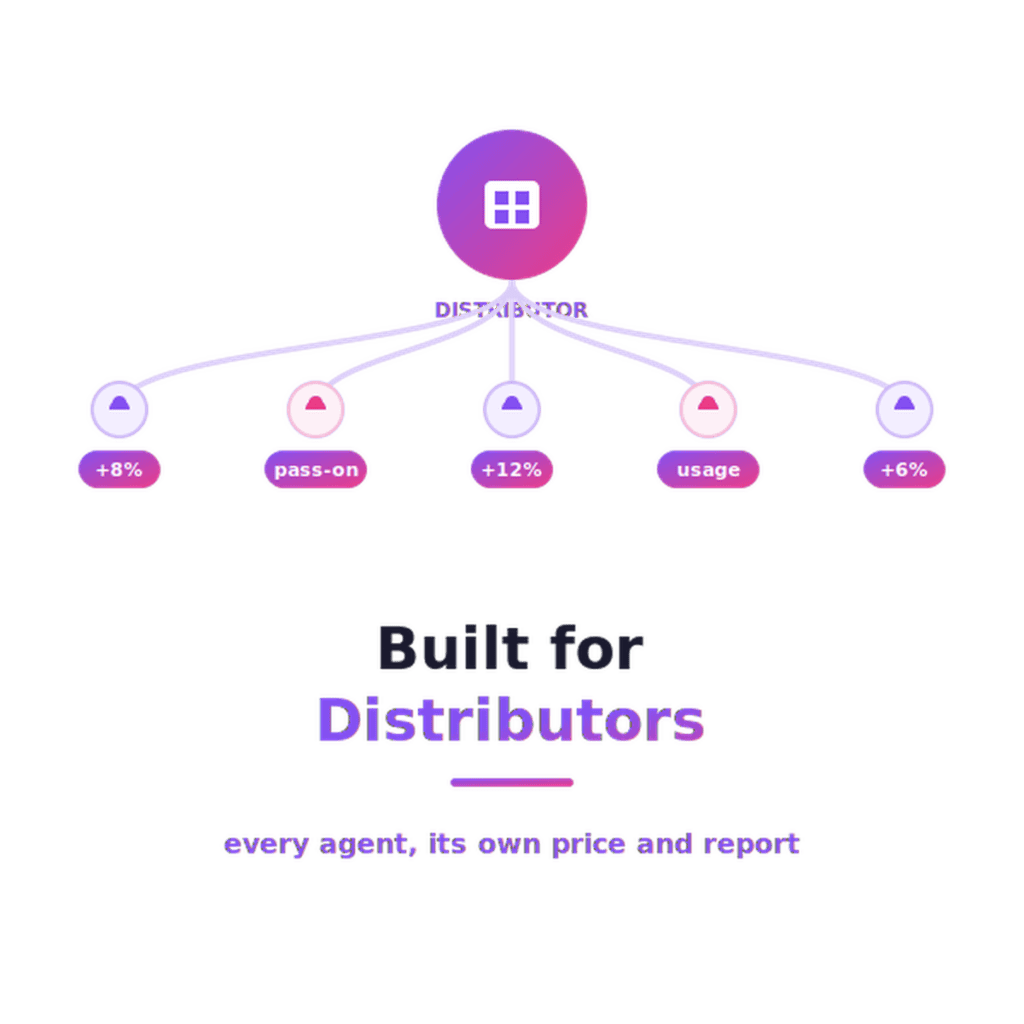
Every agent with their own pricing, access and reporting, all from one integration.
See B2B Travel Software →Distribution economics live or die on how commission is shared. Your agents can buy from aggregators directly, so if your prices are not competitive they simply go elsewhere. The way to keep them competitive while still earning is pass-on commission, where you account for the supplier commission on a booking and split it with the agent, keeping part as your margin and passing part on to sharpen the rate they see.
This is the single most important pricing mechanic for a distributor, because it aligns your interest with your agents. A more generous split makes an agent more competitive, which drives their volume, which earns you more in absolute terms even at a thinner per-booking margin. Setting the split per agent lets you invest more in your best relationships and less in casual ones, turning commission sharing into a deliberate growth lever rather than a flat giveaway.
A distributor runs its whole network on pass-on commission, keeping part of each supplier commission and passing part on to keep agents competitive. Its three highest-volume agents sit on a more generous split, set on their own channels, so their rates are sharper still and they keep sending volume. The distributor earns more in absolute terms from the higher volume than it would have from a flat, less generous split applied to everyone.
At distributor scale, the platform capacity your agents consume becomes a real cost, while a flat platform fee across all of them is quietly unfair. A light, efficient agent ends up subsidising a heavy one whose integration hammers the platform with searches, so your best-behaved partners carry the cost of your worst-behaved. To charge fairly, you have to see what each agent actually consumes.
ZentrumHub measures API consumption per channel, so you can see exactly what each agent costs in platform usage and charge on it rather than applying one blunt fee. This lets you bill heavy users for their real usage, protect your efficient agents from subsidising others and spot an inefficient integration or abnormal pattern before it inflates your costs. We cover this in depth in our guide to charging sub-agents for what they use, which becomes more important the larger your network grows.
The final capability is per-client reporting, because a distributor cannot manage a network it can only see as a single blended total. You need to know which agents are growing, which are stalling, which are profitable after their costs and which deserve better terms or a difficult conversation. That requires reporting that isolates one agent at a time rather than averaging everyone together.
ZentrumHub provides a per-client focus view that shows a single agent’s bookings, revenue, commission and average booking value on their own. Combined with the per-channel cost view, it gives you a true picture of what each agent brings in against what they cost. That is the account-management layer a distributor runs on, turning a loose collection of agents into a deliberately managed, profitable network. The reporting side is covered fully in our guide to B2B travel portal analytics. To see how these distributor capabilities sit within the wider platform, start with the pillar guide to B2B travel agency software.
Manage hundreds of agents, price each independently, share commission with pass-on, charge fairly for usage and report per client, all from one platform. See it configured for your business.
A distributor sells inventory and technology to a network of reselling agents rather than trips to travellers, so its platform has to manage many agents at scale. Beyond a single agency’s needs, it must onboard and scope a large sub-agent network, price each agent independently, share supplier commission through pass-on models, charge partners for the platform capacity they use and report on every client separately. These are the economics of reselling at scale. A platform that handles them lets a distributor grow its network without the operation collapsing into chaos.
It keeps agents competitive while you still earn. Your agents can buy from aggregators directly, so if your prices are not sharp they go elsewhere. Pass-on commission accounts for the supplier commission on a booking and splits it with the agent, keeping part as your margin and passing part on to improve their rate. A more generous split makes an agent more competitive, which drives their volume and earns you more in absolute terms even at a thinner per-booking margin. Setting the split per agent lets you invest more in your best relationships, turning commission sharing into a growth lever.
By usage, once you are at distributor scale. A flat platform fee is quietly unfair, because a light, efficient agent ends up subsidising a heavy one whose integration hammers the platform with searches. Measuring API consumption per channel lets you see what each agent actually costs and charge on it, so heavy users pay for their real usage and your efficient agents are not carrying them. It also surfaces an inefficient integration or abnormal pattern before it inflates your costs, which matters more the larger your network grows.
Yes. A distributor has to. A high-volume agent has earned better terms than a casual one, a strategic agent in a new market might get an introductory rate, while a difficult one might be held at standard terms. On ZentrumHub pricing is scoped to each agent’s channel, so you can give every agent their own markup, commission split and terms, changed in the back office in seconds and invisible to everyone else. This is what lets a distributor run a differentiated network rather than a one-size-fits-all one.
Because you cannot manage a network you can only see as a single blended total. You need to know which agents are growing, which are stalling, which are profitable after their costs and which deserve better terms or a difficult conversation, since a blended figure hides all of that. A per-client focus view isolates one agent at a time, showing their bookings, revenue, commission and average booking value on their own. Combined with the per-channel cost view, it gives a true picture of what each agent brings in against what they cost, which is the account-management layer a distributor runs on.
Five capabilities a travel distributor or consolidator needs. Score any platform out of five.
'+ '| Capability | Yes |
|---|---|
| Onboard and scope a large sub-agent network as a repeatable task | |
| Price each agent independently, with no cross-leak | |
| Share supplier commission through pass-on, set per agent | |
| See API consumption per agent and charge on usage | |
| Report on every client separately, not just a blended total | |
| Run all of it from a single integration |
Checklist by ZentrumHub. zentrumhub.com/blog/b2b-travel-software-distributors. Book a demo at zentrumhub.com/book-time
'+ ''; var w = window.open('', '_blank'); w.document.write(html); w.document.close(); w.focus(); setTimeout(function(){ w.print(); }, 350); }