
Table of Contents
A hotel supplier integration isn’t a project you finish. It’s a connection you keep alive — through API changes, format drift, and silent booking failures — for as long as you run it. The build is a one-time cost. The maintenance is rent you pay forever.
When an OTA scopes a hotel supplier integration, the question is almost always “how long to build and how much?” It’s the wrong question — or at least an incomplete one. Because the day you go live isn’t the finish line. It’s the day the meter starts running.
A supplier integration is not a thing you buy once. It’s a connection you keep alive — patched, monitored, re-certified, and debugged — for every day it stays in production. Suppliers change their APIs without warning, bookings fail in ways no error message tells you about, and the engineering hours never quite stop. The build is a one-time cost. The maintenance is rent, and you pay it forever.
This guide is about that rent — what you’re really maintaining, why it compounds faster than you’d expect as you add suppliers, the silent failures that quietly drain revenue, and the cost nobody puts in the spreadsheet. With the bedbank market heading toward $118.7 billion by 2034 and OTAs connecting more suppliers than ever, the maintenance bill is the line item most likely to surprise you.
The build cost is visible and finite — you scope it, budget it, and ship it. Maintenance is the opposite: invisible at decision time, and effectively infinite in duration. That asymmetry is exactly why it gets underestimated. Nobody puts “supplier breaks their API in 14 months” on the project plan.
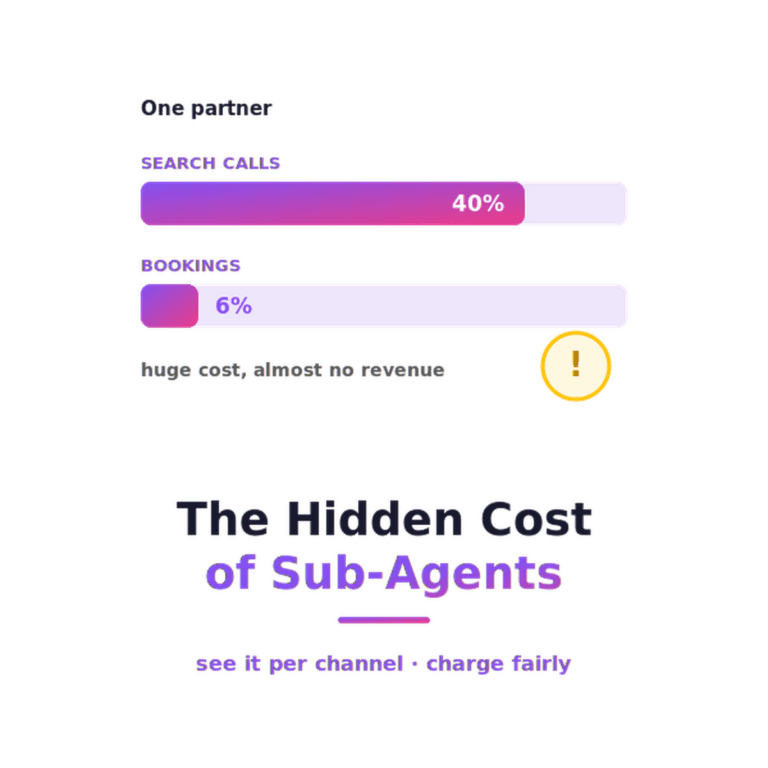
Put a number on it. Keeping live integrations healthy consumes roughly 10–15% of engineering capacity — and for a set of five suppliers, that lands around $60,000 to $90,000 a year, every year, before you’ve added a single new feature. That’s not a one-time line; it’s an annuity you owe for as long as the connections run. We break the full picture down in the hidden cost of integrating suppliers one by one.
“Maintenance” sounds vague until you list what actually breaks. Each item below is recurring, unpredictable, and on someone’s plate the moment it happens:
Of all the maintenance costs, the most dangerous is the one you can’t see. A booking doesn’t always fail with a clear error. Sometimes it just… doesn’t complete — a timeout, a malformed response, a quietly rejected payment — and no alarm goes off. The customer sees a problem; your dashboards don’t.
Across live integrations, somewhere between 2% and 7% of bookings can fail silently. That’s revenue leaving without a trace, plus a frustrated customer who may never come back. Put real numbers on it: at 500 bookings a day with a 4% silent-failure rate, the support cost alone runs around $2,000 a month — before you count the bookings themselves, which simply vanish.
Catching them requires active monitoring you have to build and maintain — booking-success tracking, anomaly detection, reconciliation against supplier records. Without that ongoing investment, the leak runs indefinitely, and the first you hear of it is a customer complaint. The cost of not maintaining detection is higher than the detection itself.
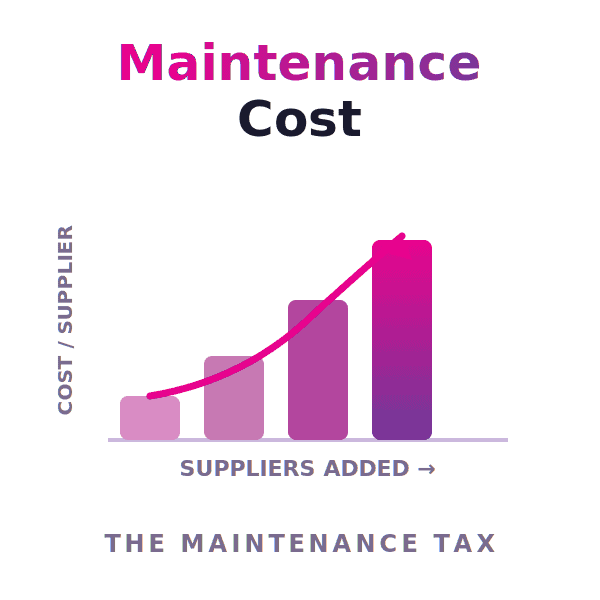
Here’s the part that catches teams off guard. You might assume maintenance scales linearly — ten suppliers cost twice the upkeep of five. It doesn’t. It scales worse than linearly, because integrations don’t sit in isolation. They share infrastructure, share an on-call rotation, and interact in ways that multiply the work. We call this the Maintenance Tax: a cost per supplier that rises as you add more.
Three forces drive the compounding. Combinatorial testing — every change to one integration has to be tested against all the others. Shared-infrastructure contention — more connections competing for the same pipes and on-call attention. And cascading failures — one supplier’s breakage can mask or trigger another’s, turning one incident into three.
“The Maintenance Tax” — a ZentrumHub framework. The thresholds are illustrative; the exact points depend on your suppliers and how volatile their APIs are.
Even if you tally every dollar of maintenance perfectly, you’ll still miss the biggest cost — because it doesn’t appear on any invoice. It’s opportunity cost. Every engineer-hour spent keeping a supplier connection alive is an hour not spent on the product, the conversion improvements, and the features that actually win and keep customers.
For most OTAs, engineering is the scarcest resource you have. Spending 10–15% of it on integration upkeep — rising as you add suppliers — means the roadmap you didn’t ship is the real price tag. The $60K–$90K is just the part you can see. The growth you traded away to keep the lights on is the part that quietly decides whether you win.
The reason maintenance hurts so much when you build in-house is that you bear it alone — every API change, every silent-failure check, every 2am page is yours. An aggregator changes the economics by spreading that cost across all its customers.
When a supplier ships an authentication change, the hotel API aggregator handles it once, centrally — not separately by every OTA connected to that supplier. The combinatorial testing, the monitoring, the on-call, the mapping re-matching — it all happens behind a single connection you maintain instead of dozens. Your marginal maintenance cost for the 7th, 20th, or 50th supplier drops toward zero, because the aggregator absorbs the upkeep the Maintenance Tax was charging you for.
One honest caveat: you’re now trusting the aggregator’s reliability and monitoring, so it’s worth asking the hard questions — what’s their uptime, how do they detect and handle supplier breakages, and do they catch silent failures? The right answers are what make outsourcing maintenance a genuine saving rather than a hidden dependency.
In-house, every supplier you add raises your maintenance tax. Through an aggregator, maintenance becomes someone else’s full-time job — handled once for everyone — so your engineers can spend their hours on product instead of upkeep.
Zentrum Connect maintains 100+ supplier integrations centrally — API changes, monitoring, and mapping handled for you, behind one connection with 99.99% uptime.
See Zentrum Connect →Zentrum Connect maintains 100+ supplier integrations for you — handling API changes, monitoring, and mapping centrally so your engineers build product instead of keeping the lights on. 30M+ daily API calls. 99.99% uptime.
Drop your work email and we’ll send you the 12-page report that breaks down where 6–9 months and $215K+ quietly disappear — free.