






Table of Contents
You already have a website. You want it to sell hotels. Somewhere along the way someone told you that means building an online travel agency from scratch. It does not. There are three very different ways to add hotel booking to a site you already have and most people pick the wrong one for their situation. Here is how to pick right.
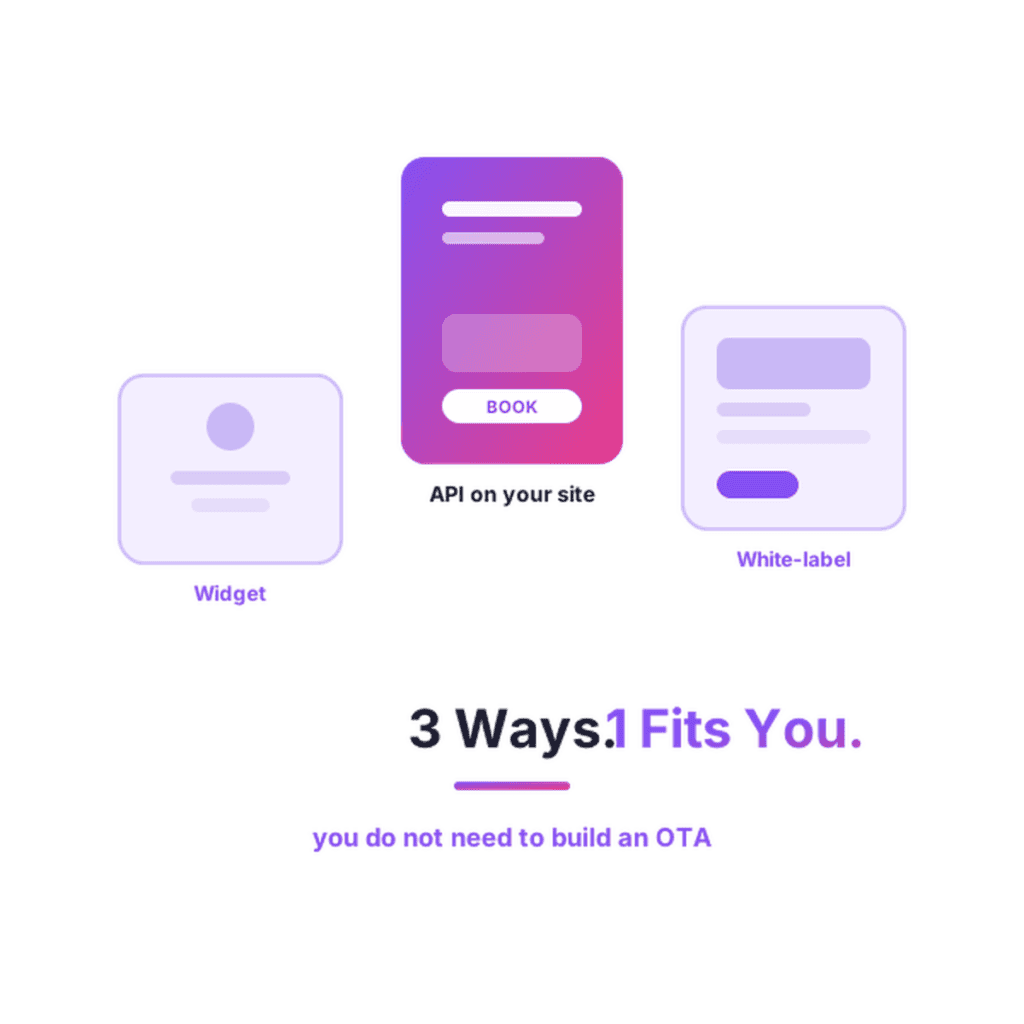
There are three ways to add hotel booking to an existing website. A widget or redirect, where a third party powers search and booking and you earn a commission, which is fastest but least yours. A hotel booking website API plugged into your own front end, where you control the experience and keep the margin while someone else handles supply and the booking engine. And a full white-label booking engine, where you run the whole platform under your brand. The right choice depends on how much control you want, how much you can build and how the booking fits your business, not on which is most advanced.
Written for website owners, agencies and niche travel sites adding hotel booking
Plenty of businesses reach the same point. A travel agency with a brochure site, a tour operator, a niche travel blog with real traffic, a membership site whose audience travels. They all realise the same thing: there is money in letting visitors book hotels without leaving and someone has told them it is a huge build. That advice is usually wrong or at least incomplete, because it assumes one route when there are three.
This guide lays out all three plainly, so you can match the approach to your actual situation rather than defaulting to the biggest one. It is not about which is the most sophisticated. It is about which earns you the most for the effort you can realistically put in. If you want the deeper reality of running the most involved option, our piece on what nobody tells you before building a booking engine is the honest companion to this one.
The belief that selling hotels on your site means building an online travel agency is the single most expensive assumption in this space. Building an OTA means owning search, booking, payments, supply relationships, reconciliation and support: a serious multi-month undertaking. For a handful of businesses that is exactly the right investment. For most, it is a sledgehammer for a job that needs a far lighter tool. Reaching for it is how good ideas die in development.
The useful way to think about it is a spectrum of control. At one end you borrow someone else’s booking experience and take a cut. At the other you own everything. In the middle, a hotel booking website API lets you keep the experience and the margin while someone else carries the heavy infrastructure. The question is not which end is best. It is where on that spectrum your business actually belongs, which depends on three things we will come back to: control, build capacity and how central booking is to what you do.
The lightest option is to embed a search widget or send visitors to a partner’s booking page and earn a commission on what they book. Someone else owns the search, the booking and the support. You add a snippet or a link and you are live in a day. For a travel blog, a content site or anyone whose main business is not booking, this is often the smartest starting point, because it turns existing traffic into revenue with almost no cost or risk.
The trade-off is ownership. The booking does not feel like yours, the visitor often leaves your site to complete it, the commission is modest and you have little control over price or experience. You are renting a revenue stream rather than building an asset. That is a perfectly good deal when booking is a side benefit, but it hits a ceiling fast if booking becomes central to your business, which is the point at which people start looking at the next option.
The middle option is where most serious businesses land. You plug a hotel booking website API into your own front end, so search and booking happen on your site, in your design, under your brand, while the supply and the booking engine behind it are handled for you. The guest never leaves, the experience is yours and you set your own margin, but you are not building and maintaining supplier connections or the booking infrastructure yourself.
This is the option that balances control and effort best for most. You get the thing that matters, ownership of the customer experience and the economics, without taking on the thing that is hard and undifferentiated, the supply and the engine. The effort is real but moderate: you build the front end and wire in the API, rather than building an entire platform. For an agency or a travel site that wants booking to be a core part of the business, this is usually the sweet spot. Our hotel API is built for exactly this.
An API into your own site gives you the two things that actually drive a booking business: the customer experience and the margin. It leaves out the two things that are hard and add no differentiation: the supplier relationships and the booking engine. That trade is why the middle option fits more businesses than either extreme and why so many sites that start on a widget eventually move to it.
Keep your brand and your margin. We handle the supply and the engine behind it.
See the Hotel API →The most complete option is a white-label booking engine: a full booking platform that runs under your brand, often with little or no development from you. Where the API option gives you the pieces to build your own front end, a white-label engine gives you a ready-made one you can style and launch. You get a complete booking site quickly, with the supply, the engine and the front end all handled and your brand on top.
This suits businesses that want a real booking operation fast without building it and without the flexibility of a fully custom front end. You trade some control over the exact experience for speed and simplicity and you can usually be live in a fraction of the time a custom build takes. For many agencies and travel businesses this is the quickest route to a proper branded booking site. Our B2C travel portal is this option, built to go live in around fifteen days.
The clearest way to see the choice is to line the three up against what matters.
| What matters | Widget / redirect | API into your site | White-label engine |
|---|---|---|---|
| Time to launch | A day | Weeks | Around 15 days |
| Who owns the experience | The partner | You | You (styled template) |
| Control of margin | Low (set commission) | Full | Full |
| Build effort | Almost none | Moderate | Low |
| Guest stays on your site | Often no | Yes | Yes |
| Best when booking is | A side benefit | Core, you want control | Core, you want speed |
Read across the bottom row first. The single best predictor of the right option is how central booking is to your business and how much you want to own the experience versus launch quickly. Everything else follows from that.
Here is the honest shortcut. If booking is a side benefit to a content or community business, start with a widget and earn commission with near-zero effort. If booking is going to be core and you want full control of the experience and have some development capacity, put a hotel booking website API into your own front end. If booking is core but you want to launch fast without a custom build, take a white-label engine. Most businesses that think they need to build an OTA actually belong in one of the last two.
The mistake to avoid is choosing by ambition rather than fit. The most powerful option is not the best option unless your business genuinely needs that power and over-building is as costly as under-building. Start from where booking sits in your business and how much you can realistically build, not from which approach sounds most impressive. If you are weighing the API route against the white-label route, a short conversation about your specific setup usually makes the answer obvious and you can book a time with our team to talk it through.
Whether you want an API into your own front end or a white-label engine live in around 15 days, we have the route that fits. Tell us your setup and we will point you to the right one.
There are three ways. Embed a widget or redirect visitors to a partner and earn commission, which is fastest and needs almost no build. Plug a hotel booking website API into your own front end, so search and booking happen on your site under your brand while supply and the engine are handled for you. Or use a white-label booking engine, a ready-made branded platform you can launch quickly. The right one depends on how central booking is to your business and how much you want to own the experience versus launch fast.
No and assuming you do is the most expensive mistake in this space. Building an online travel agency means owning search, booking, payments, supply, reconciliation and support, which is a serious multi-month project that only a few businesses actually need. Most businesses are better served by a hotel booking website API plugged into their own front end or a white-label engine, both of which give you a branded booking experience without building the whole platform yourself.
A hotel booking website API is a connection you plug into your own site so visitors can search hotel rates and availability and complete a booking without leaving, while the supply and the booking engine behind it are handled for you. It sits in the middle of the three options: more control than a widget, because the experience and margin are yours and far less effort than building an entire online travel agency, because you are not maintaining supplier connections or the booking infrastructure.
Both the API option and the white-label engine keep the guest on your site and under your brand through the whole booking. A widget or redirect often sends the visitor to a partner’s page to complete the booking, which is fine when booking is a side benefit but weaker when it is core to your business. If keeping the customer and owning the experience matters, the API into your own front end or a white-label engine are the two to look at.
The absolute fastest is a widget or redirect, which can be live in a day but gives you the least ownership. If you want a real branded booking operation fast, a white-label engine is the quickest proper route, often live in around fifteen days, because the supply, the engine and the front end are all handled and you add your brand on top. Building a custom front end on a hotel booking website API takes longer but gives you the most control over the experience.
Three questions. Where most of your answers land is your route.
'+ '| Question | Widget | API into your site | White-label |
|---|---|---|---|
| How central is booking to your business? | A side benefit | Core | Core |
| How much do you want to own the experience? | Not much | Fully | Fully (template) |
| How much can you build? | Almost nothing | A front end | Very little |
| How fast do you need to launch? | Today | Weeks is fine | About 15 days |
Mostly left: start with a widget. Mostly middle: a hotel booking website API into your own front end. Mostly right: a white-label engine.
'+ 'Decision sheet by ZentrumHub. zentrumhub.com/blog/add-hotel-booking-to-website. Book a demo at zentrumhub.com/book-time
'+ ''; var w = window.open('', '_blank'); w.document.write(html); w.document.close(); w.focus(); setTimeout(function(){ w.print(); }, 350); }