






Table of Contents
A hotel booking engine API looks deceptively simple in the demo. Search returns rooms, a booking confirms and it feels done. Then it goes live, real money moves, so the gap between a working demo and a real booking engine shows up fast. Here is what actually breaks and why.
A hotel booking engine API is easy to connect and hard to run well. Getting a search result and a test booking working takes days. What takes months is everything after that: handling bookings that fail silently, keeping cached prices honest, surviving traffic spikes, reconciling what the supplier charged against what the guest paid, handling cancellations cleanly and supporting agents when something goes wrong. The demo proves the API works. A real booking engine proves it works on the worst day, not the best one. This is what the difference costs.
Written for founders and product owners building a hotel booking platform
There is a moment every team building a booking platform remembers. The first time a hotel booking engine API returns a list of real rooms at real prices and a test booking comes back confirmed, it feels like the hard part is over. It is not. It is barely the beginning. The demo is the part that is designed to work. The business is everything that happens when it does not.
This is not another guide to connecting a hotel booking engine or weighing up its cost. Plenty of those exist, including our own. This is the honest version, the things experienced teams only learn after launch, when real guests are booking real rooms with real money. If you are about to build on a hotel booking engine API, read this before you commit, because knowing where it breaks is what separates a platform that survives its first busy month from one that quietly loses trust.
A demo runs in perfect conditions. One user searches one city, the supplier responds instantly, the rate is still valid when the booking lands and the payment clears. Every variable that can go wrong is quietly held still. That is exactly why a hotel booking engine API demos so well and runs so hard. The demo measures whether the connection works. Your business depends on what happens when the conditions are not perfect, which is most of the time.
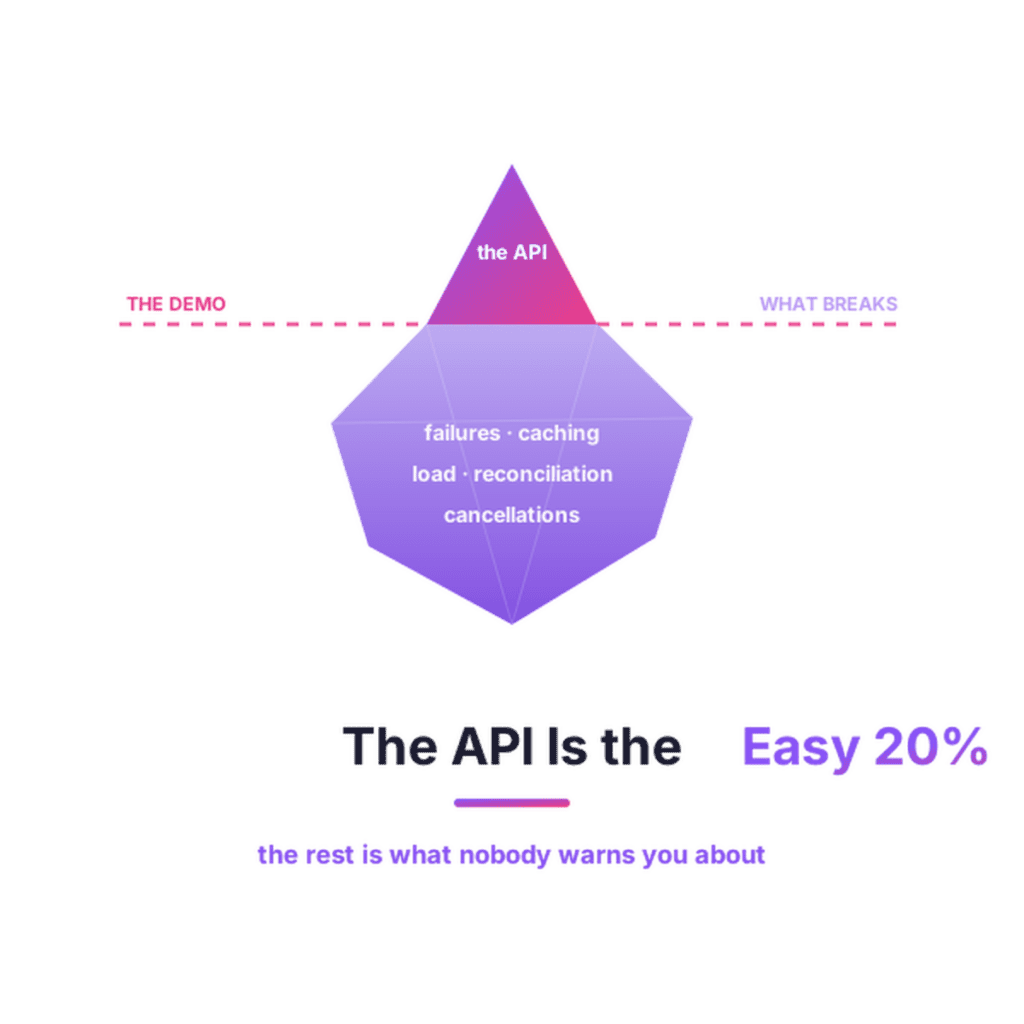
The uncomfortable truth is that the booking engine API is the easy twenty percent. The search call and the booking call are well documented and quick to wire up. The hard eighty percent is the operational layer around them: the retries, the edge cases, the reconciliation, the support, the handling of the dozen ways a real booking can go sideways between a guest clicking confirm and a guest sleeping in the room. The rest of this piece is that eighty percent, broken into the specific places it bites.
The single most damaging thing a booking engine can do is tell a guest they are booked when they are not. It happens more than anyone expects. A guest clicks confirm, your system shows success, but the booking never completed at the supplier or completed then failed to return a confirmation your system recorded. The guest has a confirmation screen and no room. They find out at the front desk, which is the worst possible place to find out.
A raw hotel booking engine API will not solve this for you. Handling it means building logic to verify every booking actually landed at the supplier, to catch the cases where the confirmation call times out but the booking succeeded, then to reconcile your records against the supplier’s continuously rather than trusting a single response. None of that is in the demo. All of it is the difference between a guest who rebooks with you and one who never comes back. This reliability layer is a large part of what a mature booking platform quietly does for you.
Hotel prices change constantly and a booking engine faces an unavoidable tension. If you call the supplier live for every search, your results are accurate but slow, with heavy search traffic able to overwhelm the supplier and your own rate limits. If you cache prices to make search fast, you serve results quickly but risk showing a price that is no longer valid. Every booking engine lives somewhere on this spectrum and where it sits is a decision most teams make by accident rather than on purpose.
The trap is that caching too aggressively produces a specific, trust-destroying failure: the guest sees one price, commits, then the booking comes back at a higher price or fails entirely because the cached rate had expired. Getting this right means caching intelligently, refreshing fast-moving rates more often than stable ones and always revalidating the price at the moment of booking rather than trusting the cached figure. That revalidation step is easy to skip and expensive to skip and it is the kind of thing a raw API leaves entirely to you.
Cache for speed in search, but never book against a cached price. Always revalidate the live rate in the step between the guest choosing a room and the guest paying. It adds one call and removes the single most common cause of a booking that confirms at the wrong price. Teams that skip it to shave milliseconds pay for it in refunds and lost trust.
A booking engine that already handles failures, revalidation and reconciliation, so you ship the product not the plumbing.
See Zentrum Engine →A booking engine API behaves one way with ten searches a minute and a completely different way with ten thousand. The first busy day, a sale, a campaign, a seasonal rush, is when the architecture that worked in testing meets the limits it never hit before. Suppliers impose rate limits and a surge of searches can breach them, which means your results start failing exactly when the most people are trying to book. The quiet assumption that the API will simply keep up does not survive contact with a real spike.
Surviving load is its own discipline. It means spreading search traffic so you do not breach supplier limits, degrading gracefully when a supplier slows rather than failing the whole page and having the capacity to absorb a spike without falling over. A single raw hotel booking engine API gives you none of this by default and building it is a serious piece of engineering. It is also invisible until the day you need it, which is why so many teams discover they do not have it at the worst possible moment.
Here is a problem no demo ever shows: at the end of the month, the money does not reconcile. What the guest paid you, what the supplier charged you, what your markup was meant to be and what actually landed in your account rarely line up on their own. Currency conversion, supplier fees, cancelled bookings, partial refunds and rate changes all introduce small discrepancies. Across thousands of bookings they become real money and real hours spent chasing them.
A booking engine API returns a price and a confirmation. It does not reconcile your books. Building the financial layer that tracks every booking from the price shown to the money settled, flags the ones that do not match and gives you a clean picture of your actual margin is a substantial undertaking that most teams underestimate entirely. It is not glamorous, but it is the difference between knowing your business is profitable and hoping it is. This is exactly the kind of back-office reality a complete platform is built to carry.
The booking is not the end of the journey, it is the middle. After a guest books, a whole second product has to exist: cancellations and the refunds that follow, modifications when plans change, the voucher or confirmation the guest actually needs and the support queue for when any of it goes wrong. A hotel booking engine API will take a booking. It will not run your post-booking operation. That operation is where a surprising amount of the real work lives.
Cancellations alone are their own project. Processing a cancellation correctly against the supplier so the refund actually flows, tracking the free-cancellation deadline on every booking and keeping a clean record for the inevitable disputes are all things you have to build or buy. The teams that treat the booking as the finish line are the ones drowning in support tickets three months after launch, because everything that happens after confirm turned out to be bigger than everything before it.
The cruellest part of building on a hotel booking engine API is the shape of the effort. The first ninety percent of a working product comes quickly, which is why early demos feel so encouraging. The last ten percent, the edge cases, the error handling, the rare supplier quirks, the production hardening, takes as long as everything else combined. This is a well-known trap in software and booking engines are a textbook case of it because the edge cases are so numerous and so consequential.
Every supplier behaves slightly differently. One formats a cancellation policy one way, another returns an error code for a situation the first handles silently, a third has a quirk in how it confirms. Handling one supplier is a project. Handling many, each with its own behaviour, is the kind of ongoing maintenance that never fully ends, because suppliers change and new edge cases keep appearing. The question is not whether you can build the first ninety percent. It is whether you want to own the last ten percent forever.
Before you build on a raw hotel booking engine API, ask one question: is building and maintaining booking infrastructure the thing your business is meant to be world-class at? If yes, build it. If your edge is your brand, your customers or your market, the infrastructure is undifferentiated work that a platform can carry, freeing your team to build what actually sets you apart.
None of this is an argument against building a hotel booking platform. It is an argument for going in with your eyes open about what a hotel booking engine API does and does not give you. The API gives you access to inventory and the ability to book it. It does not give you reliability, honest pricing under load, reconciliation, a post-booking operation or the endless maintenance of edge cases. Those you either build or you get from a platform that has already built them.
That is the real decision. Not build versus buy on cost, which we cover in our guide to booking engine cost, but build versus buy on everything the demo hid. A platform like Zentrum Engine exists precisely because the gap between a working API call and a trustworthy booking engine is so much wider than it looks. Most teams would rather spend their time on the product their customers actually choose them for. Whichever way you go, decide it deliberately, because the teams that get surprised are the ones who thought the demo was the hard part.
Zentrum Engine gives you a booking engine that already handles the failures, the revalidation, the reconciliation and the post-booking operation. Launch the product, not the plumbing.
A hotel booking engine API is the connection that lets your platform search hotel rates and availability and make bookings programmatically, rather than a person doing it manually. It powers the search and book functions behind a booking website or app. The API itself handles the core calls, but a complete booking engine also needs the operational layer around it, covering failed bookings, price revalidation, load handling, reconciliation and post-booking support, which the raw API does not provide.
Connecting the API and getting a test booking working is quick, often a matter of days. Building a booking engine that is reliable in production is hard and takes months, because the difficult work is everything around the API: verifying bookings actually landed, revalidating cached prices, surviving traffic spikes, reconciling the money and running cancellations, refunds and support. The API is roughly the easy twenty percent. The operational layer is the hard eighty percent that decides whether guests trust your platform.
Usually because the confirmation step and the actual supplier booking fell out of sync. A booking can complete at the supplier while the confirmation call times out or your system can record success before the supplier finalised it, which leaves a guest holding a confirmation for a room that was never secured. Preventing this means verifying every booking actually landed at the supplier and continuously reconciling your records against theirs, rather than trusting a single API response. A raw booking engine API does not do this for you.
You almost certainly need some caching, because calling the supplier live for every search is slow and can breach rate limits under heavy traffic. The rule that protects you is to cache for speed in search but never book against a cached price. Always revalidate the live rate in the step between the guest choosing a room and paying. That one extra call removes the most common cause of a booking confirming at the wrong price, which is the failure aggressive caching produces.
It depends on whether building and maintaining booking infrastructure is what your business is meant to be world-class at. If it is, build it. If your edge is your brand, your customers or your market, then the reliability layer, reconciliation, post-booking operation and endless edge-case maintenance are undifferentiated work that a platform can carry, freeing your team for what actually sets you apart. The real decision is not cost alone, it is whether you want to own that operational layer forever.
The seven things that break after launch. Can you answer yes to each before you ship?
'+ '| Check | Ready |
|---|---|
| Every booking is verified as landed at the supplier, not trusted from one response | |
| Timed-out confirmations are caught and reconciled, not left as silent failures | |
| Prices are revalidated live at the moment of booking, never booked from cache | |
| Search load is spread so supplier rate limits are not breached in a spike | |
| The engine degrades gracefully when a supplier slows, instead of failing the page | |
| Every booking is reconciled from price shown to money settled | |
| Cancellations, refunds, modifications and support are built, not an afterthought | |
| Per-supplier edge cases and quirks are handled and have an owner for maintenance |
Checklist by ZentrumHub. zentrumhub.com/blog/hotel-booking-engine-api-reality. Book a demo at zentrumhub.com/book-time
'+ ''; var w = window.open('', '_blank'); w.document.write(html); w.document.close(); w.focus(); setTimeout(function(){ w.print(); }, 350); }