






Table of Contents
Most people think launching an online travel agency means integrating a hotel API. That is one piece of a stack with several. The order you add them in is the difference between going live in weeks and stalling for a year. Here is the OTA API integration sequence that actually works.
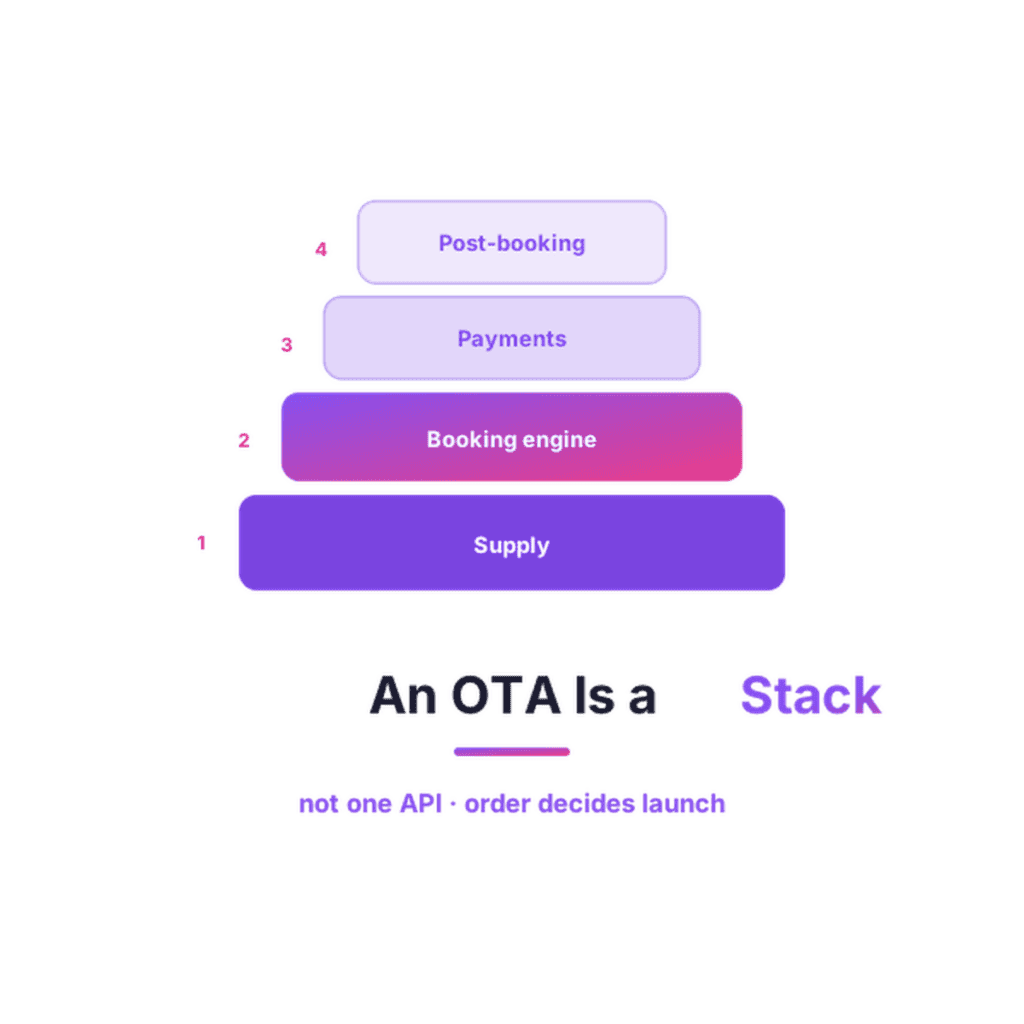
OTA API integration is not a single connection, it is a stack of them: supply, so you have hotels to sell; a booking engine, so visitors can search and book; payments, so you can take money; and post-booking, so cancellations, refunds and support work. The order matters. Lead with supply and the booking layer, add payments in parallel and treat post-booking as part of launch rather than an afterthought. The teams that stall are the ones who integrate everything at once or leave the hard layers for later, then discover at launch that the pieces do not fit.
Written for founders and product owners launching an online travel agency
Ask someone what it takes to launch an online travel agency and most will say one thing: integrate a hotel API. It is the answer that feels complete and is actually just the start. A working OTA needs several integrations that have to fit together. The teams that treat it as a single task are the ones who are still not live a year later, wondering where the time went. The problem is almost never the hotel API. It is everything they did not plan for around it.
This is a map of the whole stack and the order to build it in. It is not a line-by-line integration tutorial, our guide to hotel API integration covers that. This is the view from above: which layers an OTA actually needs, why each one matters and the sequence that gets you to launch without the stall. Get the order right and OTA API integration becomes a series of manageable steps. Get it wrong and it becomes a year of rework.
The single most useful shift in thinking is to stop picturing an OTA as a hotel API with a website on top. An OTA is a stack of four layers that each do a different job. All four have to work for a single booking to complete. You need something to sell, a way for people to find and book it, a way to take their money and a way to handle what happens after. Miss any layer and you do not have an OTA, you have a demo.
Seeing it as a stack changes how you plan. Each layer can be built or bought independently, each has its own difficulty. Each depends on the ones around it. The hotel API everyone fixates on is only the first layer. The layers people underestimate, payments compliance and the whole post-booking operation, are usually the ones that decide the launch date. The rest of this guide takes the four layers in turn, then puts them in the order that gets you live fastest.
Supply is where it starts, because without hotels to sell nothing else matters. This is the layer most people mean when they say OTA API integration: connecting to the sources of hotel rates and availability. The instinct is to integrate suppliers directly, one by one and for a first supplier that is fine. The trap is scaling it, because every direct supplier is a separate integration to build and maintain, with maintenance that never stops as suppliers change their APIs.
This is why most OTAs reach supply through an aggregator rather than wiring up suppliers themselves. A single aggregation layer gives you many suppliers through one integration, which collapses the slowest part of launching into a single connection. Whether you go direct or through an aggregator is the first real decision of your build and it sets the pace for everything after it. Get broad supply quickly and the rest of the stack has something to work with. Spend six months integrating suppliers one at a time and you have not even reached the hard layers yet.
The booking engine is the layer that turns supply into a sale. It is what lets a visitor search, see results, pick a room and confirm a booking and it carries all the logic that makes that reliable: revalidating prices, handling bookings that fail, managing availability in real time. People assume this comes free with the hotel API. It does not. The API returns data. The booking engine is what makes a trustworthy transaction out of it. Building it well is a serious piece of work.
This is the layer that most often gets underestimated, because the demo version is easy and the production version is hard. The gap between a booking that works in testing and one that holds up on a busy day with real money is wide and it is covered in depth in our piece on what nobody tells you before building a booking engine. For sequencing, the point is simple: the booking engine has to be built alongside supply, not after it, because the two only prove themselves when they work together.
Get 100+ suppliers and a production booking engine from a single integration, not a year of builds.
See the Hotel API →Payments is the layer people leave for last and regret leaving for last. Taking money online sounds like a solved problem until you are an OTA, where it comes with real complexity: multiple currencies, fraud risk on high-value bookings, the gap between charging the guest and paying the supplier, refunds that have to flow when a booking is cancelled. A payment integration that works for a simple shop is not automatically ready for the way an OTA actually moves money.
The sequencing lesson here is that payments should be built in parallel with supply and the engine, not bolted on at the end. It touches every other layer: the engine needs to trigger a charge, the supply side determines what you owe, post-booking needs to issue refunds. Teams that treat payments as a final step discover late that it reaches back into everything they have already built, which forces rework at exactly the moment they wanted to launch. Start it early, even if it finishes last.
The fourth layer is the one that barely registers in planning and dominates life after launch. Once a guest books, you need cancellations processed correctly against the supplier so refunds actually flow, modifications when plans change, the voucher or confirmation the guest relies on and a support path for when something goes wrong. None of this is in the hotel API. All of it is what your customers judge you on, because it is where real bookings meet real life.
Treating post-booking as part of launch rather than a later project is what separates an OTA that keeps customers from one that bleeds them. The teams that ship the search and booking flow and call it done are the ones drowning in support tickets a month later, because every cancellation and every change becomes a manual scramble. This layer is undramatic, which is exactly why it is skipped and skipping it is one of the most common reasons a technically working OTA still feels broken to its customers.
Here is the sequence that works, drawn from how OTAs that launch quickly actually do it.
| Step | Layer | Why this order |
|---|---|---|
| 1 | Supply | Nothing works without hotels to sell. Get broad supply first. |
| 1 (parallel) | Booking engine | Built with supply, because they only prove out together. |
| 2 (parallel) | Payments | Start early: it reaches into every other layer. |
| 3 | Post-booking | Part of launch, not a later project. Customers judge you here. |
| 4 | Launch | All four layers proven together, not search alone. |
The thread running through it is that the layers are built together, not in a straight line. The teams that stall are the ones who finish supply, then start payments, then think about post-booking, discovering each time that the new layer forces changes to the last. Build them in parallel with launch in mind and OTA API integration becomes a project with an end date rather than one that keeps receding.
Here is the part the long way around misses. Most OTAs that launch quickly do not build all four layers themselves. They get supply and the booking engine from a single platform, which collapses the two slowest and hardest layers into one integration, then focus their own effort on the front end and the brand that actually differentiates them. The build shrinks from four hard problems to one manageable one. The launch date moves from next year to next month.
That is the real decision behind OTA API integration. Not how to wire up each layer, but how many of them you genuinely need to own. If building booking infrastructure is your edge, build it. If your edge is your market, your audience or your brand, the supply and engine layers are undifferentiated work a platform can carry and the fastest OTAs treat them that way. The deeper build-versus-buy reasoning sits in our piece on the three ways to sell hotels on your own site and the shortest honest answer is that most OTAs should own less of the stack than they first assume.
Get supply and a production booking engine from one integration, so your team builds the brand and the front end instead of the plumbing. Tell us your plan and we will map your stack.
More than connecting one hotel API. An online travel agency is a stack of four layers: supply, so you have hotels to sell; a booking engine, so visitors can search and book reliably; payments, so you can take money across currencies and handle refunds; and post-booking, so cancellations, modifications and support work. OTA API integration means getting all four working together, not just returning search results. The hotel API is the first layer, but the layers people underestimate, payments and post-booking, are usually the ones that decide the launch date.
At minimum, supply and a booking engine to find and book hotels, a payment integration to take money and issue refunds and the systems behind post-booking for cancellations and support. Supply can come from direct supplier connections or, far more commonly, a single aggregation layer that delivers many suppliers through one integration. The key insight is that these are separate concerns that must work together, so an OTA is best planned as a stack of integrations rather than a single hotel API with a website on top.
Lead with supply and the booking engine together, because they only prove themselves when they work as a pair. Start payments early and in parallel, because it reaches into every other layer and forces rework if left to the end. Treat post-booking as part of launch rather than a later project, because customers judge you on cancellations and support. Then launch with all four layers proven together, not just the search flow. Building the layers in parallel with launch in mind is what prevents the year-long stall.
Usually because the team treated OTA API integration as a single task and built the layers one after another. Integrating suppliers one by one eats months before the hard layers even begin, payments turns out to reach back into everything already built and post-booking is discovered only after launch when support tickets pile up. The fix is to see the OTA as a stack, build the layers in parallel and in most cases get supply and the booking engine from a single platform so the two slowest layers collapse into one integration.
It depends on where your edge is. If building booking infrastructure is the thing your business is meant to be world-class at, build it. If your edge is your market, audience or brand, then supply and the booking engine are undifferentiated work a platform can carry, which collapses the two slowest layers into one integration and lets your team focus on the front end and brand that differentiate you. Most OTAs that launch quickly own less of the stack than they first assume and move the launch date from next year to next month.
Four layers, built in the right order. Plan all four before you start the first.
'+ '| Layer | What it has to do | Planned |
|---|---|---|
| 1. Supply | Broad hotel inventory fast, via aggregator or direct | |
| 2. Booking engine | Reliable search and book: revalidation, failure handling | |
| 3. Payments | Multi-currency, fraud, supplier payout, refunds. Start early | |
| 4. Post-booking | Cancellations, modifications, vouchers, support. Part of launch |
Order: supply + engine together, payments in parallel, post-booking before launch, then go live with all four proven.
'+ 'Checklist by ZentrumHub. zentrumhub.com/blog/ota-api-integration. Book a demo at zentrumhub.com/book-time
'+ ''; var w = window.open('', '_blank'); w.document.write(html); w.document.close(); w.focus(); setTimeout(function(){ w.print(); }, 350); }