






Table of Contents
The price on the quote is rarely what B2B travel portal software actually costs you. The headline number hides setup, supply, transaction fees, maintenance and the cost of the things the cheap option cannot do. Here is what it really costs and why choosing on sticker price is how agencies overpay in the end.
B2B travel portal software is usually priced in one of three ways: a one-off build, a monthly licence or a usage-based model tied to bookings or API calls. The sticker price is only part of it. The real cost includes setup and onboarding, how you get supply, transaction or API fees, ongoing maintenance and the hidden cost of what a cheap platform cannot do, such as lost bookings, thin margins and manual work. The cheapest option often costs the most over two or three years, because it saves on the quote and loses on everything the quote did not mention.
Written for B2B travel agency and distributor owners evaluating a platform
Every agency owner shopping for B2B travel portal software starts in the same place: asking what it costs. It is the right question with a misleading answer, because the number on the quote and the number you actually pay over the life of the platform are rarely the same. The gap between them is where good decisions go wrong, almost always in favour of the option that looked cheapest at the start.
This guide is about that gap. It lays out how B2B travel portal software is priced, what the headline figure leaves out and why the cheapest platform so often turns out to be the most expensive once the real costs land. If you want the broader picture of what a portal does before you price it, our B2B travel portal guide covers that. This one is strictly about the money and how to judge it properly.
B2B travel portal software is sold in three broad ways. The first step is knowing which one you are being quoted. A one-off build is a large upfront fee for a custom platform you then own and maintain. A monthly licence is a recurring subscription for access to a ready platform. A usage-based model charges according to activity, such as bookings made or API calls used, so the cost scales with your volume rather than sitting as a fixed line.
Each model hides its real cost in a different place. The one-off build looks like a single payment but carries years of maintenance behind it. The monthly licence looks affordable until you add what sits on top of it. The usage model looks cheap at low volume and has to be checked at the scale you actually expect to run. None of the three is inherently better value. What matters is reading each one for its full cost rather than its headline, which is exactly what the next sections do.
The quoted price is the tip of the cost. Underneath it sit several real expenses that rarely appear in the headline. Setup and onboarding take time and often money before you make a single booking. Supply has to come from somewhere and connecting to hotel inventory is either built into the price or a cost you carry separately. Transaction or API fees attach to activity. Maintenance and support continue for as long as you run the platform.
The reason this matters is that two quotes with the same headline number can carry wildly different real costs once these are added. A platform that looks cheap because supply is not included is not cheap, it has just moved a large cost off the quote and onto you. Reading B2B travel portal software pricing properly means asking what is bundled and what is extra, because the honest comparison is not quote against quote. It is total cost against total cost.
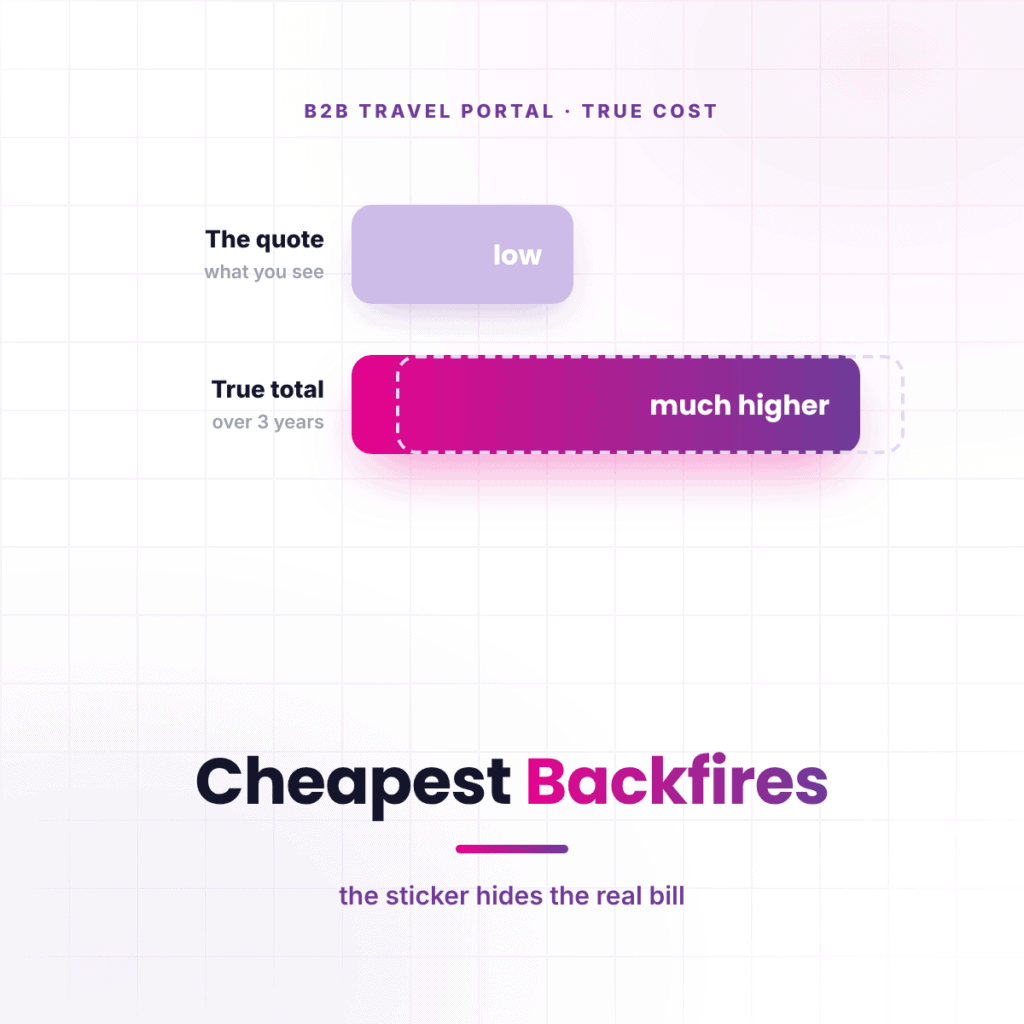
The cheapest platform wins on the quote and loses everywhere the quote is silent. Its savings are real but small. Its costs are hidden but large. They show up as lost revenue rather than line items, which is why they are so easy to miss when you are comparing prices. A cheap platform that books slowly, fails more often or gives you thin control over margin costs you money every single day, quietly, in ways that never appear on an invoice.
Think about what a weak platform actually does. Slow or unreliable search loses bookings your agents would otherwise have made. Poor margin control leaks profit on every transaction. Missing automation forces manual work that eats your team’s time. Thin supply means uncompetitive rates that send your agents elsewhere. Each of these is a cost. Together they can dwarf the few hundred dollars a month you saved on the licence. The cheapest option backfires because it optimises the one number you can see at the expense of all the ones you cannot.
Saving a few hundred dollars a month on a licence feels like a win. But if a weak platform loses you a handful of bookings a week to slow search, leaks a little margin on every sale and forces hours of manual work, the lost profit can run to many times the saving. The cheapest quote and the lowest total cost are rarely the same platform. The difference is measured in bookings you never see.
See what a B2B travel portal with supply, speed and margin control built in actually costs.
See the B2B Travel Portal →To compare B2B travel portal software honestly, add up five costs rather than one. The first is the platform cost, the build fee or licence you were quoted. The second is supply, how you reach hotel inventory and whether it is included or billed separately, because thin or expensive supply undermines everything. The third is transaction and API fees, the per-activity charges that scale with your volume and can quietly become your largest line.
The fourth is maintenance, the ongoing cost of keeping the platform running, updated and supported, which is heaviest on a custom build you own outright. The fifth and the one almost everyone forgets, is the opportunity cost, the revenue a weaker platform loses you through slow search, failed bookings, poor margin control and manual work. Add those five and you have the real number. A platform that scores well across all five is cheaper in total than one that only wins on the first, however the quotes compare.
The practical way to compare is to put every option on the same five-cost basis over the same period, usually two to three years. The table below is the shape of that comparison. The point is not the exact figures, which depend on your volume, but the discipline of filling in every row for every option, so a quote that hid a cost cannot hide it from you.
| Cost over 3 years | Cheapest option | Complete platform |
|---|---|---|
| Platform (build or licence) | Low | Moderate |
| Supply | Extra, often thin | Included, broad |
| Transaction / API fees | Unclear, can spike | Transparent, scales |
| Maintenance | On you | Handled |
| Opportunity cost | High, lost bookings | Low |
| True total | Often higher | Often lower |
Fill this in for your real options and the pattern usually inverts. The platform that looked expensive on the quote wins on total cost, because it bundles supply, keeps fees transparent, carries its own maintenance and loses you far less revenue. The cheapest quote climbs to the top of the real bill once the hidden rows are filled. That inversion is the single most useful thing to know before you sign.
Good value in B2B travel portal software is not the lowest price, it is the lowest total cost for a platform that actually grows your business. That usually means supply bundled in rather than billed as a surprise, pricing that is transparent and scales with your volume, maintenance carried by the provider rather than your team, plus a platform fast and capable enough that it wins bookings instead of losing them. Those traits cost a little more on the quote and far less over three years.
The honest test when you evaluate any option is to ask where the hidden costs are, because they are always somewhere. A platform that includes broad supply, prices transparently and carries its own maintenance has fewer places to hide them, which is why a complete platform often beats a cheap one on total cost even when it loses on the sticker. If you want to run your own numbers against a platform built this way, our team can map your real total cost rather than a headline. You can also start from how a portal is built in our guide to building a B2B hotel booking portal. The goal is simple: pay for the platform that costs you least once everything is counted.
A B2B travel portal with supply, speed and margin control built in usually costs less over three years than a cheap platform that loses you bookings. Tell us your volume and we will map your true total cost.
It depends on the pricing model and what is included. B2B travel portal software is usually sold as a one-off build with a large upfront fee, a monthly licence or a usage-based model tied to bookings or API calls. The quoted figure is only part of the real cost, which also includes setup, supply, transaction or API fees, maintenance and the opportunity cost of a weaker platform. Rather than asking for a single price, compare options on total cost over two to three years, because a low quote often carries a high real bill.
Because it wins on the quote and loses everywhere the quote is silent. A cheap platform often excludes supply, carries unclear transaction fees, pushes maintenance onto you and, most costly of all, loses you revenue through slow search, failed bookings, thin margin control and manual work. Those costs show up as lost profit rather than invoice lines, so they are easy to miss when comparing prices. Across two or three years the cheapest sticker frequently becomes the highest total cost, which is why value should be judged on the full bill, not the headline.
Five costs sit behind the quote. The platform fee itself, the build or licence you were quoted. Supply, how you reach hotel inventory and whether it is bundled or billed separately. Transaction and API fees that scale with your volume. Maintenance to keep the platform running and supported, heaviest on a build you own. And opportunity cost, the revenue a weaker platform loses through slow search, failed bookings and manual work. A quote that looks cheap has usually moved one or more of these off the headline and onto you.
Neither is inherently cheaper, because each hides its cost in a different place. A one-off build looks like a single payment but carries years of maintenance you own. A monthly licence looks affordable until you add supply and fees on top. A usage-based model looks cheap at low volume and has to be checked at the scale you expect to run. The right comparison is not model against model but total cost against total cost over two to three years, filling in every cost for each option so the headline cannot mislead you.
Put every option on the same five-cost basis over the same period: platform fee, supply, transaction and API fees, maintenance and opportunity cost. Fill in every row for every option, so a quote that hid a cost cannot hide it from you. The pattern usually inverts once you do, with the platform that looked expensive on the quote winning on total cost because it bundles supply, keeps fees transparent, carries its own maintenance and loses you far less revenue. Good value is the lowest total cost for a platform that grows your business, not the lowest sticker.
Fill in every row for each option over 3 years. The cheapest sticker often has the highest total.
'+ '| Cost over 3 years | Option A | Option B |
|---|---|---|
| Platform fee (build or licence) | ______ | ______ |
| Supply (bundled or extra?) | ______ | ______ |
| Transaction / API fees | ______ | ______ |
| Maintenance and support | ______ | ______ |
| Opportunity cost (lost bookings, leaked margin, manual work) | ______ | ______ |
| True total | ______ | ______ |
The lowest True total wins, not the lowest platform fee.
'+ 'Worksheet by ZentrumHub. zentrumhub.com/blog/b2b-travel-portal-software-cost. Book a demo at zentrumhub.com/book-time
'+ ''; var w = window.open('', '_blank'); w.document.write(html); w.document.close(); w.focus(); setTimeout(function(){ w.print(); }, 350); }