






Table of Contents
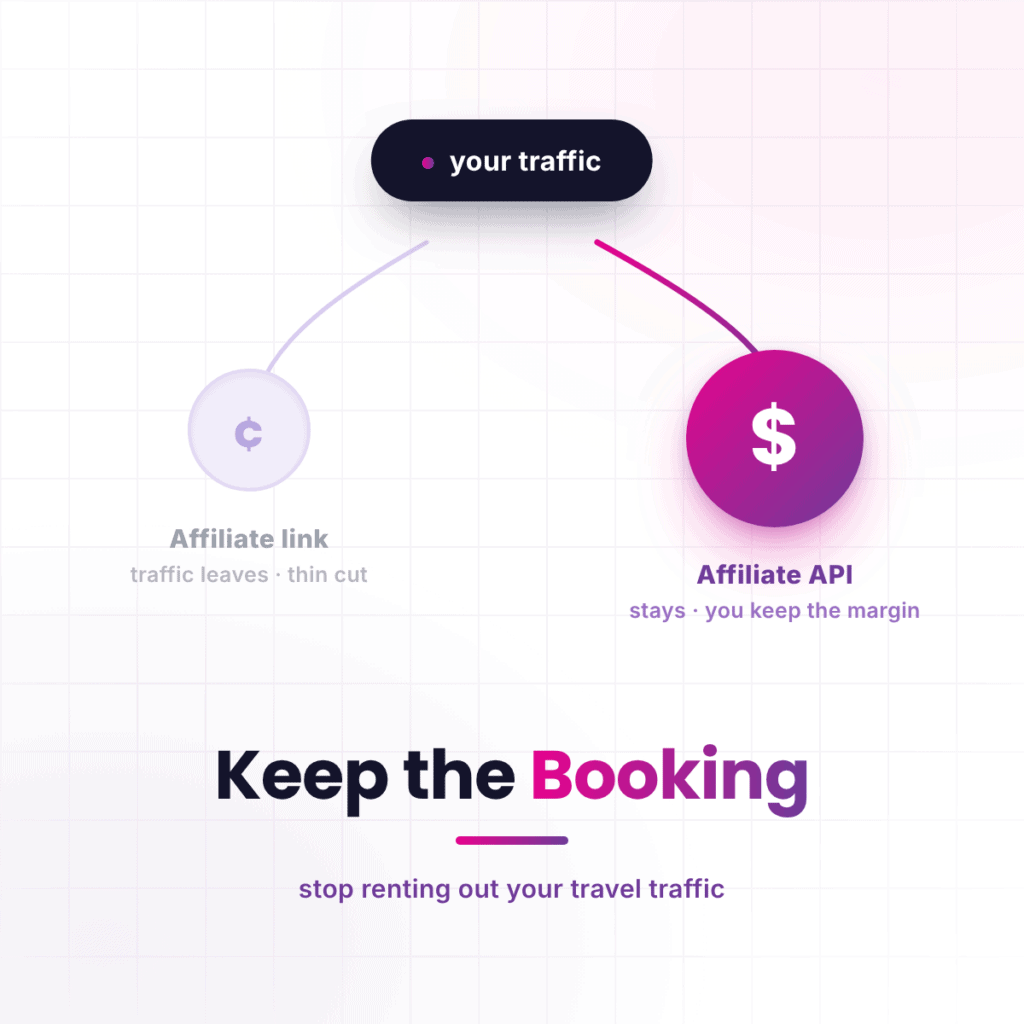
If your site sends travel traffic to an affiliate link, you are handing away the booking and keeping the smallest slice of it. There is another way to monetise the same traffic that keeps the customer on your site and pays you several times more. This is the honest comparison between an affiliate link and a hotel booking affiliate API.
An affiliate link is the easiest way to earn from travel traffic: you refer the visitor to a booking site and collect a commission if they book. It is simple, but you give away three things: the customer, the experience and most of the money. A hotel booking affiliate API is the alternative, where the booking happens on your own site so you earn the margin on it rather than a referral fee. It takes more setup, but on the same traffic it can pay several times more. The right choice depends on whether travel is a side earner or a real revenue line for you.
Written for content sites, comparison sites and communities with travel traffic
A travel blog, a destination guide, a comparison site, a community whose members travel: they all sit on the same quiet goldmine. People read, get inspired and then go somewhere else to book. The standard way to earn from that is an affiliate link and for good reason, because it is the easiest possible start. What almost nobody does is the simple sum of what that affiliate link actually leaves on the table.
This is that sum. It compares the affiliate link you probably use now with a hotel booking affiliate API, which lets the booking happen on your own site. It is honest about both the upside and the work involved. If the broader question of how to put booking on a site you already run interests you, our guide to the three ways to sell hotels on your own site is the companion piece. This one is specifically about the money.
An affiliate link works like this: a visitor clicks from your site to a booking partner and if they book within a tracking window, you get a commission. It is genuinely easy. You add a link and you are done, which is exactly why it is where everyone starts. For a site where travel is a side topic, it is often the right answer, because it turns traffic into a little money with almost no effort or risk.
The limits show up once the traffic is real. Affiliate commissions on hotels are typically modest, the booking partner keeps the lion’s share. Your earning depends entirely on their tracking actually crediting you, which it does not always do. You also compete with everything else on the partner’s site once the visitor lands there. The affiliate link is a fine first step and a poor destination, because it caps what your traffic can ever earn you at the thin end of the booking.
Every affiliate booking costs you three things beyond the obvious small commission. The first is the customer. The moment they click away they belong to the booking partner, who gets their email, their booking history and every chance to sell to them again. You introduced them and then lost them, which means you pay to acquire a customer for someone else every time.
The second is the experience. Once the visitor lands on the partner’s site, you have no control over the price they see, the upsells they get or whether the booking even goes smoothly. Any bad experience still reflects on your recommendation. The third is the money, which is the big one. A referral commission is a fraction of the margin on a booking, so you are collecting the smallest slice of a transaction your content created. Give away the customer, the experience and the margin and what is left is the least valuable part of the deal.
A hotel booking affiliate API flips the model. Instead of sending the visitor away, you let them search and book hotels on your own site, powered by an API behind the scenes that supplies the inventory and handles the booking. The visitor never leaves. The booking is yours and you earn the margin on it rather than a referral fee. You keep the customer, you control the experience and you collect the valuable part of the transaction instead of the scrap.
The important shift is from referrer to seller. With an affiliate link you are paid for an introduction. With a hotel booking affiliate API you are the one making the sale, with a markup you set rather than a commission someone else decides. The same visitor, reading the same content, now books with you and earns you the margin on the room. This is the same underlying technology as a full booking platform, just pointed at monetising existing content traffic rather than running a standalone travel agency. Our hotel API is built for exactly this.
Let visitors book on your own site and earn the margin, not a thin referral fee.
See the Hotel API →The whole argument lives in one comparison: the same visitor, the same booking, two ways of earning from it. On an affiliate link you earn a referral commission, a small percentage that the booking partner sets and pays you after the fact. On your own site through a hotel booking affiliate API you earn your markup, which you set, on a booking you own outright. The difference per booking is not small, it is usually several times over.
| On the same booking | Affiliate link | Affiliate API on your site |
|---|---|---|
| What you earn | A referral commission | Your full markup |
| Who sets it | The partner | You |
| Who keeps the customer | The partner | You |
| Who controls the experience | The partner | You |
| Setup effort | A link | Moderate, a booking flow |
| Ceiling on earnings | Low, fixed by the partner | High, set by you |
The row that matters most is the last one. An affiliate link has a ceiling you do not control, set at the thin end of the booking. An affiliate API has a ceiling you do control, set at the margin. For a site with real, growing travel traffic, that difference compounds into a serious gap in annual revenue from the exact same audience.
The honest trade-off is effort. An affiliate link takes minutes. A hotel booking affiliate API means putting a real booking flow on your site, which is more setup and makes you part of the transaction rather than a bystander to it. That is more responsibility as well as more reward. For a small site or one where travel is a genuine afterthought, the affiliate link may well remain the sensible choice, because the extra earning does not justify the extra work at low volume.
The point at which it flips is volume and intent. Once your travel traffic is real and especially once you would like travel to be a proper revenue line rather than pocket money, the affiliate link is leaving too much on the table to ignore. A white-label or API approach that handles the hard parts of the booking for you shrinks the effort considerably, which moves that break-even point much earlier than most people assume. The question is not whether the API pays more, it clearly does, but whether your volume justifies the switch yet.
There is a simple signal. When you look at your affiliate earnings and start wishing the number were bigger, when the traffic is clearly there but the payout feels thin, that is the moment to run the math on an API instead. If your content is already sending enough people to book, you are already proving the demand. You are just collecting the smallest possible reward for it and that is a fixable problem.
The move does not have to be all at once. Many sites keep affiliate links on their lighter pages and put a real booking experience on their highest-traffic ones, capturing the margin where the volume justifies it. If you want to see what that would look like for your traffic, the practical next step is to look at how an API or a white-label booking experience plugs into a site you already run, which our booking engine is designed for or to walk your numbers through with our team. Either way, the first step is simply admitting the affiliate link was never going to pay what your traffic is worth.
Turn the travel traffic you already have into bookings on your own site. We handle the supply and the booking engine behind it. Tell us your traffic and we will show you the difference.
It is a way to let visitors search and book hotels on your own site, powered by an API that supplies the inventory and handles the booking behind the scenes, so you earn the margin on the booking rather than a referral commission. It is the alternative to an affiliate link. With an affiliate link you send the visitor to a booking partner and collect a small commission if they book. With an affiliate API the booking happens on your site, you keep the customer and the experience, you earn the markup you set.
On the same booking, usually several times more. An affiliate link pays a referral commission, a small percentage the booking partner sets. A hotel booking affiliate API lets you earn your own markup on a booking you own, which you set rather than the partner. You also keep the customer and control the experience instead of handing them away. The trade-off is effort: an affiliate link takes minutes while an API means putting a real booking flow on your site, so the extra earning is worth it once your travel traffic is real.
No and that is the main point. With an affiliate link the visitor clicks away to a booking partner and completes the booking there, so you lose the customer and the experience. With a hotel booking affiliate API the search and booking happen on your own site, under your brand, so the visitor never leaves. You keep the relationship with the customer, control the experience end to end and earn the margin on the booking rather than a referral fee for the introduction.
Not always. For a small site or one where travel is a genuine afterthought, an affiliate link may remain the sensible choice, because the extra earning from an API does not justify the extra setup at low volume. The point it flips is volume and intent: once your travel traffic is real and especially once you want travel to be a proper revenue line rather than pocket money, the affiliate link leaves too much on the table. A white-label or API approach that handles the hard parts shrinks the effort and moves that break-even point earlier than most expect.
Yes and many sites do exactly that. The move does not have to be all at once. A common approach is to keep affiliate links on lighter pages and put a real booking experience on the highest-traffic ones, capturing the margin where the volume justifies the effort. That lets you test the API model on your best content without reworking the whole site, then expand it as the numbers prove out. The first step is simply running the math on your highest-traffic pages to see what the affiliate link is costing you there.
Fill in your own numbers to see the gap on the same traffic.
'+ '| Your number | Affiliate link | Affiliate API |
|---|---|---|
| Bookings your traffic drives per month | ______ | ______ (same) |
| Average booking value | ______ | ______ (same) |
| What you earn per booking | Referral %: ____ | Your markup %: ____ |
| Monthly earning (bookings x value x your %) | ______ | ______ |
| Who keeps the customer | Partner | You |
| The gap, per year | (API monthly minus affiliate monthly) x 12 = ______ | |
If the yearly gap is bigger than the setup effort, it is time to look at an API.
'+ 'Worksheet by ZentrumHub. zentrumhub.com/blog/hotel-booking-affiliate-api. Book a demo at zentrumhub.com/book-time
'+ ''; var w = window.open('', '_blank'); w.document.write(html); w.document.close(); w.focus(); setTimeout(function(){ w.print(); }, 350); }