






Table of Contents
Behind every confirmed room is a sequence most people never see. A hotel room booking API turns a guest’s search into a real reservation through five real-time steps and there is one step in the middle that most teams skip. Skipping it is where the majority of booking failures begin. Here is the whole flow, step by step.
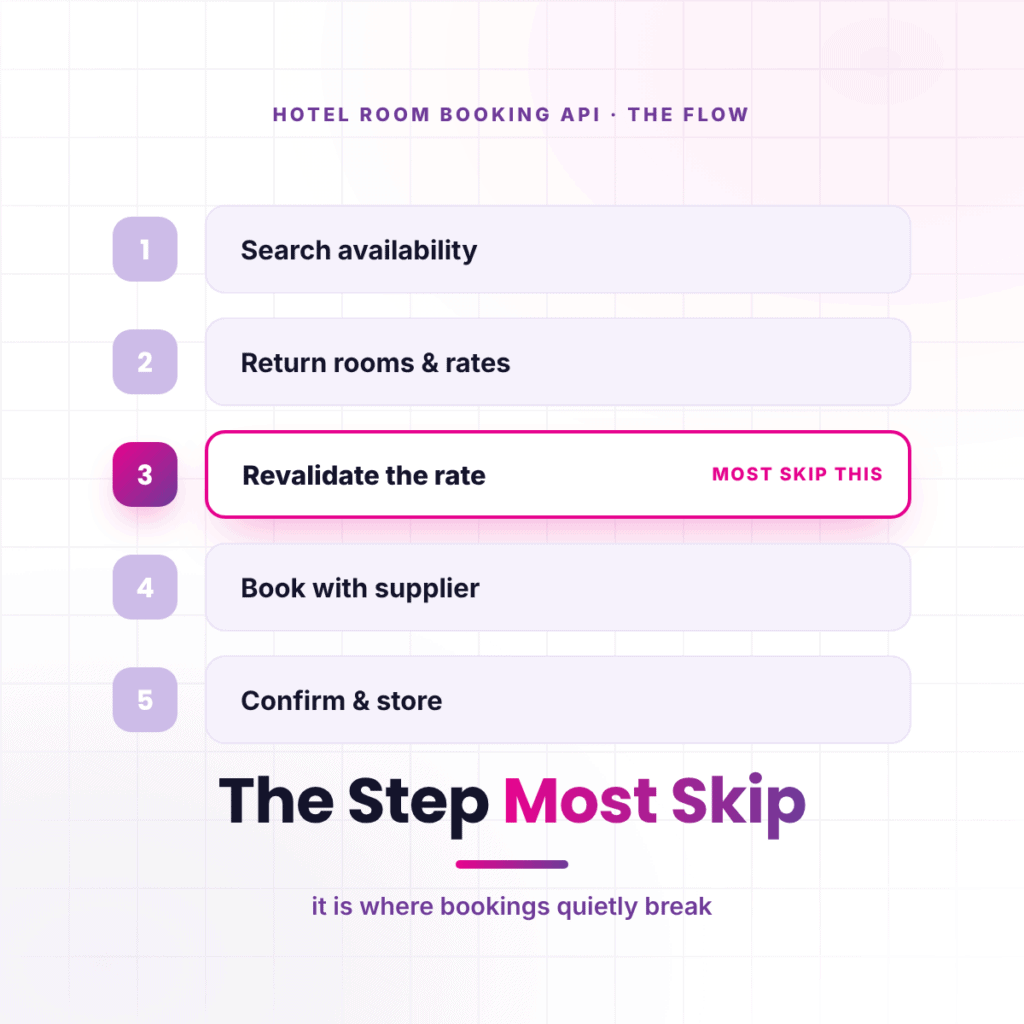
A hotel room booking API turns a search into a confirmed room in five steps: search for availability, return the room and rate options, revalidate the chosen rate live, book it against the supplier, then confirm and store the reservation. The step most teams skip is the fourth-from-start one, revalidation, where you re-check the live price and availability in the moment between the guest choosing a room and paying for it. Skip it and you book against a price that may have changed, which is the single most common cause of a failed or mispriced booking.
Written for founders, product owners and developers building hotel booking
A guest searches for a room, picks one, pays and gets a confirmation. It feels like a single action. Underneath, a hotel room booking API has run a precise sequence of real-time calls, each of which has to succeed for that confirmation to be real. Understanding that sequence is the difference between a booking flow that holds up and one that tells guests they are booked when they are not.
This guide walks the five steps a hotel room booking API runs for every reservation, in plain terms, then points at the one step that quietly causes most of the trouble. It is not a line-by-line integration manual. It is the mental model you need before you build or buy, so you can tell a booking flow that is complete from one that only looks complete. For the wider reality of running this in production, our piece on what nobody tells you before building a booking engine is the honest companion.
A hotel room booking API is the connection that lets your platform do, programmatically, what a person would otherwise do by hand: find available rooms, see the rates, pick one and make the reservation. It sits between your booking flow and the hotel supply, carrying each request out to the supplier and bringing the answer back. Where a simple inventory feed just tells you what exists, a room booking API takes you all the way to a confirmed, held reservation.
The reason it helps to see it as a sequence rather than a single call is that each step can succeed or fail on its own. A search can return stale results. A rate can expire between being shown and being booked. A booking call can time out after the supplier has already confirmed. Treating the room booking API as one magic action hides all of that, which is exactly why booking flows break in ways their builders did not expect. The five steps below are where the real work lives.
It starts with a search. The guest gives a destination, dates and occupancy, then your platform asks the hotel room booking API what is available. The API queries the supply behind it and returns the hotels and rooms that match. This is the step with the heaviest traffic, because every browsing guest triggers it many times, which makes its speed and its load behaviour the first things that shape the whole experience.
The tension at this step is speed against freshness. Query the supplier live for every search and results are current but slower, with heavy traffic able to strain the supplier and your own limits. Serve cached results and search is fast, but the prices risk being slightly out of date. Where you sit on that line is a real decision, not a default. It sets up the single most important step later: revalidation. How this step scales under real traffic is covered in our guide to OTA API integration.
Next the guest picks a hotel and the API returns its specific rooms and rates: the room types, the board options, the cancellation terms and the price for each. This is where a search result becomes a set of real, bookable choices. The quality of this step shapes conversion directly, because a guest deciding between rooms needs clear, complete and accurate information to commit and gaps or confusion here lose the booking before it is even attempted.
Each rate carried back here comes with conditions that matter: whether it is refundable, until when, what the board basis is and what the final price includes. Presenting these clearly is part of the job, because a guest who books a rate without understanding its cancellation terms becomes a dispute later. The room and rate step is where the commercial detail of the booking is set, so getting it complete and honest is what makes the steps after it go smoothly.
This is the step most booking flows skip and the one that matters most. Between the moment a guest chooses a room and the moment they pay, the price or availability can change, especially if the earlier search used any caching. Revalidation is a live check, right before booking, that the rate and availability the guest is about to pay for are still real. It is one extra call. It is the difference between a booking that holds and one that surprises everyone.
Skip revalidation and you book against a price that may no longer exist. The guest sees one figure and commits, then the booking either fails or comes back at a different rate, which destroys trust at the worst possible moment. Teams skip this step to save a call and shave milliseconds, then pay for it in failed bookings, refunds and support. Revalidation is quiet, unglamorous and the single highest-value step in the whole hotel room booking API flow, because it catches the gap that aggressive search caching opens.
Never book against a cached price. Always revalidate the live rate and availability in the step between the guest choosing a room and paying for it. It adds one call and removes the most common cause of a booking that confirms at the wrong price or fails outright. Every reliable hotel room booking API flow has this step. The unreliable ones are usually missing it.
A hotel API with search, revalidation, booking and confirmation built to be reliable from day one.
See the Hotel API →With a revalidated rate, the API sends the actual booking request to the supplier that holds the room. This is the moment the reservation is really made, the point where a held intention becomes a committed booking. It carries the guest details, the chosen rate and everything the supplier needs to secure the room. It is the step where real money and a real room are now on the line.
The risk at this step is the gap between sending the request and knowing it succeeded. A booking call can complete at the supplier while the response back to you times out, which leaves you unsure whether the room was actually booked. Handling that uncertainty, by verifying the booking truly landed rather than trusting a single response, is what separates a reliable flow from one that occasionally double-books or loses a reservation. The booking call is simple to make and surprisingly hard to make bulletproof, which is much of what a mature platform carries for you.
Finally the API returns a confirmation, then your platform records the booking: the reference, the rate, the terms and everything you will need afterwards. This is what the guest sees as their proof. It is what your business relies on for everything that follows, from sending the voucher to handling a cancellation to reconciling the money. A confirmation that is not reliably captured is a booking you cannot support later.
The step is easy to treat as an afterthought and costly to get wrong. If a booking succeeds at the supplier but your system fails to store the confirmation cleanly, you have a guest with a room and no record of it, which surfaces as chaos the moment they try to cancel or change it. Storing the confirmation reliably and reconciling it against the supplier, is what turns a successful booking call into a reservation your business can actually stand behind. It is the quiet end of the flow that the whole post-booking operation depends on.
Of the five steps, four feel obviously necessary and one feels optional. You clearly have to search, show rooms, make the booking and store the confirmation. Revalidation, the live re-check right before booking, is the one that looks skippable, because in the demo the price never changes in the few seconds a test takes. In production, across thousands of real bookings where guests pause and prices move, it changes often enough to matter a great deal.
That is why revalidation is the honest test of whether a hotel room booking API flow was built for the demo or for the real world. A flow that searches, shows and books but does not revalidate will work beautifully in testing and fail intermittently in production, in a way that is maddening to diagnose because it depends on timing. If you take one thing from this breakdown, make it this: the five-step flow is only reliable with all five steps. The one most likely to be missing is the one that protects every booking. To see how the full reliable flow fits a real platform, start with our hotel API.
Search, revalidation, booking and confirmation, built to be reliable from the first real guest. Skip the step that breaks bookings by using a flow that already has all five.
A hotel room booking API is the connection that lets your platform find available rooms, see their rates, pick one and make a reservation programmatically, rather than a person doing it by hand. It sits between your booking flow and the hotel supply, carrying each request to the supplier and returning the answer. Unlike a simple inventory feed that only tells you what exists, a room booking API takes you all the way to a confirmed, held reservation through a real-time sequence of search, room and rate selection, revalidation, booking and confirmation.
In five real-time steps. First, search: the guest gives dates and destination and the API returns available hotels and rooms. Second, rooms and rates: the API returns the specific room types, board options, cancellation terms and prices. Third, revalidate: a live re-check that the chosen rate and availability are still real, right before booking. Fourth, book: the API sends the actual reservation request to the supplier. Fifth, confirm and store: the API returns a confirmation and your platform records it. Each step can fail on its own, so all five must work for a booking to be real.
Usually because the rate was never revalidated. Between the guest choosing a room and paying, the price or availability can change, especially if the search used caching. If the flow books against the old cached price without a live re-check, the booking either fails or comes back at a different rate, which surprises the guest at the worst moment. Adding a revalidation step, a live check of rate and availability right before booking, removes the most common cause of a failed or mispriced booking. It is one extra call that protects every reservation.
Rate revalidation is a live check, made right before the booking call, that the price and availability the guest is about to pay for are still real. It exists because search results are often cached for speed, which means the rate shown could be slightly out of date by the time the guest commits. Revalidation closes that gap by confirming the current rate and availability in the moment between room selection and payment. It is the step most booking flows skip and the one that prevents the majority of failed or wrong-price bookings, so it is the single highest-value step in the flow.
You need all five steps to exist, but you do not have to build them yourself. Connecting a raw hotel room booking API and wiring up search and booking is quick, but making the full flow reliable, especially revalidation and verifying that bookings truly landed at the supplier, is where the hard, ongoing work lives. A mature hotel API or booking platform provides the complete, reliable flow out of the box, so your team builds the front end and the brand rather than the plumbing. Whether you build or buy, the test is the same: does the flow have all five steps, revalidation included.
Five steps. A flow missing any of them is not complete, especially step 3.
'+ '| Step | What it must do | Done |
|---|---|---|
| 1. Search | Return available hotels and rooms fast, under real load | |
| 2. Rooms and rates | Show room types, board, cancellation terms and price clearly | |
| 3. Revalidate (the skipped one) | Live re-check of rate and availability right before booking | |
| 4. Book | Send the reservation to the supplier, verify it truly landed | |
| 5. Confirm and store | Capture the confirmation reliably, reconcile against supplier |
If step 3 is missing, the flow will pass testing and fail in production.
'+ 'Checklist by ZentrumHub. zentrumhub.com/blog/hotel-room-booking-api. Book a demo at zentrumhub.com/book-time
'+ ''; var w = window.open('', '_blank'); w.document.write(html); w.document.close(); w.focus(); setTimeout(function(){ w.print(); }, 350); }