



Table of Contents
India is one of the fastest-growing travel markets on earth, and no single hotel API covers it well. Winning here means combining domestic depth, outbound breadth, and GST-ready billing. This guide maps the suppliers that actually work for an Indian OTA, and how to assemble them into one stack.
India rewards travel businesses that get supply right and punishes those that treat it like any other market. The country’s online travel market is worth roughly $23 to $25 billion and growing fast, online travel agencies take the large majority of online bookings, and demand runs from luxury chains in metros down to budget hotels in Tier 2 and Tier 3 towns that global suppliers barely list. Serve that spread with a single Western feed and you will miss most of the country.
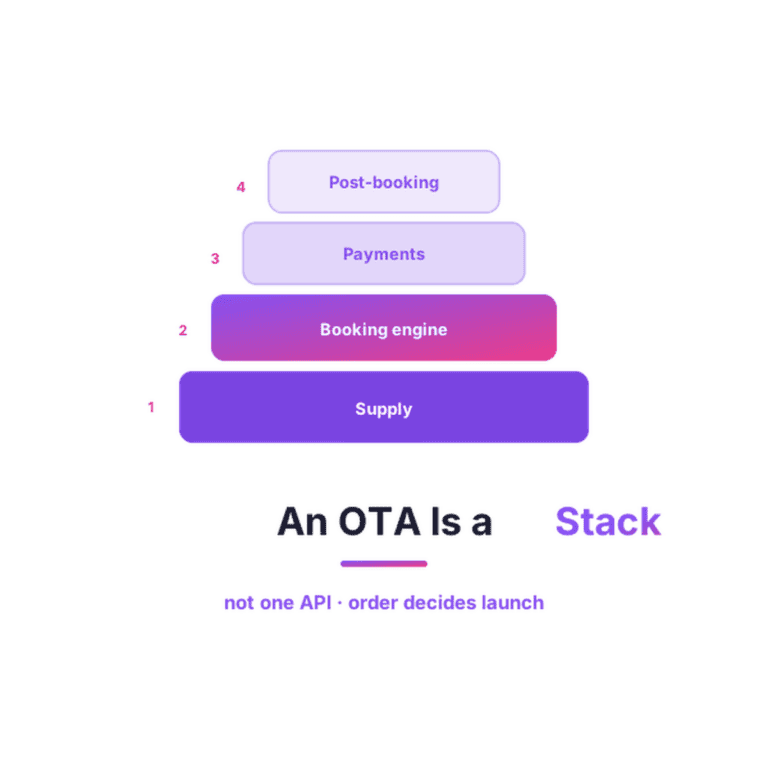
The winning approach is a deliberate stack: a domestic specialist for India’s own hotels, an international source for outbound travel, and billing that satisfies Indian tax rules. MakeMyTrip anchors the domestic side — the MakeMyTrip hotel API reaches deeper into Indian domestic inventory than any global supplier can. Around it you add TBO for India-native B2B breadth, a bedbank or two for outbound, and GST-ready billing throughout. Here is how each piece fits.
Three features make India distinct. First, scale and growth: the online travel market sits in the low-to-mid twenty billions of dollars and continues to expand at a healthy clip, with a single player, MakeMyTrip, holding around 60% of the OTA market. Second, mobile and Tier 2/3 demand: roughly two-thirds of bookings happen on mobile, and a large share of new users come from smaller cities where budget and mid-market Indian hotels dominate — inventory that international bedbanks carry thinly if at all.
Third, regulation: India’s GST regime requires GST-compliant, INR-denominated invoicing, so a supplier that only settles in foreign currency creates tax and accounting friction for your Indian business. Put together, these features mean the best hotel API for India is rarely one API — it is a combination that covers domestic depth, outbound reach, and compliant billing at once. The rest of this guide works through that combination.
MakeMyTrip is the foundation for Indian domestic inventory. As the country’s number-one OTA, with around $10 billion in gross bookings, it has spent two decades contracting directly with Indian hotels — including the Tier 2 and Tier 3 properties, budget hotels and homestays that make up so much of real Indian demand. For a domestic Indian OTA or a diaspora platform, that depth is close to irreplaceable.
TBO is the India-native B2B complement. Built for travel agents since 2007 and reaching 1M+ properties across 159 countries, the TBO hotel API pairs strong Indian coverage with international breadth, supports both XML and REST, and settles on credit in a way Indian agents know well. The two are complementary rather than redundant: MakeMyTrip goes deepest on India domestic, TBO adds India-plus-international B2B reach. Our dedicated MakeMyTrip vs TBO comparison breaks down exactly where each leads.
Indian travellers increasingly book abroad, and domestic suppliers cannot cover that well. This is where global bedbanks and OTA-wholesalers earn their place. Hotelbeds brings 300,000+ directly contracted hotels with particular strength in Europe, the Mediterranean and global chains — the natural choice for Indian outbound to popular Western destinations. RateHawk adds 2.9M+ accommodations from 330+ suppliers with aggressive net rates and strong emerging-market coverage, useful for the price-sensitive Indian segment and less mainstream destinations.
Agoda is the essential outbound partner for Indian travellers heading to Asia-Pacific — Thailand, Singapore, Bali, Vietnam and the rest of the region where Agoda’s exclusive APAC contracts beat Western feeds. Given how much Indian outbound travel goes to Southeast and East Asia, the Agoda hotel API often matters as much as any Western bedbank for an Indian OTA. One or two of these three, chosen by where your travellers actually fly, covers most outbound demand.
Cleartrip deserves a mention for platforms serving the India–Gulf corridor. Headquartered in Mumbai and operating across India and the Middle East, Cleartrip lists in the region of 600,000 hotels and has deep roots in both markets, strengthened by its earlier acquisition of Flyin in the UAE. For an OTA whose travellers move between India and the Gulf — a huge real-world flow of workers, families and business travellers — the Cleartrip hotel API adds relevant, regionally aware inventory. It is not a first pick for pure domestic depth, where MakeMyTrip leads, but it is a strong specialist for the India–Middle East axis that generic global suppliers treat as an afterthought.
This is the detail that quietly disqualifies otherwise-strong global suppliers for Indian businesses. Under Indian tax law, travel agency services attract GST, agents must register once turnover crosses the threshold, and buyers expect a GSTIN-on-invoice so they can claim input tax credit. A supplier that bills only in foreign currency and issues no GST-compliant invoice forces your finance team into workarounds and can erode the margin advantage its rates seemed to offer. Indian and India-focused suppliers — MakeMyTrip, TBO, Cleartrip — handle INR pricing and GST-compliant invoicing natively, which is a real operational advantage over a purely international bedbank. When you evaluate any supplier for India, treat GST and INR support as a hard requirement, not a nice-to-have, and confirm it before you value the inventory. This is precisely the kind of hidden operational cost the free report below is built to expose.
| Supplier | Role in an India stack | Best for |
|---|---|---|
| MakeMyTrip | Deepest India domestic inventory | Domestic, diaspora, Tier 2/3 |
| TBO | India-native B2B + international | Agents, India + outbound |
| Hotelbeds | Global directly contracted outbound | Europe, Med, chains |
| RateHawk | Wide net-rate outbound | Price-led, emerging markets |
| Agoda | Exclusive APAC outbound | Asia outbound (Thailand, Bali…) |
| Cleartrip | India + Middle East corridor | India–Gulf travel flows |
A typical Indian OTA needs one domestic anchor, one or two outbound sources, and GST-ready billing throughout — not every supplier here at once.
Start with your booking mix. A domestic-first Indian OTA anchors on MakeMyTrip for India depth, adds TBO for agent-facing breadth, and layers Agoda for the heavy Asia-outbound flow — three suppliers covering most demand. A B2B agent platform might lead with TBO, add MakeMyTrip for domestic gaps, and a bedbank like Hotelbeds or RateHawk for wider outbound. An India–Gulf specialist pairs Cleartrip with a global bedbank. In every case, GST and INR billing must run through the whole stack.
The catch is that three or four India-relevant suppliers integrated directly means three or four separate builds, settlement relationships and content pipelines — plus deduplicating the many Indian and Asian hotels that appear across them. That maintenance load is heaviest exactly where India’s inventory overlaps. An aggregator removes it: one integration reaches MakeMyTrip, TBO, Cleartrip, Hotelbeds, RateHawk, Agoda and 100+ more, with INR and GST handling and duplicate listings resolved by a dedicated mapping partner so the same hotel shows once, best rate winning. For most Indian OTAs, that is the difference between launching this quarter and spending the year building plumbing.
MakeMyTrip, TBO, Cleartrip, Agoda and 100+ more — INR and GST ready, deduplicated, live in days.
Explore the Universal Hotel API →Related reading: MakeMyTrip vs TBO · DidaTravel vs Agoda · Best hotel API providers 2026
There is no single best hotel API for India — the market needs a combination. MakeMyTrip provides the deepest India domestic inventory, TBO adds India-native B2B plus international breadth, and a global bedbank such as Hotelbeds or RateHawk or an APAC specialist like Agoda covers outbound travel. The right mix depends on whether your bookings are mainly domestic, outbound, or India–Gulf, and all of it must support GST-compliant INR billing.
MakeMyTrip. As India’s number-one OTA it has contracted directly with Indian hotels for two decades, giving it the deepest domestic inventory including Tier 2 and Tier 3 city hotels, budget properties and homestays that global bedbanks carry thinly. TBO is also strong in India and adds international reach, but for pure domestic depth MakeMyTrip leads. Many Indian OTAs run both to combine domestic depth with agent-facing breadth.
For an Indian business, effectively yes. Travel agency services attract GST under Indian law, and buyers need a GSTIN-on-invoice to claim input tax credit, so a supplier that bills only in foreign currency without GST-compliant invoicing creates real tax and accounting friction. Indian and India-focused suppliers such as MakeMyTrip, TBO and Cleartrip handle INR pricing and GST-compliant invoicing natively, which is a meaningful advantage over purely international suppliers.
It depends on destination. For Indian travellers heading to Asia-Pacific — Thailand, Singapore, Bali, Vietnam — Agoda’s exclusive APAC inventory is hard to beat. For Europe, the Mediterranean and global chains, Hotelbeds leads with directly contracted rates. For wide, price-competitive coverage across many markets, RateHawk’s net rates work well. Most Indian OTAs pick one or two of these based on where their travellers actually fly.
Usually three to four: a domestic anchor (MakeMyTrip), an India-native B2B source (TBO), and one or two outbound suppliers (Agoda for Asia, Hotelbeds or RateHawk for the rest), all with GST-ready billing. Integrating that many directly is a significant engineering and operational load, which is why many Indian OTAs use an aggregator to reach the whole stack through one connection with deduplication and INR/GST handling built in.
Reach MakeMyTrip, TBO, Cleartrip, Agoda, Hotelbeds, RateHawk and 100+ suppliers through one normalised API — INR and GST ready, deduplicated, live in days, with the per-supplier build already done.
Drop your work email and we’ll send you the 12-page report that breaks down where 6–9 months and $215K+ quietly disappear — free.