





Table of Contents
Is there a free hotel API? Yes, a few exist. But before you build anything on one, it is worth knowing what free actually gets you, because it is rarely what you are hoping for. Free hotel APIs are great for learning and almost useless for running a business. Here is the honest version.
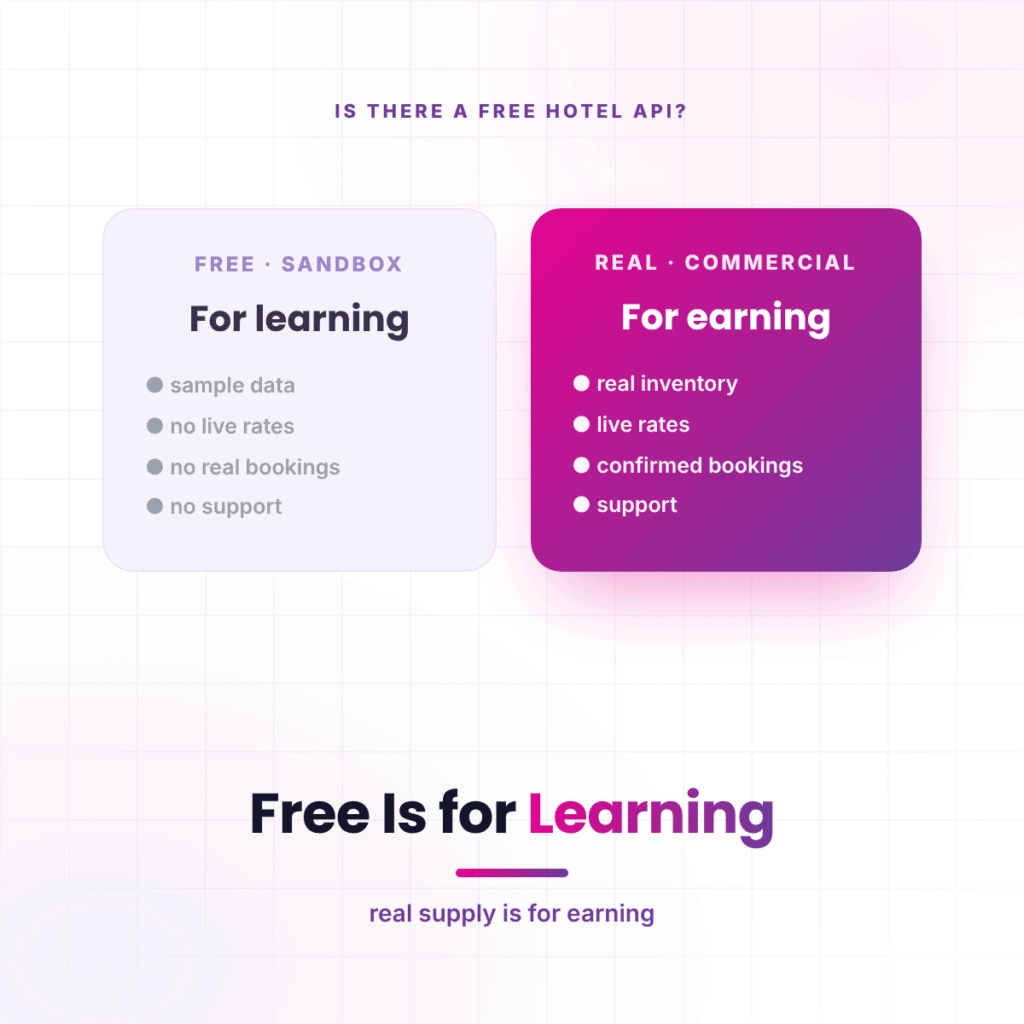
Yes, free hotel APIs exist, mostly as sandbox or test environments from suppliers and as limited free tiers meant for developers to experiment with. They are genuinely useful for learning how a hotel API works. They are not useful for running a real booking business, because free almost always means thin or fake inventory, no live rates, no real bookings and no support. The moment you want actual hotels, actual prices and actual confirmed bookings, you need a paid or commercial API. Free is for learning. Real supply is for earning.
Written for developers and founders exploring hotel APIs on a budget
It is a reasonable question and almost everyone building something with hotels asks it early: is there a free hotel API I can just use? The hope is understandable. APIs for weather, maps and currency have generous free tiers, so why not hotels? The answer is yes in a narrow sense and no in the sense that matters and understanding the difference saves you from building on something that cannot carry a real business.
This guide gives the honest answer. It covers whether free hotel APIs exist, what kinds you will actually find, what free quietly costs you and when it is genuinely the right choice versus when you need a real, paid connection. If your underlying question is really about what a proper hotel API costs, our guide to hotel API pricing covers that side. Here we focus on the word free and what it is really worth.
Yes, they do, but not in the way the question usually imagines. There is no free hotel API that hands you a global catalogue of real hotels at live prices that you can book and sell for nothing. What exists instead are test environments, sandbox access and limited free developer tiers, offered so people can see how a hotel API works before committing. These are real and useful. They are also deliberately limited, because no supplier gives away its actual sellable inventory for free.
The reason is simple economics. Hotel inventory is a valuable commercial asset that suppliers and aggregators spend enormous effort contracting, maintaining and keeping live. Giving that away for free would make no sense, so they do not. A free hotel API therefore gives you the shape of the thing, the request and response, the structure, without the substance, the real hotels, live rates and confirmable bookings. Knowing that upfront reframes the question from where do I find a free one to what is free actually good for.
When you go looking, the free hotel APIs you find fall into a few types. Supplier sandboxes are test versions of a real API, returning sample or static data so developers can build and test an integration before going live. Limited free tiers give you a small number of calls or a restricted dataset at no cost, enough to experiment but not to operate. And there are small or hobby APIs offering basic hotel data, often with narrow coverage or questionable freshness.
What all of these share is that they are built for trying, not for trading. A sandbox is there so you can write and test code. A free tier is there so you can evaluate before you pay. A hobby dataset is there for a side project, not a storefront. None of them is designed to be the live supply behind a business that takes real money from real guests. Treating any of them as if it were is the mistake this whole guide exists to prevent.
Free hotel APIs have a price, it is just not on the invoice. The first cost is inventory: free sources give you thin, narrow or outright fake hotel data, so you have little real to sell and no competitive coverage. The second is live rates: free tiers rarely provide genuine real-time pricing, so the numbers you show are stale or sample data, which is useless and dangerous for an actual booking. The third is bookings: most free APIs cannot make a real, confirmed reservation at all.
The fourth cost is everything around the API: no support when something breaks, no reliability guarantees, no help when a booking fails, because free comes with no one on the other end. Add these up and the true cost of a free hotel API for a real business is lost bookings, broken trust and a platform that cannot actually transact. Building a business on a free API is building on sample data. The bill arrives the moment a real guest tries to book. Our guide to how agencies get real wholesale rates shows what actual sellable supply looks like instead.
A free hotel API costs you nothing in money and everything in substance: thin or fake inventory, no live rates, no real bookings and no support. For learning that is a fair trade. For a business it means lost bookings and broken trust, which costs far more than any paid API would. Free is cheap only until you try to sell something real.
Get live rates and confirmed bookings from 100+ suppliers through one real API.
See the Hotel API →None of this means free hotel APIs are useless. For the right purpose they are exactly the tool you want and reaching for a paid one too early would be a waste. If you are a developer learning how hotel APIs work, a sandbox is perfect. If you are building and testing an integration before you go live, a test environment is precisely what it is for. If you are prototyping an idea and just need the shape of hotel data to design around, a free tier does the job.
In all of these cases, what you need is to understand and build against the structure of a hotel API, not to sell real rooms yet. Free is ideal for that, because the limitation that makes it useless for business, no real sellable inventory, does not matter when you are learning or testing. The skill is simply matching the tool to the stage: free for learning and building, real supply for selling. Problems only start when someone uses the learning tool to try to run the business.
The moment your goal changes from learning to earning, you need a real, commercial hotel API. If you want to show real hotels, at live prices, that a guest can actually book and pay for, free cannot do it, by design. This is not a limitation to work around, it is the fundamental difference between a learning tool and a business tool. The instant real money and real guests are involved, sample data is not an option.
A real hotel API, usually from an aggregator, gives you what free cannot: broad, genuine inventory, live rates and availability, confirmable bookings and the support and reliability a business depends on. ZentrumHub is this kind of API, delivering real, sellable supply from more than a hundred suppliers through one hotel API. It costs money because the inventory behind it is real, contracted and maintained, which is exactly why it can run a business when a free API cannot. The question is never free versus paid in the abstract, it is learning versus earning and only one of those is free.
The good news is that time spent on a free hotel API is not wasted when you move to a real one, if you use the free stage for what it is good at. Learning how hotel API requests and responses work, designing your integration and building your front end against the structure all carry straight over to a commercial API, because the shape is broadly the same. The free sandbox was your rehearsal and the paid API is the live performance using everything you practised.
The practical path is to use free to learn and prototype, then switch to a real supply API the moment you need to sell. Because a good aggregator provides a clean, well-documented API, the move from sandbox to live supply is usually straightforward, swapping the test connection for the real one and gaining actual inventory, rates and bookings. If you are at that switching point, our team can help you make the jump. You can also see where a real API fits in the bigger picture in our guide to how to start an online travel agency. Use free to learn, then earn with the real thing.
Free is for the rehearsal. When you need real hotels, live rates and confirmed bookings, get them from 100+ suppliers through one real API. Tell us your plan and we will show you the difference.
Yes, but not the kind the question usually imagines. Free hotel APIs exist as supplier sandboxes, test environments and limited free developer tiers, meant for learning and building before you commit. There is no free hotel API that gives you a global catalogue of real hotels at live prices that you can book and sell for nothing, because no supplier gives away its actual sellable inventory for free. Free hotel APIs are genuinely useful for learning how a hotel API works and not useful for running a real booking business.
Because hotel inventory is a valuable commercial asset. Suppliers and aggregators spend enormous effort contracting hotels, maintaining the data and keeping rates and availability live, so giving that away for free would make no sense. A free hotel API therefore gives you the shape of the thing, the request and response structure, without the substance, the real hotels, live rates and confirmable bookings. The real inventory that a business needs has a real cost behind it, which is why running a booking business requires a paid or commercial API rather than a free one.
Nothing in money and a great deal in substance. Free sources give you thin, narrow or fake inventory, rarely provide genuine live rates, usually cannot make a real confirmed booking at all and come with no support or reliability when something breaks. For learning, that is a fair trade. For a real business, it means lost bookings, broken trust and a platform that cannot actually transact, which costs far more than any paid API would. Building a business on a free API is building on sample data. The bill arrives the moment a real guest tries to book.
When you are learning or building, not selling. A free hotel API is ideal if you are a developer learning how hotel APIs work, testing an integration before going live or prototyping an idea and just need the shape of hotel data to design around. In all of these the limitation that makes free useless for business, no real sellable inventory, does not matter, because you are not selling real rooms yet. The skill is matching the tool to the stage: free for learning and building, a real supply API for selling.
No, if you use the free stage for what it is good at. Learning how hotel API requests and responses work, designing your integration and building your front end against the structure all carry straight over to a commercial API, because the shape is broadly the same. The free sandbox is your rehearsal and the paid API is the live performance using what you practised. Because a good aggregator provides a clean, well-documented API, moving from sandbox to real supply is usually straightforward: you swap the test connection for the real one and gain actual inventory, rates and bookings.
Free is for learning. Real supply is for earning. Match the tool to your stage.
'+ '| What matters | Free hotel API | Real / commercial API |
|---|---|---|
| Inventory | Thin, narrow or fake | Broad, real, sellable |
| Rates | Stale or sample | Live, real-time |
| Real bookings | Usually none | Confirmed reservations |
| Support and reliability | None | Yes |
| Good for | Learning, testing, prototyping | Running a business |
Learning or building? Free is fine. Selling to real guests? You need a real API.
'+ 'Cheat sheet by ZentrumHub. zentrumhub.com/blog/free-hotel-api. Book a demo at zentrumhub.com/book-time
'+ ''; var w = window.open('', '_blank'); w.document.write(html); w.document.close(); w.focus(); setTimeout(function(){ w.print(); }, 350); }