






Table of Contents
Wholesale hotel rates are how travel agencies make their margin, selling rooms above the net price they pay. The hard part is getting access to those rates in the first place. There are four routes. The right one depends entirely on where you are in your journey. Here is how agencies actually get them.
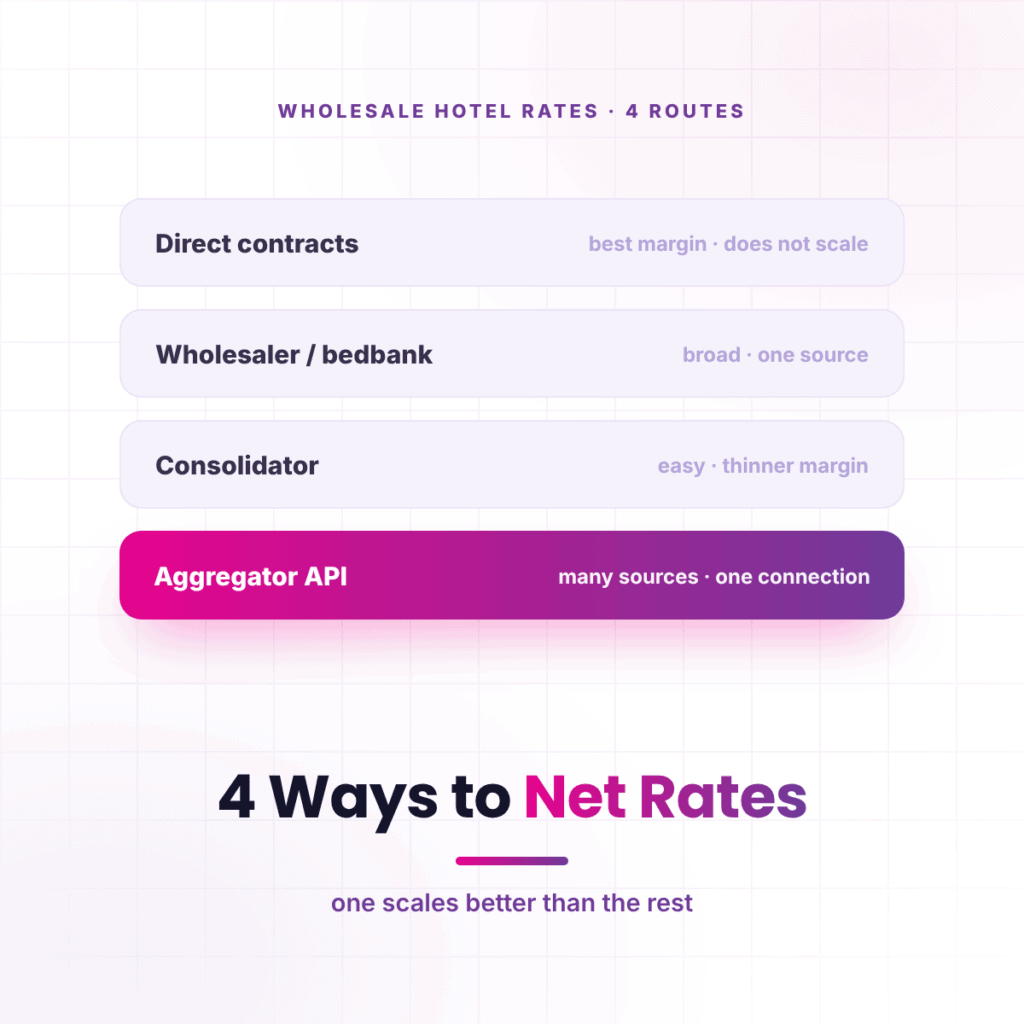
Travel agencies get wholesale hotel rates, also called net rates, through four routes. Direct contracts, negotiating net rates with hotels one by one, which gives the best margin but takes huge effort. Wholesalers and bedbanks, buying from companies that have already contracted thousands of hotels. Consolidators, going through an intermediary who resells wholesale rates to smaller agencies. And an aggregator API, connecting once to reach many wholesalers and bedbanks at scale. For most agencies the practical answer is a wholesaler or an aggregator, because direct contracting does not scale and consolidators add a markup. The right route depends on your size and volume.
Written for new and growing travel agencies, OTAs and TMCs
Every travel agency runs on the gap between what it pays for a hotel room and what it sells it for. That gap only exists if you can buy rooms below the public price, at what the industry calls wholesale or net rates. It is the single most important thing a new agency needs to figure out and also one of the most confusing, because nobody explains the actual routes to getting them. This guide does.
There are four ways agencies access wholesale hotel rates, each with a very different trade-off between margin, effort and scale. Knowing which one fits where you are now and where you want to be, saves you from either chasing contracts you are too small to win or paying an intermediary more than you need to. If you want the bigger picture of how supply fits into launching a travel business, our guide to the OTA tech stack puts this in context. This piece is about the rates themselves.
Wholesale hotel rates, also called net rates, are prices below the publicly advertised rate that hotels offer to the trade rather than to the public. A net rate is the price you pay as an agency. The difference between that net rate and the price you sell at is your margin. If a room sells to the public for 100 and your net rate is 75, you have 25 of room to price competitively and still make money. Without a net rate, you have nothing to sell on.
The reason this matters so much is that wholesale rates are the entire basis of the agency business model. You are not really selling rooms, you are selling your access to rates the public cannot get, plus the service around them. So the question of how you get wholesale hotel rates is not a detail, it is the foundation. The four routes below are the only real ways to reach them. They differ enormously in what they ask of you.
The first route is to negotiate net rates directly with hotels, one property or chain at a time. You agree terms, sign a contract and get a net rate for that hotel. This gives you the best possible margin, because there is no intermediary taking a cut. It also gives you rates nobody else has, which is a real competitive edge on those specific properties. For a destination specialist focused on a handful of hotels, direct contracting can be exactly right.
The problem is that it does not scale. Each contract is a separate negotiation, relationship and piece of admin. Hotels will only contract directly with agencies that can send them meaningful volume. A new or general agency cannot realistically contract thousands of hotels this way and would not get the time of day from most of them. Direct contracts are powerful for depth on a few key properties and hopeless for breadth, which is why almost no agency relies on them alone.
The second route is to buy from wholesalers, often called bedbanks: companies that have already done the direct contracting at scale and resell that inventory to agencies. A bedbank has contracted thousands of hotels and offers you net rates across all of them through a single relationship, so instead of negotiating hotel by hotel you get broad wholesale supply from one source. This is how a huge share of the agency world actually gets its rates.
The trade-off is a slightly higher net rate than a direct contract, because the bedbank takes a margin for the work it has done, in exchange for enormous breadth you could never contract yourself. For most agencies that is a very good deal. The one catch is that a single bedbank is still one source, so relying on just one leaves gaps in coverage and competitiveness. This is why many agencies work with several, which leads directly to the fourth route. Our overview of hotel wholesalers goes deeper on this.
Get wholesale rates from 100+ suppliers and bedbanks through a single API.
See Zentrum Connect →The third route is to go through a consolidator, an intermediary that has access to wholesale rates and resells them to smaller agencies that cannot reach wholesalers directly. For a very small or brand-new agency, a consolidator can be the easiest way to start, because it asks little of you and gets you selling quickly without volume commitments or complex setup. It lowers the barrier to entry when you have no track record yet.
The cost of that ease is margin. A consolidator sits between you and the wholesale rate and takes its own cut, so your net rate is higher and your margin thinner than if you reached the wholesaler yourself. That can be a fair trade when you are starting out and need simplicity over every last point of margin. But as you grow it becomes the most expensive route, which is why agencies that scale usually move off consolidators and toward buying from wholesalers more directly, often through an aggregator.
The fourth route solves the breadth problem of bedbanks and the margin problem of consolidators at once. An aggregator connects you, through a single API, to many wholesalers and bedbanks simultaneously, so one integration gives you wholesale rates from a large number of sources. Instead of managing several bedbank relationships or paying a consolidator’s markup, you reach broad wholesale supply through one connection and get the best available net rate across all of it.
This is why aggregation has become the default for agencies serious about scale. You get the breadth of many wholesalers, competitive net rates because you are comparing across sources rather than locked to one and a single technical relationship instead of many. ZentrumHub is an aggregator of exactly this kind, connecting you to more than a hundred suppliers and bedbanks through one hotel API. For an agency that wants wide, competitive wholesale rates without contracting hotels or juggling bedbanks itself, this route combines the strengths of the others while avoiding their worst trade-offs.
A single bedbank gives you breadth but from one source. A consolidator gives you ease but takes a margin. An aggregator gives you many bedbanks through one connection, so you get breadth and competitive net rates without the consolidator markup or the work of managing each wholesaler yourself. That combination is why growing agencies gravitate to it.
The right route is mostly a question of size and ambition. The table below lines them up so you can see where you fit, but the short version is simple. A brand-new agency with no volume often starts with a consolidator for ease. A destination specialist adds direct contracts for depth on key hotels. An agency wanting broad, competitive supply reaches wholesalers. The moment it wants many of them without the overhead, it uses an aggregator.
| Route | Margin | Effort | Best for |
|---|---|---|---|
| Direct contracts | Best | Very high | Depth on a few key hotels |
| Wholesaler / bedbank | Strong | Moderate | Broad supply from one source |
| Consolidator | Thinner | Low | Brand-new, no volume yet |
| Aggregator API | Strong, competitive | Low after one setup | Breadth and scale |
Most agencies end up combining routes: an aggregator for broad, competitive wholesale rates as the backbone, plus a few direct contracts for depth where they have real volume. The one route almost everyone outgrows is the consolidator, useful at the very start and expensive once you scale. If you want to see how reaching many wholesalers through one connection would work for your agency, our team can walk it through. You can also start from how supply plugs into a booking site in our guide to selling hotels on your own site.
Skip contracting hotels and juggling bedbanks. Reach broad, competitive wholesale hotel rates through a single API. Tell us your volume and we will show you the rates.
Through four routes. Direct contracts, negotiating net rates with hotels one by one, which gives the best margin but does not scale. Wholesalers or bedbanks, buying from companies that have already contracted thousands of hotels and resell net rates through one relationship. Consolidators, going through an intermediary who resells wholesale rates to smaller agencies for ease but at a thinner margin. And an aggregator API, connecting once to reach many wholesalers and bedbanks at scale. Most agencies use a wholesaler or an aggregator as their backbone, because direct contracting does not scale and consolidators cost margin.
Net rates, also called wholesale rates, are prices below the publicly advertised rate that hotels offer to the travel trade rather than the public. The net rate is what an agency pays. The difference between it and the price the agency sells at is the margin. If a room is 100 to the public and your net rate is 75, you have 25 to price with and still profit. Net rates are the foundation of the agency business, because an agency is really selling its access to rates the public cannot get, plus the service around them.
A bedbank or wholesaler, contracts thousands of hotels directly and resells that net-rate inventory to agencies through one relationship, giving broad supply at a strong margin. A consolidator is an intermediary that itself has access to wholesale rates and resells them to smaller agencies that cannot reach wholesalers directly, which is easy to start with but adds another markup so your margin is thinner. In short, a bedbank is a primary source of wholesale inventory, while a consolidator sits one step further from the rate and charges for the convenience.
Yes, but usually not through direct contracts at first, because hotels only contract directly with agencies that can send meaningful volume. A brand-new agency normally starts with a consolidator for ease or connects to a wholesaler or an aggregator to get broad wholesale supply without needing a track record. An aggregator is often the best starting point for an agency that wants competitive rates and room to grow, because a single integration gives access to many wholesalers at once and the agency can add direct contracts later for depth where it builds real volume.
For breadth and scale, an aggregator API is usually the best route, because it connects you to many wholesalers and bedbanks through a single integration. That gives you the breadth of many sources, competitive net rates because you compare across them rather than being locked to one and a single technical relationship instead of many. A single bedbank gives breadth from one source, a consolidator gives ease but takes a margin and direct contracts give the best margin but do not scale. An aggregator combines the strengths while avoiding the worst trade-offs, which is why growing agencies gravitate to it.
Pick the route that fits where your agency is now. Most combine an aggregator with a few direct contracts.
'+ '| Route | Margin | Effort | Best for |
|---|---|---|---|
| Direct contracts | Best | Very high | Depth on a few key hotels |
| Wholesaler / bedbank | Strong | Moderate | Broad supply from one source |
| Consolidator | Thinner | Low | Brand-new, no volume yet |
| Aggregator API | Strong, competitive | Low after one setup | Breadth and scale |
Rule of thumb: start where your volume allows, move to an aggregator as you grow, add direct contracts for depth.
'+ 'Sheet by ZentrumHub. zentrumhub.com/blog/wholesale-hotel-rates. Book a demo at zentrumhub.com/book-time
'+ ''; var w = window.open('', '_blank'); w.document.write(html); w.document.close(); w.focus(); setTimeout(function(){ w.print(); }, 350); }