





Table of Contents
People search for a Google hotel booking API expecting one thing and finding another. There is a genuine mix-up behind that search, between a way to show your prices on Google and a way to get hotels to sell in the first place. They are not the same. Here is what Google actually offers and what most people searching this really need.
There is no single Google hotel booking API that gives you hotels to sell. Google offers ways to show your hotel prices to travellers searching on Google, a demand channel that sends you customers, through its hotel products and partner integrations. That is different from a supply API, which is how you get the hotels, rates and availability to sell in the first place. Most people searching for a Google hotel booking API actually need a supply API, usually from an aggregator. Google brings you demand. An aggregator brings you supply. A real booking business needs both.
Written for OTAs and travel businesses sorting out Google and hotel supply
Type Google hotel booking API into a search box and you will get a confusing mix of results, because the phrase means different things to different people. Some want to show their hotel prices on Google. Others want to pull hotels from Google to sell on their own site, which is not actually something Google offers. The gap between those two intentions is the source of most of the confusion and clearing it up saves a lot of wasted effort.
This guide untangles it plainly. It explains what Google really provides for hotels, why that is a demand channel rather than a source of supply and what you actually need if your goal is to get hotels to sell. If your underlying question is how to source hotel inventory at all, our guide to how OTAs get live rates and availability answers it directly. Here we start with the Google confusion, because that is where so many people begin.
The confusion comes from the word booking doing two jobs. On one side, a Google hotel booking API could mean a way to feed your prices into Google so travellers searching there can see and book with you. On the other, people assume it means an API from Google that supplies hotels to put on their own website. These are opposite directions: one pushes your offer out to Google, the other would pull hotels in from Google. Only the first exists.
This matters because the two needs lead to completely different solutions. If you want more travellers to find your existing hotel offers, Google’s hotel products are relevant. If you want hotels to sell because you do not have any yet, Google is the wrong place to look entirely, so you need a supply source instead. Knowing which side of the mix-up you are on is the first step, because it decides whether Google is part of your answer or a distraction from it.
Google provides ways for hotels and travel sellers to appear when people search for places to stay, showing prices and linking through to book. For a business that already has hotel offers to sell, this is a powerful demand channel, putting your rates in front of travellers at the exact moment they are searching. Feeding prices into Google is usually done through a technical integration or a partner that handles the connection, rather than a simple public API you plug into.
The crucial thing to understand is the direction of the flow. In every one of Google’s hotel products, you are the one providing the hotel prices and Google is showing them to searchers. Google is the shop window, you are the stock. It is a way to be found and to attract bookings, which is genuinely valuable, but it assumes you already have hotels and rates to show. It is about demand, getting customers, not about supply, getting hotels.
A supply API is the opposite of what Google offers. It is a connection that gives you hotels, rates and availability to sell, pulling inventory in from suppliers so you have a product. Google does not do this. It will happily show the prices you already have, but it will not hand you hotels to sell if you have none. Expecting Google to be your source of inventory is the single most common misunderstanding behind the Google hotel booking API search and it leads people down a dead end.
The reason this trips people up is natural: Google feels like it has all the hotels, because you can see them all when you search. But seeing hotels in Google’s results is not the same as having the right to sell them and a live feed of their rates and availability. That comes from suppliers, through a supply API, not from Google. So if your actual need is hotels to sell, no amount of looking at Google’s hotel products will give you what you are after, because supply is simply not what they do.
Get live rates and availability from 100+ suppliers through one supply API.
See the Hotel API →If what you are really after is hotels to sell, the thing you need is a supply API, usually from an aggregator. This is a connection that gives you live rates and availability from many hotel suppliers at once, so you have a broad, bookable catalogue to put on your site. It is the actual source of inventory that a Google integration assumes you already have. Without it, there is nothing for Google to show on your behalf in the first place.
An aggregator supply API solves the real problem behind most Google hotel booking API searches: getting a product to sell. It connects you to wholesalers and bedbanks through a single integration, delivering the hotels, rates and availability you need. ZentrumHub is exactly this kind of supply API, reaching more than a hundred suppliers through one hotel API. The full picture of how agencies source inventory is in our guide to getting wholesale rates, but the short version is clear: supply comes from an aggregator, not from Google.
Once the confusion clears, the two pieces fit together rather than competing. A supply API gives you hotels to sell. Google gives you travellers to sell them to. They are the two halves of a booking business, supply and demand and a serious OTA eventually wants both: inventory from an aggregator and visibility on Google to attract the customers who book it. Seeing them as complementary rather than interchangeable is what turns the confusion into a plan.
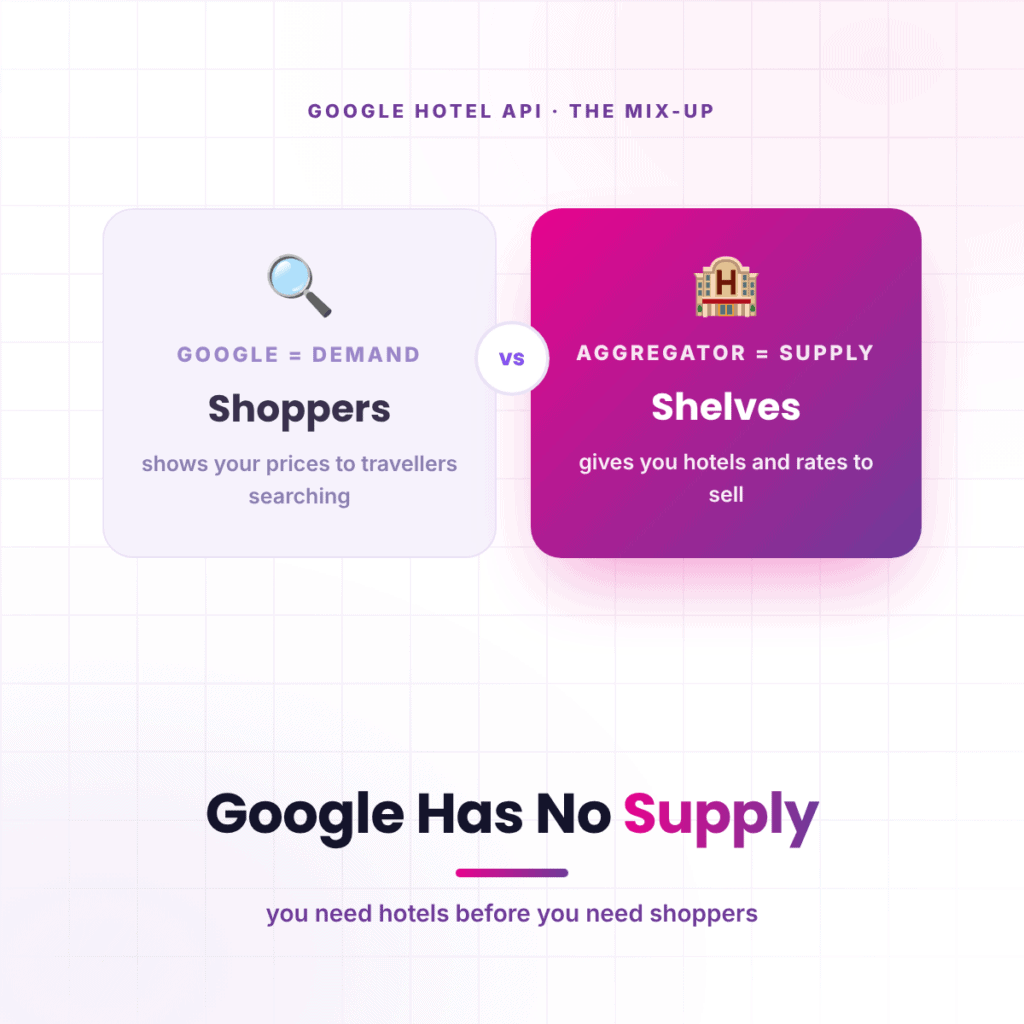
The order, though, is clear. You need supply before demand matters, because there is no point attracting travellers through Google to a site with no hotels to sell. Get your supply API in place first so you have a real product, then use Google and other channels to drive demand to it. Treating Google as the demand layer on top of a supply foundation, rather than as the foundation itself, is the mental model that makes both work. One fills the shelves, the other brings the shoppers.
Supply API fills your shelves with hotels to sell. Google brings shoppers to the shop. You need both, in that order, because there is no point driving demand to empty shelves. Get supply first from an aggregator, then layer Google and other channels on top to attract the travellers who book it.
So, which do you actually need? If you already sell hotels and want more travellers to find your offers, you are looking for a demand channel and Google’s hotel products are worth exploring, usually through a partner who handles the integration. If you have no hotels to sell yet or only thin coverage and rates, you are looking for supply. The answer is a supply API from an aggregator, not anything from Google. Most people who search for a Google hotel booking API are in this second group without realising it.
The honest test is to ask what is missing. If what is missing is customers, think about Google and demand. If what is missing is hotels, think about a supply API. Getting this right saves you from chasing a Google API that cannot give you inventory, when a supply connection would solve your actual problem in a single step. If you are not sure which side you are on or you need both, our team can help you map it or you can start from the foundations in our guide to how to start an online travel agency.
Google shows your prices. An aggregator gives you the hotels and rates to show in the first place. Get live supply from 100+ sources through one API, then drive demand to it.
Not in the sense most people mean. There is no Google API that gives you hotels to sell. What Google offers is ways to show your hotel prices to travellers searching on Google, a demand channel that sends you customers, usually through a technical integration or a partner that handles the connection. That is different from a supply API, which is how you get hotels, rates and availability to sell in the first place. Most people searching for a Google hotel booking API actually need a supply API, which comes from an aggregator, not from Google.
No. Google shows hotel prices to people searching, but it does not supply hotels for you to sell. Seeing hotels in Google’s results is not the same as having the right to sell them and a live feed of their rates and availability, which is what you need to run a booking business. That inventory comes from suppliers through a supply API, typically an aggregator that connects you to many wholesalers and bedbanks at once. If your goal is hotels to sell, Google is the wrong place to look and a supply API is the right one.
Google’s hotel products are a demand channel: you provide your hotel prices and Google shows them to travellers searching, sending you customers. A hotel supply API is the opposite direction: it gives you the hotels, rates and availability to sell in the first place, pulling inventory in from suppliers. One helps people find your offers, the other gives you offers to make. They are complementary, not interchangeable and a real booking business needs both: supply from an aggregator and demand from channels like Google.
Supply first. There is no point attracting travellers through Google to a site with no hotels to sell, so you need a supply API in place before demand matters. Get your inventory through an aggregator so you have a real product, then use Google and other channels to drive demand to it. Treating Google as the demand layer on top of a supply foundation, rather than as the foundation itself, is the right order. One fills your shelves with hotels, the other brings the shoppers. Empty shelves cannot be sold however many shoppers arrive.
Ask what is missing. If what is missing is customers and you already have hotels to sell, you need a demand channel and Google’s hotel products are worth exploring through a partner. If what is missing is hotels or your coverage and rates are thin, you need supply and the answer is a supply API from an aggregator, not anything from Google. Most people who search for a Google hotel booking API are in this second group without realising it, chasing a Google API that cannot give them inventory when a supply connection would solve their actual problem.
Google is demand. An aggregator is supply. A booking business needs both, supply first.
'+ '| Google hotel products (demand) | Supply API / aggregator (supply) |
|---|---|
| Shows your prices to travellers searching | Gives you hotels, rates and availability to sell |
| You provide the prices, Google displays them | Suppliers provide the inventory, you sell it |
| Brings customers (demand) | Brings hotels (supply) |
| Useful once you already have hotels to sell | Needed before you can sell anything |
| Use it second, to attract bookings | Set it up first, as your foundation |
Missing customers? Think Google. Missing hotels? Think supply API. Most people searching Google hotel API need supply.
'+ 'Cheat sheet by ZentrumHub. zentrumhub.com/blog/google-hotel-booking-api. Book a demo at zentrumhub.com/book-time
'+ ''; var w = window.open('', '_blank'); w.document.write(html); w.document.close(); w.focus(); setTimeout(function(){ w.print(); }, 350); }