





Table of Contents
When an OTA shows you a hotel at a live price with rooms available tonight, that data came from somewhere, in real time, in the split second you searched. Getting that stream of rates and availability onto your own site is the core technical problem of running an OTA. Here is how it actually works, explained simply.
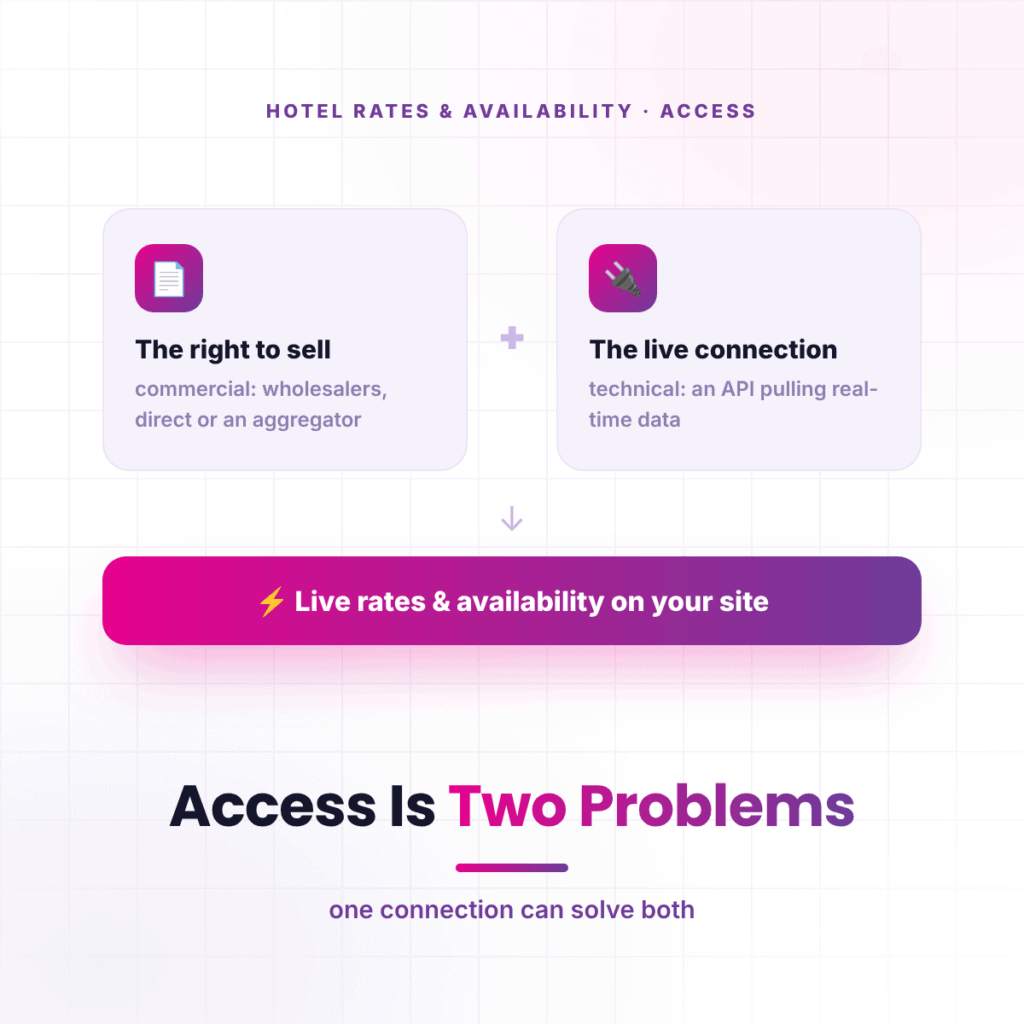
An OTA gets hotel rates and availability by connecting to hotel supply through an API, which returns live prices and room availability from suppliers at the moment a guest searches. Access is really two problems. The commercial one is getting the right to sell that supply, through wholesalers, direct contracts or an aggregator. The technical one is pulling the live data onto your site fast and reliably, which is what the API does. Most OTAs solve both at once by connecting to an aggregator API that bundles the supply and delivers the live rates and availability through a single connection.
Written for new and growing OTAs and travel platforms
It is the question every OTA founder hits early: where do the hotels, the prices and the little green available tonight come from and how do I get them onto my own site? It feels like it should have a simple answer. It has a clear one, but it is in two parts and confusing the two is why so many people get stuck. One part is about permission to sell. The other is about the live data stream. You need both.
This guide explains the technical half, how live rates and availability actually reach your site in real time, in plain terms. It is the companion to our piece on how agencies get wholesale rates, which covers the commercial half of the same question. Read together they answer the whole thing. Here we focus on the mechanism: what the data is, how it moves and why getting it live and reliable is the real work.
When people ask how an OTA gets access to hotel rates and availability, they are actually asking two different questions at once, which is why the answers they find feel contradictory. The first is commercial: do you have the right to sell this hotel supply and at what rate. The second is technical: how does the live price and availability data physically get from the supplier onto the page your guest is looking at. These are separate problems with separate solutions. You cannot run an OTA with only one solved.
The commercial problem is about relationships and contracts, reaching supply through wholesalers, direct deals or an aggregator, which our wholesale rates guide covers in full. The technical problem, the focus here, is about data: getting accurate, current rates and availability to display and book in real time. Separating the two is the first clarity most OTA founders need, because a great commercial deal with no way to pull the data live is useless and a brilliant technical setup with no right to sell has nothing to show.
Rates and availability are the two live pieces of information behind every hotel search. Availability is whether a given room type is open for your dates and rates are what it costs, including the board basis and the cancellation terms. Both change constantly, as other people book, as hotels adjust prices and as inventory opens and closes. That constant change is the whole challenge, because the moment this data is even slightly stale it becomes misleading.
This is why rates and availability are called dynamic data, as opposed to the static content like photos and descriptions that rarely changes. Static content you can store and serve. Dynamic data you have to fetch close to real time, because a price from an hour ago or a room that was available this morning may both be wrong now. Understanding that rates and availability are live, perishable data is the key to understanding why getting access to them is a genuine technical problem and not just a download.
The data reaches your site through an API, the connection between your platform and the hotel supply. When a guest searches, your platform sends a request through the API to the supplier, asking what is available for those dates at what price. The supplier responds with live rates and availability, then your site displays them. The whole round trip happens in the moment of the search, which is what makes the prices a guest sees current rather than guesses.
The important thing to grasp is that you are not downloading a list of hotels and prices to keep. You are opening a live line to the supplier that you query every time someone searches. That is why an API, rather than a static feed, is how rates and availability actually get onto an OTA. The mechanics of how one of those queries turns into a confirmed booking are covered step by step in our guide to the hotel room booking API flow. Here the point is simpler: the live line is the API and the API is how the data arrives.
Pull real-time hotel rates and availability from 100+ suppliers through a single API.
See the Hotel API →Because rates and availability change constantly, how fresh your data is becomes a real decision. Query the supplier live for every search and your data is always current, but search can be slower and heavy traffic can strain the supplier. Store recent results and serve them from a cache and search is fast, but the data can drift out of date between the moment you cached it and the moment a guest books. Every OTA sits somewhere on this line and where it sits shapes both speed and accuracy.
The danger of leaning too hard on cached data is the mismatch it creates: a guest sees a price or an available room that is no longer real, then the booking fails or comes back changed. The practical answer most good setups use is to cache for speed in browsing but confirm the live rate and availability at the moment of booking, so the guest never commits to stale data. Getting access to rates and availability is not just getting the data once, it is keeping it fresh enough to trust, which is a core part of what a strong supply connection handles for you.
Here is where the two problems meet. You could solve the commercial side by signing up with several wholesalers, then solve the technical side by building a separate API connection to each one, keeping each live, handling each one’s quirks. That works. Some large OTAs do exactly that. For most, it is a lot of parallel effort to reach the same place: live rates and availability on your site.
An aggregator collapses both problems into one. It brings the commercial supply, many wholesalers and bedbanks already contracted and the technical delivery, a single API that pulls their live rates and availability, into one connection. Instead of solving permission and plumbing separately for each supplier, you connect once and get live, bookable rates and availability across a large pool of supply. ZentrumHub is an aggregator of this kind, delivering real-time rates and availability from more than a hundred suppliers through one hotel API, which is why aggregation is how most OTAs actually get access without building it all themselves.
Rather than contracting suppliers and building a live API connection to each, most OTAs connect to one aggregator that has already done the commercial contracting and provides the technical delivery. One integration gives both the right to sell and the live rates and availability to show, which is why aggregation is the common answer to how an OTA gets access to hotel supply.
In practice, getting access to hotel rates and availability comes down to a short sequence. Decide how you will reach supply commercially, which for most new OTAs means an aggregator rather than contracting hotels directly. Connect to that supply through its API, so your platform can query live rates and availability. Then build your search and booking flow on top, deciding your own balance of cached speed and live accuracy, always confirming the live rate before a booking completes.
The reason an aggregator shortens this so much is that it hands you the two hardest parts already solved: the supply is contracted and the live data connection exists, so you are left with the part that is actually yours to build, the experience your guests see. If you want to see how live rates and availability would reach your specific platform, our team can walk through it or you can start from the technical side in our guide to the hotel inventory API. Either way, the answer to how an OTA gets access is: connect to live supply through an API and let an aggregator carry the parts you should not have to build.
One connection solves both the commercial and the technical side: contracted supply plus real-time rates and availability from 100+ suppliers. Tell us your plan and we will show you how.
By connecting to hotel supply through an API that returns live rates and availability at the moment a guest searches. Access is really two problems. The commercial one is the right to sell the supply, obtained through wholesalers, direct contracts or an aggregator. The technical one is pulling the live data onto your site fast and reliably, which the API handles. Most OTAs solve both at once by connecting to an aggregator API that bundles contracted supply and delivers its live rates and availability through a single connection, rather than contracting hotels and building each connection themselves.
Because they change constantly, unlike static content such as photos and descriptions that rarely changes. Availability shifts as people book and as hotels open and close inventory, while rates move as hotels adjust prices. Static content can be stored and served, but dynamic data has to be fetched close to real time, because a price from an hour ago or a room that was free this morning may both be wrong now. That perishability is why getting access to rates and availability is a genuine technical problem and not just a one-time download of a list.
They fetch it live rather than downloading a fixed list. When a guest searches, the OTA sends a request through an API to the supplier asking what is available for those dates at what price. The supplier responds in that moment with live rates and availability. The OTA is opening a live line to the supplier that it queries every search, not keeping a static copy, because rates and availability change too fast for a stored list to stay accurate. This is why an API, not a static feed, is how rates and availability reach an OTA.
Usually a balance of both. Querying live for every search keeps data current but can be slower and strain the supplier, while serving cached results is fast but risks the data drifting out of date. The practical answer most good setups use is to cache for speed while a guest browses, then confirm the live rate and availability at the moment of booking, so the guest never commits to stale data. Getting access to rates and availability is not just getting the data once, it is keeping it fresh enough to trust right up to the booking.
Connecting to an aggregator, because it solves both the commercial and the technical side at once. An aggregator has already contracted many wholesalers and bedbanks and provides a single API that pulls their live rates and availability, so instead of signing up with several suppliers and building a connection to each, you connect once and get broad, bookable supply. That leaves you to build only the part that is truly yours, the guest experience, which is why aggregation is the common starting point for a new OTA getting access to hotel rates and availability.
Access is two problems. Solve both before you launch.
'+ '| Check | Done |
|---|---|
| Decided how you reach supply: aggregator, wholesaler or direct | |
| Have the right to sell the supply you plan to show | |
| Supply is broad enough to be competitive on your key destinations |
| Check | Done |
|---|---|
| Connected to supply through an API, not a static feed | |
| Rates and availability pulled live at search | |
| Balance of cached speed and live accuracy decided | |
| Live rate confirmed at the moment of booking, never cached |
Checklist by ZentrumHub. zentrumhub.com/blog/ota-hotel-rates-availability. Book a demo at zentrumhub.com/book-time
'+ ''; var w = window.open('', '_blank'); w.document.write(html); w.document.close(); w.focus(); setTimeout(function(){ w.print(); }, 350); }