

Table of Contents
Both “collect hotels from many places,” so people use the words as if they mean the same thing. They don’t. One is infrastructure that supplies inventory to a seller; the other is a marketing channel that sends shoppers to a seller. Confuse them in a strategy meeting and the whole plan points the wrong way.
The word “aggregator” gets attached to two products that could not be more different in purpose. One lives in the engine room of an OTA, quietly supplying the rooms it sells. The other lives on the open consumer web, comparing prices across dozens of OTAs and handing the shopper off to whichever one wins. Same verb — “aggregate” — opposite jobs, opposite customers, opposite sides of the transaction.
This guide separates them cleanly, then explains the part that surprises people: a single OTA relates to both at once, and on opposite terms. It buys from one and advertises on the other. In a market where OTAs carry 40%+ of global hotel bookings (Phocuswright, 2024) inside a sector heading for $107B by 2026 (Skift Research), knowing which “aggregation” a colleague means is the difference between a supply conversation and a marketing one.
Hotel metasearch is a consumer-facing price-comparison service: a traveller searches once, and the metasearch engine shows the same hotel’s price across many sellers side by side, then links out to the chosen seller to complete the booking. It does not sell the room itself and it does not hold inventory. Its product is the comparison, and its business model is referral — sellers pay to appear, usually per click or on a commission when the referred traveller books. Metasearch sits on the open web between the shopper and the sellers, and its customers are two-sided: travellers who want to compare, and the OTAs and hotels who pay to be compared favourably. In short, metasearch is a marketing and distribution channel, not a piece of booking infrastructure.
A hotel API aggregator is the opposite kind of thing entirely: B2B infrastructure that supplies a seller with inventory. It connects an OTA or booking platform to many suppliers — bedbanks, GDS, wholesale programmes, direct contracts — through one API, deduplicates the same property across sources, normalises formats, and returns one clean feed the seller can actually book against. It never faces the consumer, never sends anyone anywhere, and never charges for referrals. Its product is bookable, unified supply; its customer is the seller. Where metasearch aggregates sellers’ prices for a shopper to compare, an aggregator aggregates suppliers’ rooms for a seller to sell.
Both “aggregate,” so the tell is what each one collects and who it collects for. One question resolves it: is it collecting inventory to sell, or collecting prices to compare and refer?
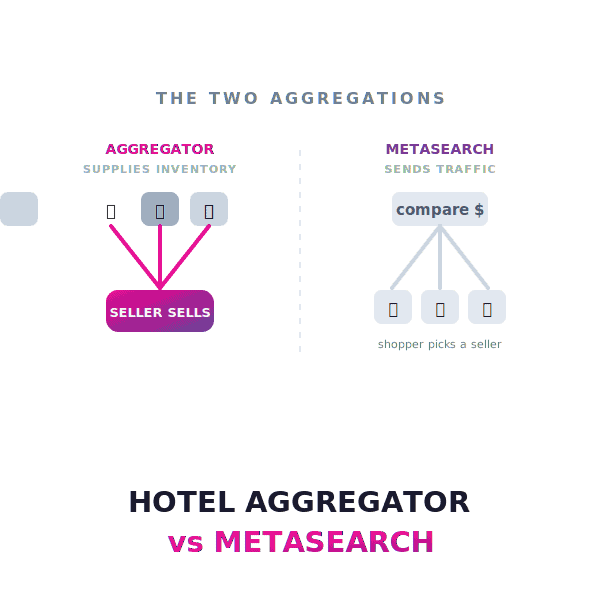
The Two Aggregations. Collecting inventory to sell → aggregator. Collecting prices to compare and refer → metasearch.
| Dimension | Hotel API aggregator | Hotel metasearch |
|---|---|---|
| Category | B2B infrastructure | Consumer marketing channel |
| Aggregates | Suppliers’ inventory | Sellers’ prices / listings |
| Who it serves | Sellers (OTAs, agencies, platforms) | Travellers + the sellers who pay to appear |
| Where the booking happens | On the seller’s own platform | On whichever seller the shopper is referred to |
| Business model | Flat SaaS / connectivity subscription | Pay-per-click / referral commission |
| An OTA’s relationship | Buys it (supply side) | Advertises on it (demand side) |
| Shows up on | The tech stack | The marketing budget |
Here is the relationship that makes the whole thing click. An OTA sits between the two aggregations, connected to each on opposite terms. On the supply side, it uses a hotel API aggregator to source the rooms it sells — infrastructure it buys and builds on. On the demand side, it lists its prices on consumer metasearch to attract shoppers — a channel it advertises on and pays for referrals. The aggregator fills the shelves; metasearch drives footfall to the shop. The two never compete for the same budget line or solve the same problem, which is exactly why “aggregator vs metasearch” is a false choice for an OTA: it needs one to have something to sell and uses the other to help sell it.
There is even a quality link between them. Metasearch rewards competitive, accurate, always-available prices — and a strong aggregation layer underneath is what produces those. Deduplicated inventory with reliable best-rate selection and near-zero booking failure is what lets an OTA show sharp prices on metasearch and actually honour them at checkout. Weak supply infrastructure shows up as uncompetitive or broken listings on the very channel meant to drive growth. The two aggregations are separate, but the first quietly determines how well the second performs.
If the goal is “get more people to my booking site,” you mean metasearch — a marketing decision about channels, bids and cost-per-acquisition. If the goal is “have more and better inventory to sell, from more suppliers, without ten integrations,” you mean a hotel API aggregator — an infrastructure decision about coverage, deduplication and maintenance. The quickest self-check is the budget it lands on: marketing spend points to metasearch; engineering and supply point to an aggregator. Most OTAs, especially early on, discover they were really asking about supply — because there is no point buying traffic to a thin, duplicate-ridden, unreliable inventory. Supply first, traffic second; the aggregator is the foundation the metasearch spend eventually stands on.
It starts with deduplicated best-rate supply — one API to Expedia Hotel API, Priceline Hotel API, and 100+ pre-integrated suppliers.
Explore the Universal Hotel API →ZentrumHub is the supply side of this story — the aggregator, not a metasearch engine. It is the infrastructure an OTA builds on to have competitive, reliable inventory in the first place: through Zentrum Connect, one API reaches 100+ suppliers and 900,000+ deduplicated hotels across 190+ countries, with best-rate selection and automatic recheck that keep booking failure near zero at sub-500ms. That combination is precisely what a strong metasearch presence depends on downstream: accurate prices that hold at checkout, and inventory deep enough to compete on the comparison page. ZentrumHub does not send you traffic; it makes sure that when traffic arrives — from metasearch or anywhere else — you have something worth selling and a booking that actually confirms.
Also Read: Best Hotel API Aggregators in 2026: the ranked comparison by layer →
100+ suppliers, 900,000+ deduplicated hotels, best-rate selection, near-zero booking failure — one API, live in 15 days.
A hotel API aggregator is B2B infrastructure that supplies inventory to a seller: it unifies many suppliers behind one API so an OTA can source and sell rooms. Hotel metasearch is a consumer marketing channel that compares sellers’ prices for a shopper and refers the shopper to whichever seller they choose. The aggregator aggregates supply for a seller to book; metasearch aggregates listings for a traveller to compare. Different customers, different business models, opposite sides of the transaction.
Only in the loose, everyday sense that it “collects hotels from many places.” In travel-tech terms they are different categories: metasearch aggregates sellers’ prices to compare and refer, and earns money on clicks or referral commission; a hotel API aggregator aggregates suppliers’ inventory to be booked, and is paid as supply infrastructure. Calling both “aggregators” is why the terms get confused. If it sends shoppers elsewhere to book, it is metasearch; if it lets a seller book the room itself, it is an inventory aggregator.
Both, on opposite terms. An OTA uses a hotel API aggregator on the supply side to source the inventory it sells, and it advertises on consumer metasearch on the demand side to attract shoppers to that inventory. One is infrastructure the OTA buys and builds on; the other is a paid channel the OTA competes on. They are complementary, not alternatives — the aggregator gives the OTA something to sell, and metasearch is one of the ways it drives traffic to sell it.
Those are the best-known examples of consumer metasearch — services that compare hotel prices across many sellers and refer the traveller onward to complete the booking. They are marketing and comparison channels, not booking infrastructure: they do not supply inventory to an OTA to sell. A hotel API aggregator is the different, behind-the-scenes product that gives an OTA its inventory in the first place. The everyday habit of calling metasearch sites “aggregators” is exactly the confusion this article exists to clear up.
Supply first. There is little point paying for metasearch traffic if the inventory behind it is thin, riddled with duplicates, or unreliable at checkout — the clicks arrive and convert poorly or fail. Get the aggregation layer right so you have deep, deduplicated, accurately priced inventory that holds at booking, then invest in metasearch to drive traffic to it. The aggregator is the foundation; metasearch spend performs in proportion to how solid that foundation is.
Drop your work email and we’ll send you the 12-page report that breaks down where 6–9 months and $215K+ quietly disappear — free.