

Table of Contents
A hotel API aggregator and a channel manager both sit between hotels and sellers — which is why they get confused. But they move inventory in opposite directions, for opposite customers. Pick the wrong one and you have built plumbing that points away from your business.
The two terms travel in the same sentences — “connectivity,” “distribution,” “one platform for all your channels” — so it is no surprise that OTA founders and hoteliers alike mix them up. But a hotel API aggregator and a channel manager are not two flavours of the same tool. They point in opposite directions, and the direction is the whole distinction: one is how a seller pulls inventory in, the other is how an owner pushes inventory out.
This guide fixes the confusion with a single test, then shows how the two actually relate — because they do connect, just not as competitors. The channel manager market is on its own growth curve, worth $1.2B in 2025 and heading to $2.6B by 2033 at 9.6% CAGR (Business Research Insights, 2024), precisely because hotels need to distribute; OTAs sit on the other side of that same transaction, needing to source. Knowing which side you are on decides which tool you build around.
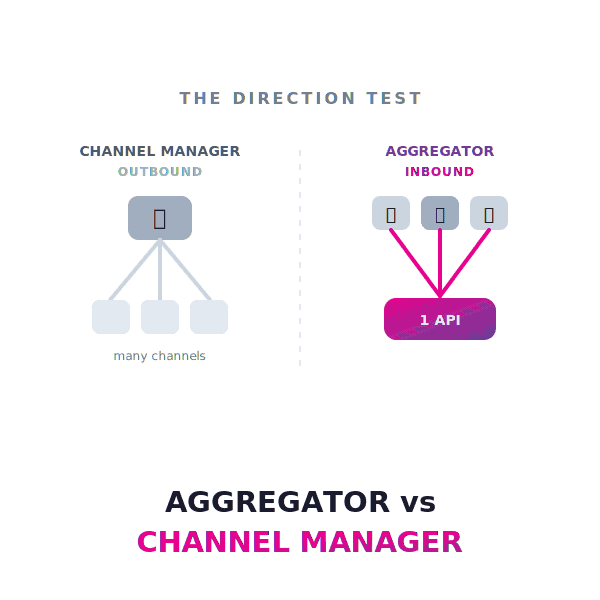
A channel manager is software a hotel uses to distribute its own rooms across many sales channels at once — OTAs, its own website, GDS, wholesalers — from one dashboard, keeping rates and availability in sync so it never oversells. It is a hotelier’s tool. Its job is outbound: take the inventory this one property owns and push it out to every channel that can sell it, then pull bookings back in and update availability everywhere in real time. When a hotel updates its price or closes out a date, the channel manager propagates that change to every connected channel so the same room is not sold twice at two prices. The customer of a channel manager is the property owner; the problem it solves is “how do I sell my rooms in more places without managing each place by hand.”
A hotel API aggregator is the mirror image. It is software a seller — an OTA, travel agency or booking platform — uses to source inventory from many suppliers through one API. Its job is inbound: connect to bedbanks, GDS, wholesale programmes and direct contracts, deduplicate the same property across them, normalise every format, and hand the seller one clean feed to sell from. When the seller runs a search, the aggregator queries every connected supplier in parallel and returns the best available options as a single response. The customer of an aggregator is the seller of inventory; the problem it solves is “how do I source rooms from many suppliers without building and maintaining an integration for each one.”
One question classifies which tool you need, and it is about direction of flow: are you trying to source rooms to sell, or distribute rooms you own?
The Direction Test. Source rooms to sell → aggregator. Distribute rooms you own → channel manager.
| Dimension | Channel manager | Hotel API aggregator |
|---|---|---|
| Direction of flow | Outbound — pushes inventory out | Inbound — pulls inventory in |
| Who it’s for | Hotel owners / property managers | Sellers — OTAs, agencies, platforms |
| Core job | Distribute one property to many channels | Source many suppliers into one feed |
| Inventory owned? | Yes — the hotel’s own rooms | No — connects to suppliers who own it |
| Deduplication | Not applicable — one property | Core function across suppliers |
| Prevents | Overselling across channels | Duplicate listings & fragmented supply |
| Typical buyer | A hotel or hotel group | A travel business that resells hotels |
The two tools are not rivals because they occupy adjacent links of the same chain. Picture a room’s journey: a hotel loads it into its channel manager, which distributes it outbound to a bedbank; that bedbank is one of the suppliers a hotel API aggregator connects to; the aggregator pulls that inventory inbound and hands it to an OTA, which sells it to a traveller. The channel manager pushed at one end; the aggregator pulled at the other. The same room passed through both, in the same direction of travel, serving two different businesses. This is why a hotelier and an OTA can each be right when they say they “need connectivity” and still need completely different products.
There is a related comparison worth separating cleanly: channel managers are also sometimes weighed against a direct supplier API from the hotelier’s own side. That is a different question with a different answer, covered in hotel channel manager vs supplier API — worth reading if you sit on the supply side rather than the selling side.
Run the Direction Test and the answer is usually immediate. If your business sells hotel rooms it does not own — an OTA, a travel agency, a B2B distributor, a corporate booking platform — you are inbound, and you need a hotel API aggregator. With 40%+ of global hotel bookings now flowing through OTAs (Phocuswright, 2024), the overwhelming majority of travel businesses asking this question sit on the selling side and need to source, not distribute. If your business owns hotel rooms and needs to sell them in more places — a hotel, a small chain, a property manager — you are outbound, and you need a channel manager. The rare business that does both, owning some inventory and reselling other suppliers’, needs both tools, each pointed in its own direction. What almost never works is buying the wrong-direction tool because the marketing sounded adjacent.
That’s the inbound job — one API to 100+ suppliers, deduplicated and normalised.
See the Universal Hotel API →ZentrumHub is squarely on the inbound side — the aggregator, not the channel manager. It exists for sellers: OTAs, agencies and platforms that source hotel inventory and need it as one clean feed rather than a dozen supplier integrations. Through Zentrum Connect, a seller connects once and reaches 100+ suppliers and 900,000+ deduplicated hotels across 190+ countries, at sub-500ms, on their own supplier contracts, with ZentrumHub maintaining every connection. Notably, channel managers themselves are among the source types that feed in — Zentrum Connect draws from bedbanks, GDS, wholesalers and channel-manager-connected inventory alike — which is the supply chain from the earlier section working exactly as designed: the aggregator sits at the seller’s end, pulling everything in.
Also Read: Best Hotel API Aggregators in 2026: the ranked comparison by layer →
If you sell hotel rooms, you need to source them — 100+ suppliers, 900,000+ deduplicated hotels, one API, live in 15 days.
Direction of flow. A channel manager is outbound: a hotel uses it to push its own rooms out to many sales channels from one dashboard. A hotel API aggregator is inbound: a seller uses it to pull inventory in from many suppliers through one API. They serve opposite customers — channel managers serve hotel owners, aggregators serve sellers of hotel inventory such as OTAs and agencies — so they are complementary links in the supply chain, not competing products.
Usually not. An OTA sells rooms it does not own, so it is on the inbound, sourcing side — it needs a hotel API aggregator, not a channel manager. A channel manager only becomes relevant if the OTA also owns hotel inventory it needs to distribute outbound, which is a separate business from reselling suppliers’ inventory. For the core OTA job of sourcing and selling many suppliers’ rooms, the aggregator is the tool.
Yes — they sit at adjacent points in the same supply chain. A hotel distributes its rooms outbound through a channel manager to suppliers such as bedbanks; those suppliers are then among the sources a hotel API aggregator connects to inbound on behalf of a seller. The same room can pass through both tools on its way from the property to the traveller. They cooperate rather than compete, each serving a different party in the transaction.
No. “Supplier connectivity” from a seller’s perspective means connecting to inventory sources to buy — the aggregator’s job. A channel manager is connectivity from the owner’s perspective — connecting one property to sales channels to sell. The word “connectivity” is used on both sides of the market, which is a large part of why the tools get confused. There is also a distinct comparison between channel managers and direct supplier APIs on the supply side, covered separately in the channel manager vs supplier API guide.
A hotel API aggregator. An OTA’s foundation is deep, deduplicated, reliable supply from many sources, delivered as one feed — which is exactly what an aggregator provides. Building around a channel manager would point your infrastructure at distributing inventory you do not own, the wrong direction for a reselling business. Choose the aggregator, connect your supplier contracts through it, and let it handle deduplication, normalisation and maintenance across every source you carry.
Drop your work email and we’ll send you the 12-page report that breaks down where 6–9 months and $215K+ quietly disappear — free.