






Table of Contents
Choosing a hotel booking API in India is not the same decision as choosing one anywhere else. The supply mix is different, the money moves differently, tax works differently and the market is more price-sensitive. A choice that is right for an agency in Europe can be wrong for one in India. Here is what actually matters here.
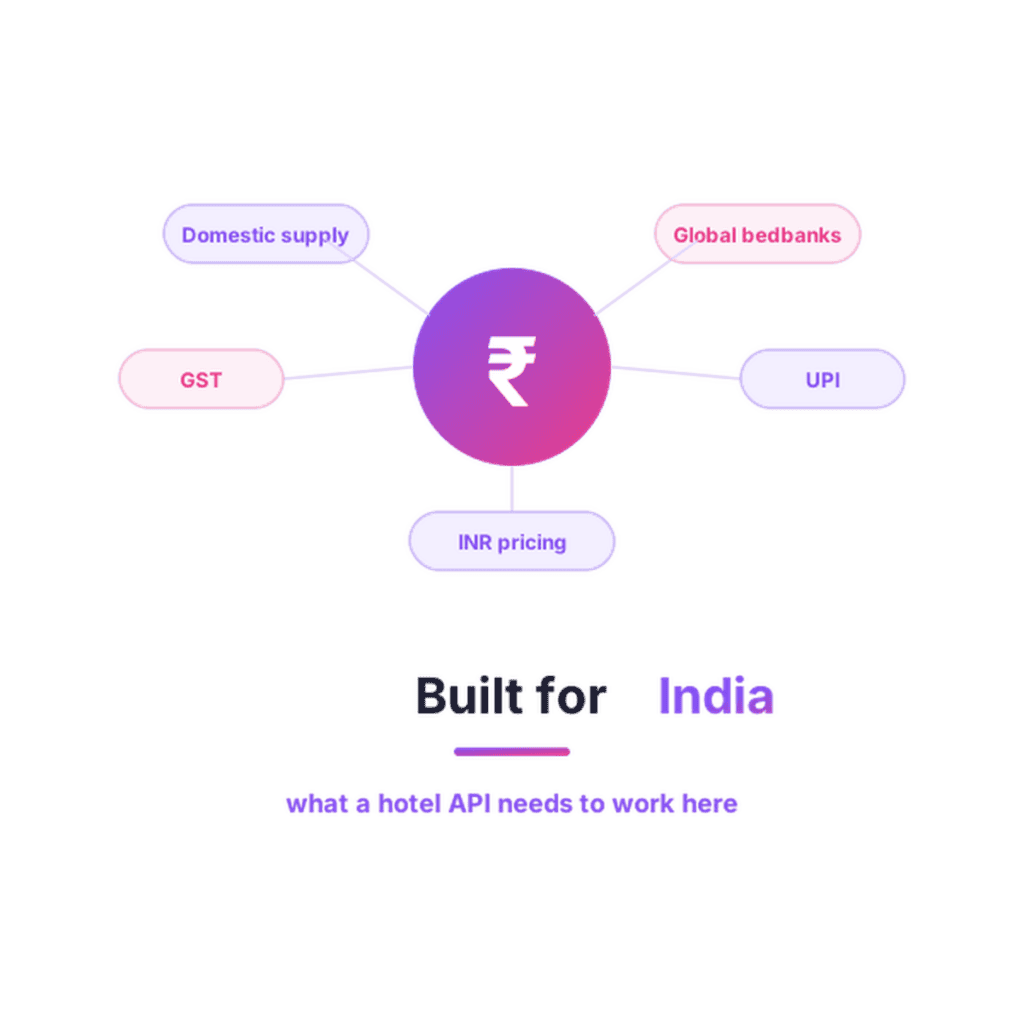
Choosing a hotel booking API in India comes down to five things that are specific to this market: the right supply mix of strong domestic inventory plus global bedbanks, settlement and pricing in INR without losing margin to exchange swings, GST handled correctly on every booking, support for the local payment methods Indian customers expect including UPI and pricing that works for a highly price-sensitive market. A hotel booking API chosen on global features alone can miss all five. The right one for India fits the way travel is actually sold and paid for here.
Written for Indian OTAs, travel agencies and travel startups
India is one of the fastest-growing travel markets in the world. The number of agencies and startups wanting to sell hotels online here grows every year. Most of them start by reading global advice on choosing a hotel booking API, which is useful but incomplete, because it assumes a market that works like the US or Europe. India does not. The supply, the money, the tax and the buyer all behave differently and those differences change which API is actually the right one.
This guide is the India-specific version. It walks through the five things that genuinely matter when choosing a hotel booking API for an Indian business, each of which a generic guide tends to skip. If you want the broader picture of the whole launch stack, our guide to OTA API integration covers that. This one is about the local realities that decide whether your platform fits the market you are actually selling into.
The mistake is assuming a hotel booking API is a global, interchangeable product. On the core technology it nearly is. On the things that decide whether you can actually run a profitable travel business in India, it is not. An API built and chosen for a Western market can leave an Indian operator fighting its own tooling: pricing in the wrong currency, tax that does not reconcile, payment methods customers do not use and a supply mix thin on the domestic hotels Indian travellers actually book.
The useful frame is that the API is the same everywhere but the business around it is local. Your customers pay in rupees. Your accountant needs GST handled. Your travellers want to pay by UPI. Your inventory has to be strong on Indian properties as well as international ones. The five sections below are the specific places where the local reality should shape your choice. Getting them right is what separates an API that technically works from one that works for India.
Indian travellers book a lot of Indian hotels and a lot of those properties sell best through domestic sources rather than the global bedbanks that dominate Western inventory. An Indian OTA that connects only to global suppliers ends up with weak coverage and uncompetitive rates on exactly the domestic properties its customers search for most. Strong India coverage usually means pulling from domestic suppliers alongside the international ones, so your catalogue is deep where your demand actually is.
This is where single-supplier thinking fails fastest in India. No one supplier gives you both the domestic depth and the global reach an Indian business needs. The practical answer is an aggregation layer that brings domestic and international supply together through one connection. ZentrumHub connects to domestic Indian sources such as MakeMyTrip alongside global bedbanks and other suppliers, so your Indian customers get competitive rates on the hotels they want at home and abroad. Supply mix is the first thing to get right, because everything else is moot if the rates are not competitive on the properties people search for.
Your customers think and pay in rupees, so your platform has to price in rupees cleanly. That sounds obvious until you realise much international hotel supply is priced in dollars or euros, which means every international booking carries a currency conversion between what the supplier charges you and what you charge the guest. Handled carelessly, that conversion quietly eats your margin or leaves you exposed when the rupee moves between the quote and the settlement.
The right setup lets you present prices in INR to your customers while managing the exchange risk on the supply you buy in other currencies, so a rupee price is both attractive to the customer and safe for your margin. This matters more in India than in a single-currency market, because so much of the attractive international inventory is priced in foreign currency. A hotel booking API decision in India should always include how cleanly it lets you sell in rupees without giving away margin on the conversion.
Selling international hotels to Indian customers means buying in dollars and selling in rupees. If the exchange rate moves between the price you quote and the money you settle, the gap comes out of your margin. The fix is pricing in INR with a built-in buffer on each currency pair, so a rupee price stays attractive to the customer while your margin stays protected from the swing.
Domestic and global supply, INR pricing and local payments, through one hotel API.
See the Hotel API →Tax is where an India travel business gets real. It is almost entirely absent from global hotel API advice. Selling travel in India means dealing with GST and getting it right across thousands of bookings is not optional. Your platform and your process need to handle the tax correctly on every transaction, capture the details your business needs for compliance and give you clean records at the end of the period, rather than leaving you to untangle it by hand.
The practical point for choosing a hotel booking API is to think about tax from the start rather than discovering it at your first filing. A setup that ignores GST until the accountant asks is a setup that creates months of reconciliation pain, because the information you needed was never captured at the point of booking. This is a specifically Indian requirement that a generic API guide will not mention. It is exactly the kind of local reality that should weigh on your decision. If GST handling matters to your operation, raise it early when you evaluate any platform.
India has its own payment culture. It does not look like the card-first West. UPI has become the default way a huge number of Indians pay for everything, alongside net banking, wallets and cards. A travel platform that only accepts international credit cards is quietly turning away a large share of Indian customers at the final, most important step, the moment they try to pay. Payment fit is not a detail here, it is often the difference between a completed booking and an abandoned one.
This mostly sits in your payment integration rather than the hotel booking API itself, but the two have to work together, because the booking flow and the payment flow meet at checkout. When you plan an Indian platform, make local payment support a first-class requirement rather than an afterthought and make sure your booking flow and your chosen payment methods fit cleanly. A beautiful search experience that ends at a checkout your customer cannot use is a platform that loses the booking at the finish line.
India is a famously price-sensitive travel market, where customers compare rates closely and small differences decide bookings. That puts two demands on your hotel booking API. The rates you get have to be competitive, which comes back to the supply mix and getting genuinely good inventory rather than marked-up feeds. And the control you have over your own pricing has to be fine-grained, so you can compete on price where it matters without giving away margin everywhere.
The ability to set your markup precisely, by supplier, by route, by customer type, is more valuable in India than in a less price-driven market, because the margin you work with is thinner and the competition on price is sharper. An API and platform that give you both competitive source rates and precise control over your selling price let you win price-sensitive customers without bleeding margin. In a market this competitive, that combination is not a nice-to-have, it is how you survive.
Choosing a hotel booking API in India is really about fit with the local business, not global feature checklists. Get competitive domestic and global supply through one connection. Price in rupees without losing margin on currency. Handle GST from the first booking. Support the payment methods Indians actually use. And keep precise control of your pricing for a market that watches price closely. An API that does all five fits India. One chosen on global features alone usually misses at least two.
The reason an aggregation platform tends to fit Indian businesses well is that it addresses several of these at once: domestic and global supply through one integration, INR pricing with managed currency risk and the pricing control a competitive market demands. If you are weighing options for an Indian OTA or agency, the fastest way to see whether a platform fits is to walk through these five points against your own plan, which you can do with our team or using the deeper build-versus-buy view in our guide to the three ways to sell hotels on your own site. The right choice for India is the one that fits how travel is sold and paid for here.
Domestic and global supply through one connection, INR pricing with managed currency risk and the control a price-sensitive market demands. Tell us your plan and we will show you how it fits.
Five India-specific things. A supply mix with strong domestic Indian inventory alongside global bedbanks, so your rates are competitive on the hotels Indians actually book. INR pricing that protects your margin on international supply bought in other currencies. GST handled correctly on every booking. Support for local payment methods including UPI, net banking and wallets. And precise control over your own pricing for a price-sensitive market. An API chosen on global features alone tends to miss several of these, so judge it on fit with the Indian business, not just the feature list.
Because the business around the API is local even though the technology is global. Indian customers pay in rupees, so you need clean INR pricing. Selling travel in India means handling GST. Indian travellers pay by UPI and other local methods far more than by international card. And Indian travellers book many domestic hotels that sell best through domestic suppliers. A hotel booking API chosen for a Western market can leave an Indian operator with the wrong currency, unreconciled tax, payment methods customers do not use and thin domestic coverage.
For an Indian audience you almost always need both. Indian travellers book a lot of Indian hotels and many of those properties sell best through domestic sources rather than global bedbanks, so connecting only to international suppliers leaves you with weak coverage and uncompetitive rates on exactly the properties your customers search for most. The practical answer is an aggregation layer that brings domestic Indian supply and global inventory together through one connection, so your catalogue is deep at home and wide abroad.
A lot, because much international hotel supply is priced in dollars or euros while your Indian customers pay in rupees. Every international booking carries a conversion between what the supplier charges you and what you charge the guest and if the rupee moves between the quote and the settlement, the gap comes out of your margin. The right setup lets you present prices in INR while managing the exchange risk with a buffer on each currency pair, so a rupee price stays attractive to the customer and safe for your margin.
GST handling sits across your platform and your process rather than being a single API feature, but it has to be planned from the start. Selling travel in India means dealing with GST on bookings. The details you need for compliance have to be captured at the point of booking rather than reconstructed later. A setup that ignores GST until the first filing creates months of reconciliation pain, so raise tax handling early when you evaluate any platform and make sure it gives you clean records for the period.
Five India-specific checks. Run them against any platform before you commit.
'+ '| What to check | What good looks like in India | OK |
|---|---|---|
| Supply mix | Strong domestic Indian hotels plus global bedbanks, one connection | |
| INR pricing | Sell in rupees with margin protected on foreign-currency supply | |
| GST | Tax handled on every booking, clean records for filing | |
| Local payments | UPI, net banking, wallets and cards all supported at checkout | |
| Pricing control | Precise markup by supplier, route and customer type |
Checklist by ZentrumHub. zentrumhub.com/blog/hotel-booking-api-india. Book a demo at zentrumhub.com/book-time
'+ ''; var w = window.open('', '_blank'); w.document.write(html); w.document.close(); w.focus(); setTimeout(function(){ w.print(); }, 350); }