






Table of Contents
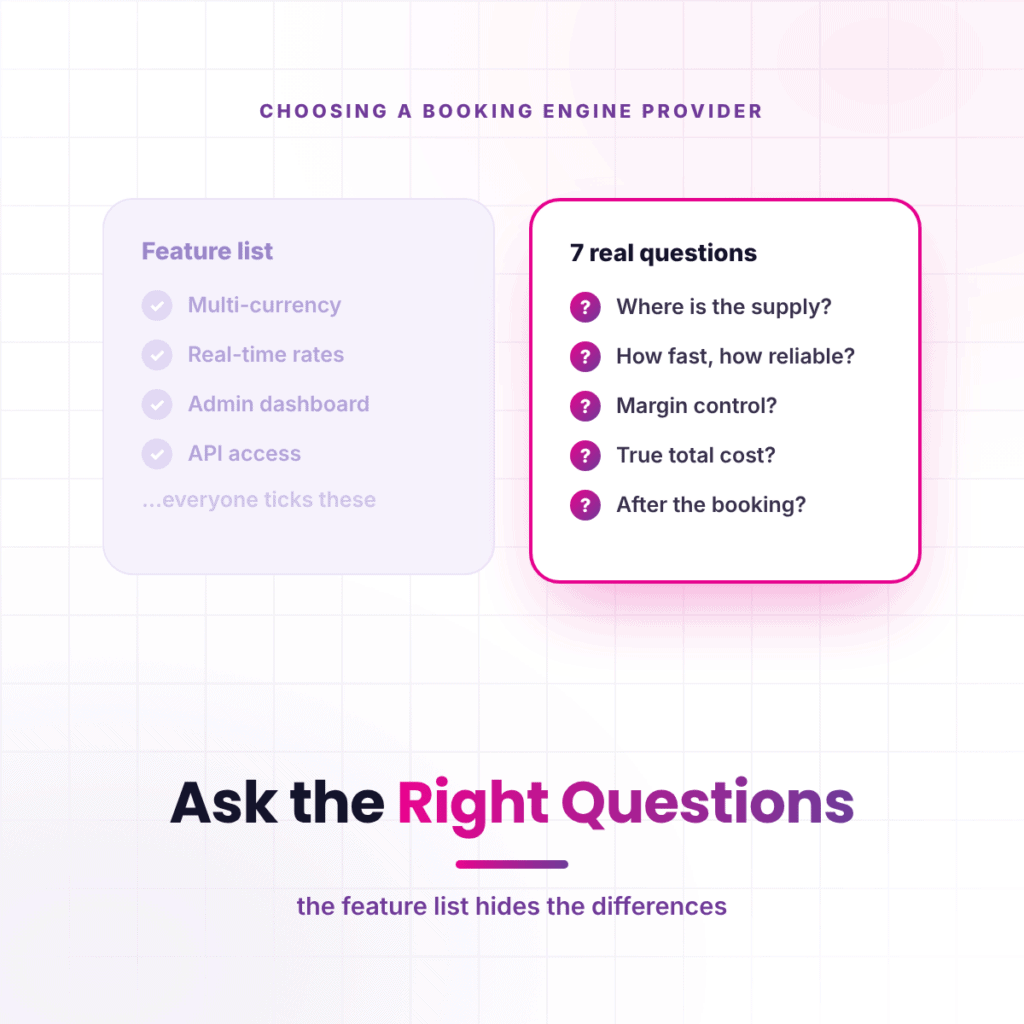
On a feature list, every hotel booking engine provider looks the same. They all tick the boxes. The differences that decide whether you grow or struggle do not show up on a comparison table, they show up in seven questions most buyers never ask. Here they are, including the one almost everyone forgets.
To choose a hotel booking engine provider, look past the feature list and ask seven questions: where does the supply come from and is it included, how fast and reliable is the booking flow, how much control do you have over pricing and margin, how is it priced in total, how quickly can you go live, who owns the customer experience and what happens after the booking. The question most buyers forget is the first one, supply, because a booking engine with thin or separately billed inventory undermines everything else. Judge providers on these, not on who has the longest feature list.
Written for OTA and travel business owners choosing a booking engine
Shortlisting hotel booking engine providers usually starts with a spreadsheet of features. That spreadsheet is almost useless. Every serious provider supports multi-currency, has an admin dashboard and offers an API. Tick, tick, tick. The feature list tells you what a booking engine has, not whether it will actually help your business grow and those are very different questions. The second one is the only one that matters. It is not on the table.
This guide replaces the feature checklist with seven questions that actually separate providers once the boxes are all ticked. They are the questions experienced buyers wish they had asked earlier. The first one is the one most people forget entirely. If you also want to weigh the build-versus-buy side of this decision, our guide to booking engine cost is the companion. This piece is about how to judge a provider you are considering buying from.
Feature lists converge because features are easy to copy and easy to claim. Once one provider lists multi-currency, real-time availability and a mobile-ready design, every competitor lists the same, because none of it is hard to say on a website. The result is that comparing hotel booking engine providers on features is like comparing cars on whether they have wheels. Everyone passes, so the comparison tells you nothing.
What a feature list hides is the quality and the economics behind each tick. Two providers both claim real-time availability, but one is fast and reliable and the other is slow and flaky. Both claim supplier connectivity, but one includes broad supply and the other expects you to source it. The checkbox is identical. The reality behind it is worlds apart. The only way to see it is to ask the seven questions below, which no feature list answers.
This is the question almost everyone forgets. It is the most important. A booking engine is only as good as the hotels it can sell, so the first thing to ask any provider is where the inventory comes from and whether it is included. Some providers give you a booking engine and leave the supply entirely to you, which means a large, hidden project to find and connect suppliers before you can sell a single room. Others include broad supply from the start.
The difference is enormous and invisible on a feature list, because both providers can tick supplier connectivity. One means we have supply built in and you can sell immediately. The other means we support connecting supply that you must arrange yourself. Ask directly: how many hotels can I sell on day one, through this provider, without sourcing my own. A provider that bundles broad supply, as Zentrum Connect does, removes the single biggest hidden cost of launching and a provider that does not has quietly handed you a second project.
Speed and reliability are where a booking engine quietly wins or loses you money every day. Slow search loses bookings, because users abandon a page that makes them wait. It is worse on mobile, where most browsing now happens. Unreliable booking is worse still, because a flow that confirms rooms that were not actually secured destroys trust at the front desk. Neither shows up on a feature list. Both decide your real conversion.
So ask for the things behind the tick: how fast is a typical search, how does the engine behave under heavy load and how does it handle a booking that fails partway through. A provider confident in its performance will answer concretely. One that deflects to the feature list is telling you something. The reliability layer behind a booking engine is where most of the hard engineering lives, which we cover in our piece on what nobody tells you before building a booking engine and it is exactly what separates providers that look equal on paper.
Your margin lives in how precisely you can control pricing and providers vary a lot here behind an identical-looking tick for markup support. The question is how fine-grained that control is. Can you set markup by supplier, by market, by customer type and by date? Or only a single blunt percentage across everything? Fine-grained control lets you compete where you need to without giving away margin everywhere, which over thousands of bookings is the difference between a healthy business and a thin one.
Ask to see the pricing controls, not just hear that they exist. A provider with real pricing depth will show you rules by supplier and channel. A provider with a single markup field will show you a single markup field. Both ticked pricing on the feature list. Only one gives you the control to actually protect and grow your margin and that control compounds into real money over time.
For supply, ask how many hotels you can sell on day one without sourcing your own. For speed, ask for a typical search time and how the engine behaves under load. For margin, ask to see markup set by supplier and channel, not just confirmed that it exists. Make every provider answer concretely, because the confident, specific answer and the vague deflection tell you most of what you need to know.
Broad supply built in, fast and reliable, with the margin control to grow. See it for yourself.
See Zentrum Engine →Three more questions round out the real comparison. On cost, ask for the total, not the headline: the platform fee plus supply, transaction fees, maintenance and anything billed separately, because the cheapest quote often hides the highest true cost. On speed to launch, ask how long until you are actually live and selling, since a provider that takes six months to onboard is costing you six months of revenue a faster one would have earned.
On ownership, ask who owns the customer experience and the data. With some providers the booking happens under your brand, on your site, with your customer relationship intact. With others the experience is theirs, so you are effectively renting. These three questions, alongside supply, speed and margin, are the real comparison. They almost never appear on the feature table a provider hands you. Asking them is how you compare providers on what actually matters rather than on who claims the most.
The last question is the one buyers discover too late. A booking engine that takes bookings beautifully but leaves you alone afterwards is only half a system. Cancellations, modifications, refunds, the voucher the guest needs and the support for when something goes wrong are all part of running a booking business and providers differ sharply in how much of this they handle. The demo shows you the booking. It rarely shows you the cancellation three weeks later.
So ask what happens after the booking: how are cancellations and refunds processed, how are modifications handled, what support exists when a booking goes wrong. A provider that has thought about the whole lifecycle will have clear answers. One that only talks about search and book is leaving the hardest operational part to you, which you will discover the first time a guest needs to change a reservation. The after-booking answer often separates two providers that looked identical right up until a real customer needed help.
Put your shortlisted providers against the seven questions rather than the feature list. The real differences appear fast. The table below is the shape of that comparison. Score each provider on each question. The one that looked average on features often pulls ahead, because it answers the questions that actually decide whether you grow.
| The question | Weak provider | Strong provider |
|---|---|---|
| 1. Supply | You source it | Broad, built in |
| 2. Speed / reliability | Vague answers | Concrete numbers |
| 3. Pricing control | One markup field | By supplier and channel |
| 4. Total cost | Low quote, hidden extras | Transparent total |
| 5. Time to launch | Months | Weeks |
| 6. Ownership | Theirs | Yours |
| 7. After the booking | Left to you | Handled |
Fill this in from real answers, not brochures. Your decision makes itself. The provider that scores strong across all seven is the one that will actually help you grow, whatever the feature lists said. If you want to see how a booking engine with supply, speed, margin control and the full lifecycle built in scores against these, our team can walk your real shortlist through them. You can also start from Zentrum Engine.
Broad supply built in, fast and reliable booking, fine-grained margin control, transparent cost and the full lifecycle handled. Put Zentrum Engine against the seven and see.
Look past the feature list and ask seven questions: where the supply comes from and whether it is included, how fast and reliable the booking flow is, how much control you have over pricing and margin, what the total cost is rather than the headline, how quickly you can go live, who owns the customer experience and what happens after the booking. Features converge because they are easy to claim, so they tell you little. The real differences live in the quality and economics behind each tick, which only these questions reveal.
Where the supply comes from and whether it is included, which is the question most buyers forget. A booking engine is only as good as the hotels it can sell, yet some providers give you the engine and leave sourcing suppliers entirely to you, a large hidden project before you can sell a single room. Both a provider that bundles broad supply and one that expects you to source it can both tick supplier connectivity on a feature list, so ask directly how many hotels you can sell on day one without arranging your own supply.
Because features are easy to copy and easy to claim, so every serious provider lists the same ones. Comparing on features is like comparing cars on whether they have wheels, everyone passes. What a feature list hides is the quality and economics behind each tick: two providers both claim real-time availability, but one is fast and reliable and the other slow and flaky; both claim supplier connectivity, but one includes broad supply while the other expects you to source it. The checkbox is identical while the reality is worlds apart.
Very, because your margin lives in how precisely you can control pricing and providers vary a lot behind an identical-looking tick for markup. The question is how fine-grained the control is: can you set markup by supplier, by market, by customer type and by date? Or only a single blunt percentage across everything. Fine-grained control lets you compete where you need to without giving away margin everywhere, which over thousands of bookings is the difference between a healthy business and a thin one. Ask to see the controls rather than just hear that they exist.
Ask how cancellations and refunds are processed, how modifications are handled and what support exists when a booking goes wrong. A booking engine that takes bookings well but leaves you alone afterwards is only half a system and providers differ sharply in how much of the post-booking lifecycle they handle. The demo shows the booking, rarely the cancellation three weeks later. A provider that has thought about the whole lifecycle will have clear answers, while one that only talks about search and book is leaving the hardest operational part to you.
Score each provider 1 to 5 on the questions that actually matter. Highest total wins, not the longest feature list.
'+ '| Question | Provider A | Provider B |
|---|---|---|
| 1. Supply: hotels you can sell day one, without sourcing your own | __ | __ |
| 2. Speed and reliability: concrete search time and failure handling | __ | __ |
| 3. Pricing control: markup by supplier, market, customer, date | __ | __ |
| 4. Total cost: platform plus supply, fees, maintenance | __ | __ |
| 5. Time to launch: weeks, not months | __ | __ |
| 6. Ownership: your brand, your customer, your data | __ | __ |
| 7. After the booking: cancellations, refunds, support handled | __ | __ |
| Total | __ | __ |
Scorecard by ZentrumHub. zentrumhub.com/blog/hotel-booking-engine-providers. Book a demo at zentrumhub.com/book-time
'+ ''; var w = window.open('', '_blank'); w.document.write(html); w.document.close(); w.focus(); setTimeout(function(){ w.print(); }, 350); }