






Table of Contents
Search for a hotel booking system and you will find cheap scripts and templates promising a full platform for the price of a dinner. They are not a booking system. They are a front end with no engine. The real hotel booking system is the API behind it and that is the part a template cannot give you.
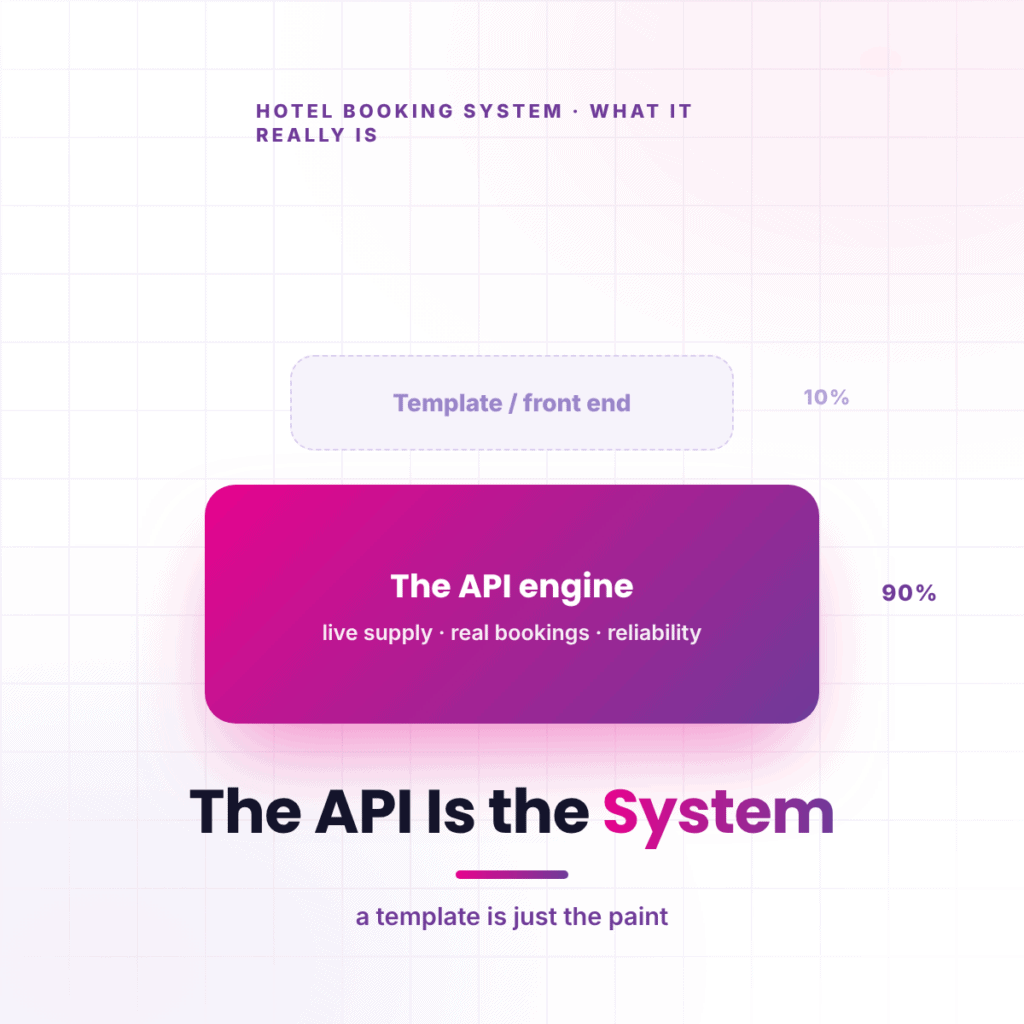
A hotel booking system has two parts: the front end a guest sees and the hotel booking system API behind it that supplies real rooms and makes real reservations. A cheap script or template gives you the front end, which is the easy ten percent. The hard ninety percent is the API layer: live rates and availability from real suppliers, a booking flow that actually confirms rooms and the reliability to handle it at scale. Without that API a template is a demo with no hotels in it. The real system is the engine, not the skin.
Written for founders and developers building a hotel booking system
If you have searched for a hotel booking system, you have seen the listings: polished templates and scripts on marketplaces, each promising a complete platform, many for less than a hundred dollars. It is tempting and for understanding a layout it is even useful. But there is a reason those templates are so cheap, the same reason they rarely become a working business: they are the part of a booking system that was never the hard part.
This guide separates the two things a hotel booking system is made of, so you can see exactly what a template gives you and what it leaves out. The missing piece has a name, the hotel booking system API. It is where the real work and the real value live. If you want the mechanics of how that API turns a search into a confirmed room, our breakdown of the hotel room booking API flow pairs directly with this. This piece is about why the engine matters more than the skin.
A hotel booking system template gives you the front end: the search box, the results page, the room cards, the checkout screens, maybe an admin dashboard. It is the visible layer, the part a guest looks at and a good template can look genuinely professional. That is real value if what you need is a design starting point. It explains why these templates sell so well. They solve the problem you can see.
The catch is that a front end is only a shell. The search box has nothing to search. The results page has no results. The room cards have no rooms, because the template ships with placeholder data, not a live connection to real hotels. A template answers the question of what the system looks like and leaves entirely unanswered the question of where the hotels come from and how a booking is actually made. Those two questions are the whole system. They are exactly what a template does not include.
Under any real hotel booking system is an engine the template never had. That engine does the things that actually constitute a booking business: it reaches out to real hotel suppliers for live rates and availability, it turns a guest’s choice into a confirmed reservation held at the supplier. It keeps doing both reliably when many people book at once. None of that is cosmetic. None of it comes in a template download.
This is why so many template-based projects stall at the same point. The site looks finished, the demo clicks through nicely, then someone asks the obvious question: where do the actual hotels come from? At that moment the real work begins, because connecting live supply and building a reliable booking flow is a serious engineering effort that the cheap template quietly left for you. The template was the easy ten percent. The engine is the ninety percent. It is the only part that makes the system real.
The hotel booking system API is that engine. It is the connection that gives your front end something real to show and a way to actually transact. Through it your system gets live rooms and rates from real suppliers, the ability to make and confirm a booking against those suppliers and the handling that keeps it all working under real conditions. Plug a capable API into even a simple front end and you have a real booking system. Leave it out of the most beautiful template and you have a brochure.
This reframes the whole build. The question is not which template looks best, it is which hotel booking system API sits behind it, because that is what determines whether you have inventory worth selling, bookings that actually confirm and a system that holds up. A plain front end on a strong API beats a stunning front end on nothing every time. The API is the system. The template is the paint. On our hotel API, the engine is what you connect to and the front end is yours to build or style however you like.
When you evaluate any hotel booking system, ask one question: where do the real hotels and live prices come from and how does a real booking get confirmed? A template cannot answer it. A hotel booking system API is the answer. If a solution cannot tell you where the inventory comes from, it is a front end, not a system, whatever the listing calls it.
Live rooms, real rates and confirmed bookings through one hotel booking system API.
See the Hotel API →The reason the template trap catches so many people is that the cost is front-loaded to look tiny. You pay a small amount for the template and feel most of the way there. Then the real bill arrives: finding and connecting suppliers, building the live booking flow, handling failures, keeping it all running. The cheap template did not save you that work, it just hid it until after you had committed to the approach.
| Part of the system | Template gives you | Booking system API gives you |
|---|---|---|
| Front end / design | Yes | You build or style it |
| Real hotels and live rates | No, placeholder data | Yes, live supply |
| Real, confirmed bookings | No | Yes |
| Reliability at scale | No | Yes |
| Share of the real work | ~10 percent | ~90 percent |
The split is the whole story. A template handles the tenth of the job you could see and skips the nine tenths you could not. That is not a scam, it is just a front end being sold as a system and understanding the difference is what keeps you from building on a foundation that was never there.
Knowing the template is only the skin leaves two sensible paths. The first is to keep a front end, your own or a template and put a real hotel booking system API behind it, so you control the look while the engine supplies live hotels and real bookings. This suits teams that want design control and have the capacity to wire an API into their front end. It is the route that turns a template from a dead end into a genuine starting point.
The second path is to take a complete platform, where the front end and the engine come together so you launch quickly under your brand. This suits teams that want a real booking system fast without assembling it from parts. Either way, the decision that matters is not the template, it is the engine behind it and both good paths put a capable API at the centre. The reality of running the engine yourself is covered honestly in our piece on what nobody tells you before building a booking engine.
The decision comes down to where your effort should go. If your edge is a distinctive front-end experience and you have the team to build it, buy or build the front end and connect a strong hotel booking system API behind it. If you want to be live quickly and the front end is not where you differentiate, take a complete platform and skip the assembly. In both cases you are choosing the engine first and treating the front end as the lighter decision, which is the correct order.
The one choice to avoid is the one the cheap template invites: buying the skin and assuming the system is handled. It is not and discovering that after you have built around a template is an expensive way to learn where the real work was. Decide on the API first, pick a front-end approach second and a hotel booking system becomes a project you can actually finish. If you want help mapping which path fits your team, our team can walk it through with you. You can also start from the API that would sit behind it.
Connect a hotel booking system API with live supply and real bookings, then put any front end you like on top. Build the paint, not the plumbing. Tell us your plan and we will map it.
A hotel booking system API is the engine behind a booking system: the connection that supplies live rooms and rates from real hotel suppliers and lets your platform make and confirm real reservations. A hotel booking system has two parts, the front end a guest sees and this API behind it and the API is the part that makes the system real. A front end without it, such as a template, can display a layout but has no actual hotels and cannot complete a booking, so the API is what turns a design into a working system.
A template gives you the front end, which is the easy part, but not a working system on its own. It ships with placeholder data, not real hotels, so the search box has nothing to search and no booking can actually confirm. To make it a real system you still have to connect live supply and build a reliable booking flow, which is the hard ninety percent of the work. A template can be a useful starting point for your design, but only once you put a hotel booking system API behind it to supply real hotels and real bookings.
Because they are only the front end, which is the part that was never the hard or expensive piece of a booking system. A template is a design shell with placeholder data: it shows what the system looks like but includes no live supply, no real booking capability and no reliability at scale. Those missing parts, delivered by a hotel booking system API, are where the real cost and effort sit. The low price reflects what the template actually is, a front end, not what a full booking system costs to make work.
The front end is what a guest sees: the search box, results, room cards and checkout. The booking system is everything behind it that makes a booking real: live rooms and rates from suppliers, the flow that confirms a reservation and the reliability to do it at scale. A template is only the front end. The engine, delivered through a hotel booking system API, is the system. A plain front end on a strong API is a real booking system, while a beautiful front end on nothing is just a brochure.
Both are valid and the choice depends on where your edge is. If a distinctive front-end experience is your differentiator and you have the team to build it, keep a front end and connect a strong hotel booking system API behind it for design control. If you want to launch quickly and the front end is not where you compete, take a complete platform where the front end and engine come together. In both cases you choose the engine first and treat the front end as the lighter decision, which is the right order. The mistake is buying the skin and assuming the system is handled.
Is it a real hotel booking system or a front end with placeholder data? Check each.
'+ '| Does the solution actually provide this? | Yes / No |
|---|---|
| Real hotels and live rates from actual suppliers (not placeholder data) | ______ |
| A booking that genuinely confirms a room at the supplier | ______ |
| Live rate revalidation before booking | ______ |
| Reliability when many people book at once | ______ |
| A clear answer to: where does the inventory come from? | ______ |
| Cancellations, confirmations and records after booking | ______ |
Mostly No means you are looking at a front end, not a system. The API is what fills the gaps.
'+ 'Checklist by ZentrumHub. zentrumhub.com/blog/hotel-booking-system-api. Book a demo at zentrumhub.com/book-time
'+ ''; var w = window.open('', '_blank'); w.document.write(html); w.document.close(); w.focus(); setTimeout(function(){ w.print(); }, 350); }